Tackling Winter Humidity HVAC System Issues
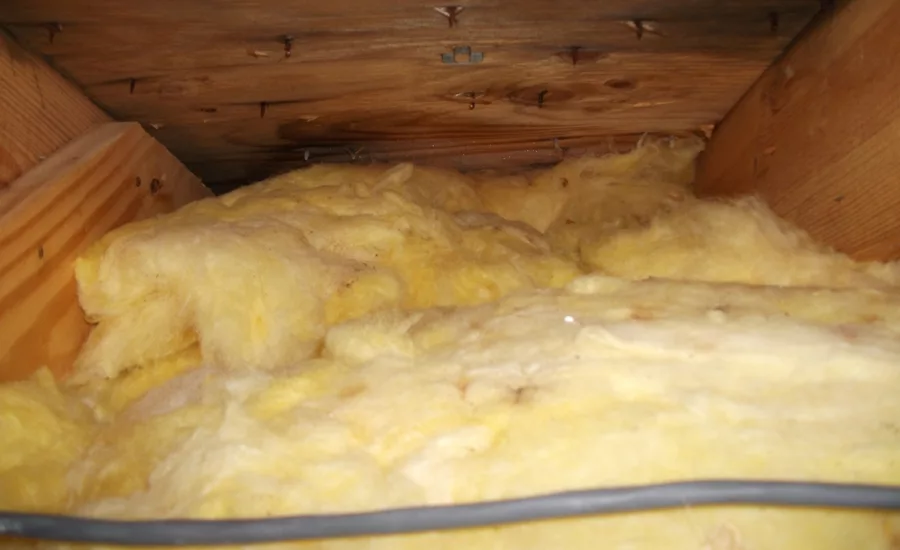
COLD AND WET: When humid interior air contacts colder surfaces, condensation can occur. The blackened roof sheathing in this photo shows signs of moisture damage and is frosting near the fiberglass insulation.
Tackling winter humidity issues can be a nightmare if you don’t have a grasp on the foundational principles that influence them. Have you ever wondered what causes some homes to be too dry even with a properly operating humidifier? Let’s look at some basic humidity principles, commonly encountered issues, and how you can solve them to cure your customers’ problems.
HUMIDITY BASICS
Relative humidity (RH) is a common term used to express the amount of moisture in the air as a percentage. Today’s test instruments calculate relative humidity using dry and wet bulb temperatures. If you’ve been around the industry for a while, you’ve probably twirled around a sling-psychrometer to obtain these readings. Newer instruments do this digitally — no twirling or distilled water are required.
The ideal winter humidity range should be between 40-60 percent RH. When outside these ranges, you could end up with numerous IAQ and building issues. You’ll need to understand the rules of moisture to help prevent those issues. Some of these rules include:
- Warmer air holds more moisture than cooler air;
- Moisture moves from warm to cold;
- Moisture moves from wet to dry; and
- Moisture often travels with air from higher pressure to lower pressure.
While there is much more that can be said about moisture, many of the issues you’ll encounter can be tied to the application of these basic rules.
TEST INSTRUMENTS AND ACCESSORIES
To measure humidity, you’ll need a good psychrometer. For HVAC purposes, the instrument needs to measure and/or calculate dry bulb temperature, wet bulb temperature, percent of relative humidity, and dew point temperature.
For troubleshooting purposes, you’ll want a psychrometer with a narrow probe that can measure ambient air as well as take measurements inside the duct system. The tried and true but outdated sling-psychrometer will limit you to ambient air measurements only.
For tougher problems that require you to dig deeper, you may need to use advanced test instruments that move beyond the role and training of an average technician. These include thermal imaging cameras, blower doors, micromanometers, and moisture meters. As your testing skills increase, you’ll know when it’s time to bring out these big guns.
IT’S TOO DRY
The most commonly encountered winter moisture problem is not having enough humidity. HVAC professionals are often asked to solve issues ranging from static shock to interior trim and doors warping to nose bleeds. The first reaction is often to recommend installing a humidifier. What if the home already has a humidifier installed and this is still happening?
Looking for quick answers on air conditioning, heating and refrigeration topics? Try Ask ACHR NEWS, our new smart AI search tool. Ask ACHR NEWS
It has been estimated a family of four produces enough moisture through daily activities to easily keep a 3000-square-foot home properly humidified. With all this moisture internally generated, why do some homes with a humidifier remain excessively dry?
WHAT CAUSES HUMIDITY TO DROP?
A common cause is air leakage. An excessively dry building in the winter is a leaky building. There is a lot of air moving through it from outdoors. No humidifier can overcome this influence. Remember, moisture travels with air from higher pressure to lower pressure.
Air moves based on an action known as infiltration. This is a random and uncontrolled movement of air into a building. Infiltration typically happens because of pressure imbalances caused by natural air movement, duct leakage, air balancing issues, and interior door closure.
Since cooler air holds less moisture, any outside air entering a building through infiltration acts as a dehumidifier. This causes indoor relative humidity to drop and leads to uncomfortable conditions. When this occurs, there must be a pathway for air to move from outdoors to indoors. Some of the most common pathways include:
- Attic access panels;
- Can lights;
- Chimneys and flues;
- Combustion air ducts and grilles;
- Duct chases;
- Leaky ductwork;
- Open wall cavities; and
- Tub trap openings.
Just as air enters a building, it also leaves it. This is known as exfiltration — the random and uncontrolled movement of air out of a building. When this happens, interior air can contact colder exterior surfaces, such as the roof or walls. This often results in condensation occurring on these surfaces, and your chances for moisture-related damage increase substantially.
SOLVING HUMIDITY ISSUES
Once you understand the basics of humidity and what causes it to drop, you move toward diagnosing the problem and recommending a solution. As you can see, the silver bullet isn’t always a humidifier.
You’ll want to start with the end in mind. Identify where the moisture is going and what pathways the air and moisture are traveling through. This could be as simple as a visual inspection with some basic construction knowledge — you’ll have to dig for the real finds.
The key is to identify the big pathways and seal them. In some houses, the solution simply involves closing fireplace dampers. Others are much more involved, and you’ll need to bring out the big guns to uncover those hidden pathways.
Once you find the pathways, identify the driving force causing air to leak and humidity levels to drop. If natural air movement is the culprit, sealing the pathways will help a lot. If a fan-powered force, such as duct leakage or air balancing, is causing problems, you’ll have to address the source to correct them. This often results in additional advanced testing on the airside of the system.
WHERE TO START?
Become a student of humidity and psychrometrics. Devour all the information you can find on these subjects. I’ve read that if you spend one hour per night studying a subject, you’ll be a world-class expert in five years. I promise you won’t have much competition in this department — too many people are wrapped up in other time-wasting activities.
Next, purchase a high-quality psychrometer. You should expect to pay between $100-$300 for one that provides fast and accurate readings. As with any test instrument, you get what you pay for. Be aware, the lower priced psychrometers typically respond slower and are less accurate. If it takes you a long time to gather the information, your chances of continued measuring diminish greatly.
Once you have a decent understanding and the right test instruments, practice measuring at your home. This provides you a non-threatening environment where you have time to learn and document what you see. Measure and record readings as you see changes in your home from activities, such as cooking or taking a shower. See what happens to the humidity levels and how quickly they change. You’ll learn a lot just by observing these interactions.
OPPORTUNITY IN PSYCHROMETRICS
Most people in our industry see a psychrometric chart for the first time and panic — I know I did. This fear keeps many in our industry from learning more about air properties. Many of the problems I’ve discussed require you to look beyond the HVAC equipment to the interactions taking place between it and the building it’s installed in.
While this article barely scratches the surface of the topic, understanding how these properties change moves you past one-size-fits-all solutions.
Publication date: 2/19/2018
Want more HVAC industry news and information? Join The NEWS on Facebook, Twitter, and LinkedIn today!
Looking for a reprint of this article?
From high-res PDFs to custom plaques, order your copy today!