When You Should Look Beyond the HVAC System
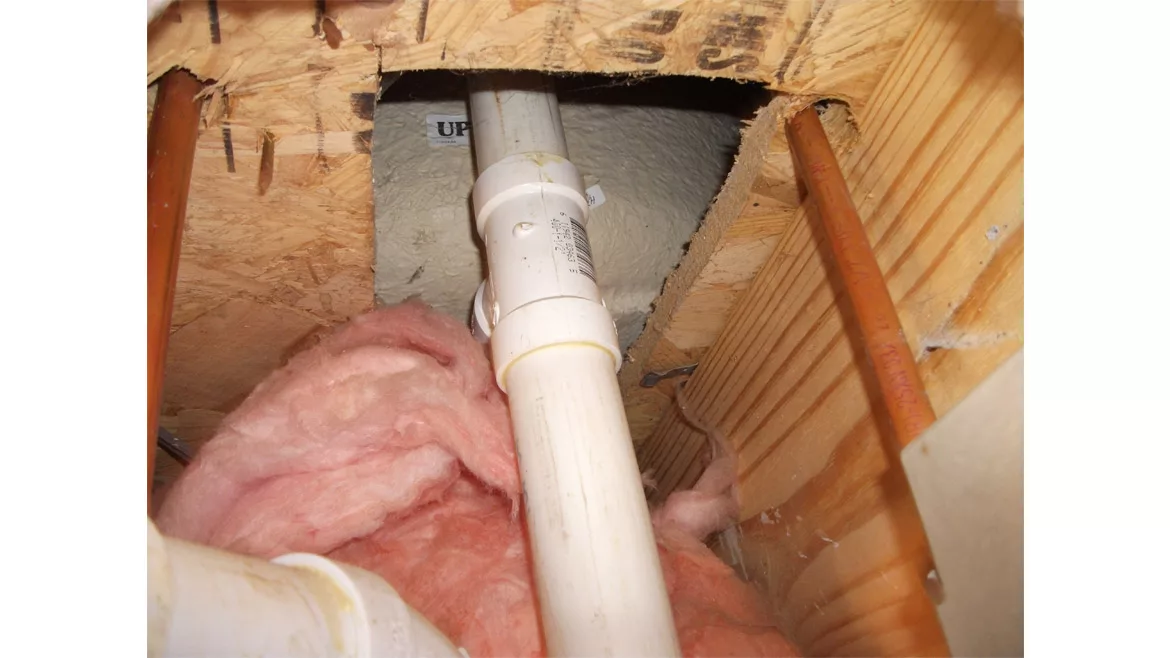
FLAWS: Problems like a hole under a tub aren’t your responsibility, but they can influence room comfort. (Courtesy of David Richardson)
Many of us have been in situations where we struggled to solve a customer's comfort problem. No matter how efficient the HVAC equipment, or how good the duct system, you couldn't find the answer. It's a frustrating and helpless position to find yourself in.
Some comfort and indoor air quality issues we encounter bleed over from areas that we might be unfamiliar with. The most common are the influences of building construction, like leakage and insulation. Knowledge of these subjects, like how a building interacts with an HVAC system, and how the building is part of the duct system are invaluable when you encounter a comfort problem missing an obvious answer.
Approximately 15 years ago, I had to salvage a relationship with a customer who paid a premium fee for a high-performance HVAC system we installed. Our understanding of how HVAC system performance and building performance work together saved the day. Let's take a trip back in time to see how we went from heel to hero when we looked beyond the HVAC system.
Meet Peggy
We got a lot of work from word-of-mouth advertising from our customers. They shared the results of our work with their friends and unintentionally became some of our best salespeople. When they shared what we did, others wanted the same outcomes, so they called us.
A new customer, who I'll call Peggy, had friends for whom we corrected long-standing comfort issues in their home. They told her how we fixed problems with her equipment and duct system. Since Peggy was building a new custom home, she didn't want the types of issues her friends experienced.
Peggy hired us to install the best HVAC equipment and system her budget could afford. She was a dream customer and wanted her HVAC system done right. So we designed, installed, and balanced her system to ensure she got what she paid for.
Peggy Has Problems, Wants Answers
A couple of months went by, and the outdoor temperature dropped. We got a phone call from Peggy, and it wasn't to brag about her new, high-dollar HVAC system. Instead, she had the same problems as her friends who recommended us.
Looking for quick answers on air conditioning, heating and refrigeration topics? Try Ask ACHR NEWS, our new smart AI search tool. Ask ACHR NEWS
Peggy continued to tell us about her cold kitchen, master bathroom, and drafty living room. The other rooms felt great, but these three areas were uncomfortable. We promised overall comfort, so she wanted answers about why these areas were uncomfortable.
I'm ashamed to admit I thought Peggy was nuts. She didn't know that her HVAC system was part of a beta-testing project we did for the National Comfort Institute (NCI) called System Efficiency Rating (SER). We knew Peggy's system was doing what it was supposed to do and had proven it with airflow and temperature measurements from each supply register and return grille. These measurements helped us establish a field-rated efficiency of her HVAC system.
We compared the results of her room-by-room load calculation to the measurements from her system to assure the delivered Btus to each room were close to design. We left no stone unturned, or at least that's what we thought. So why was Peggy uncomfortable?
Time for Another Visit
The next day, we went out to visit Peggy and further see what her problems were. Our first stop was the condensing furnace in the crawl space. Before we started diagnosing, we needed to remeasure and see if anything had changed with the equipment or duct system.
We measured total external static pressure, coil and filter pressure drop, plotted fan airflow, and temperature rise across the furnace and compared this to the furnace-rated BTU output. We were very close to our original measurements.
Once we knew the furnace was doing what it was supposed to, we moved to the problem areas in the home. We used an air balancing hood and thermometers to see what was happening in these problem spots. First, we measured supply register airflow, and then measured Δt (temperature difference) across the problem rooms to calculate delivered Btus.
Once we had the delivered Btus, we compared them to our load calculations again. We were still very close to what design conditions called for. At this point, we knew it wasn't the HVAC system. There had to be something else going on. Nothing had changed except the outdoor temperature got colder.
Moving Beyond the HVAC System
The issues affecting Peggy's comfort were beyond the HVAC system. So, we had to discover what they were. We asked Peggy to get more specific about her issues to isolate the problems better. First came the master bathroom.
Peggy's specific complaint was that it was cold in front of her toilet. We notice a return grille used as an access panel on her Jacuzzi tub across from it, and pulled the grille off to look inside. It surprised us to see Peggy's crawlspace through a hole that looks like they cut it with a chainsaw. There was also light shining through the crawlspace vent directly underneath the tub.
There it was. A massive hole affecting Peggy's comfort, and it had nothing to do with the HVAC system. Instead, it had everything to do with the building side of the duct system. There was a massive duct leak in the building.
Once we discovered the large opening, we moved to the kitchen. Peggy told us it's colder in this room and that the floor near her island cooktop always chills her feet. So, we took a cue from the bathroom and looked under the cabinets.
There is a downdraft cooktop on the island. Apparently, the installers used the same chainsaw to cut the opening in the floor for the cooktop duct. The cold air was also pouring under the cabinet and dropping the floor's surface temperature. Once again, this hole had nothing to do with the HVAC system, but it affected overall comfort.
We wondered why air was coming into the house and looked a little deeper. We went out to the van and got a micromanometer that we used with our blower door kit. I wanted to see what the building pressure was as the building sat and then see how it changed once we kicked the HVAC blower on to its highest speed.
As the house sat, it was negative two pascals (-2 pa). It was under a vacuum and pulling outdoor air in from the easiest locations. Once we kicked the furnace blower on, there was no change in pressure. Is it possible we discovered why cold air was coming in and the source of the drafty living room?
We looked further and noticed there was a fireplace and six can lights in Peggy's living room. The fireplace damper was open — that was an easy fix. Next, we used a smoke puffer at the edges of the can lights and saw smoke draw into the attic from the living room. The can lights were acting like exhaust ducts to the attic. We found ourselves at an interesting crossroads.
We Fix the Issues
Peggy's comfort problems had nothing to do with our HVAC system. They fell outside our scope of work but affected the outcome of our system. We did the right thing and made some minor repairs to Peggy's home to see what would happen.
We made a quick trip back to the shop and grabbed some ductboard and mastic. First, we sealed the holes under the tub and kitchen cabinet with ductboard and mastic. Next, we measured and prefabricated oversized ductboard boxes to go over the can lights and then sealed them to the ceiling in the attic with mastic.
After the repairs, we retested the house pressure and found it was less than 1 pascal now. We didn't make it perfect, but we made a big difference with less than two hours of work and $30 in materials.
Finally, we apologized to Peggy for her problems and let her know we would check back with her in a week to see if she still had any problems. One week passed by and we anxiously made the call. Peggy was thrilled. She told us our repairs fixed her concerns, and we had regained her trust.
What We Learned
We learned some tough lessons from this experience. First, we unintentionally created a process to look at the complete picture when diagnosing comfort problems. What seemed like a challenge at first forced us to create a process to improve how we measured and diagnosed comfort problems.
Another humbling lesson was to be careful of the promises we made. The perfect equipment and duct system can't overcome some building defects. No one blames the building or insulation for comfort problems. Instead, they blame us. We learned we need to know how to defend our work against things outside of our control.
The third lesson was the importance of using measurements instead of guesswork to arrive at solutions. We unknowingly used the process of elimination to diagnose and solve Peggy's problems. Once we knew the equipment and duct system performed as designed, we could eliminate the HVAC system as a suspect and move to other culprits.
So, When Should You Look Beyond the HVAC System?
As you can see in this example, our success in solving these problems depended on a variety of knowledge. We started with HVAC system performance and transitioned to building performance. Without measurements and knowledge of both disciplines, we couldn't solve Peggy's comfort issues.
Some in our industry choose to avoid building performance because they believe it has nothing to do with heating and cooling. Others want to know more but don't know where to begin. You could be the next generation of high-performance HVAC contractors if you learn and practice both skillsets.
I believe it's time for our industry to move beyond traditional HVAC and explore a new way of looking at our roles. Is it time to expand our expertise on how we serve our customers and improve and the places they live? You'll have to answer that question for yourself.
Looking for a reprint of this article?
From high-res PDFs to custom plaques, order your copy today!