Btu Buddy 130: Heat Pump Electrical Problems
Bob is a service technician who is well trained and nationally certified. However, he has sometimes suffered from the same confusion that all technicians occasionally do — the facts that he gathers may or may not point to the obvious cause of the problem or the best solution. But Bob has had something that no one else has. He recalled his long-time HVACR mentor and imagines him accompanying him as “Btu Buddy,” someone who reminded him to take time to stop and think before rushing to judgment, helping keep him on the right track, even with facts that are confusing.
Now, Bob’s company has promoted him to help train a new employee, right out of a school specializing in HVAC, just like Bob was. Bob is now Tim’s Btu Buddy. Tim is anxious to travel with Bob. Tim realizes that he is right out of school, with the theory and lab work that he accomplished in school, but still needs help. He knows that he worked with many of the components of the systems in the school, under ideal conditions with good light and air conditioning. Now it is into the field, sometimes under the house with poor lighting, or out on the rooftop in the sun, where the real action is. He is naturally and normally reluctant, but he has Bob to help guide him.
Bob and Tim have gotten together for another informational session. Tim requested some extra after-hours training about heat pumps.
Bob said, “In our last session, we talked about mechanical problems of heat pumps and gave some examples of how to troubleshoot the problems. One of the first things about any troubleshooting problem is to try to figure out if you have an electrical problem or a mechanical problem. For example, suppose you get to a heat pump service call and you discover that the unit is cooling and not heating. When this is the case, the electric strip heat is likely carrying the load and overcoming the refrigeration system which is cooling at the same time. The problem is almost certain to be the four-way valve which is responsible for changing between heating and cooling. The controls can be calling for defrost, an electrical problem. The valve could also be stuck in the cooling mode, a mechanical problem. Your question should be: Why is the valve not changing position? Is the electrical signal telling the valve to change, or is the valve stuck in the wrong position?”
Tim said, “I can visualize all of that. I would get the voltmeter and check to see if the valve is receiving the correct voltage. Isn’t it always supposed to be energized in the cooling cycle?”
Bob said, “Many times it is energized in the cooling cycle, but some manufacturers will energize the valve in the heating cycle. If it is energized in the heating cycle, and a valve coil is burned out, it will go to the cooling cycle. If the homeowner is absent, the unit may not provide heat and the water pipes may burst. The unit will cool normally during the cooling cycle if the valve coil is burned out.”
Tim then said, “So, when I encounter a heat pump that is frozen up in the winter, the problem could easily be that the four-way valve is not changing over to cooling so defrost will work.”
Looking for quick answers on air conditioning, heating and refrigeration topics? Try Ask ACHR NEWS, our new smart AI search tool. Ask ACHR NEWS
Bob said, “That is correct. A simple way to see if a valve coil is energized is to hold a screwdriver or knife blade close to the end of the coil and see if it is magnetized. This saves looking for the terminals where the valve is connected and using a voltmeter. If the coil is magnetized, it will attract the screwdriver or knife blade.”
Tim then asked, “What other electrical problems are typical for a heat pump?”
Bob said, “The heat pump has all of the components of an air conditioning unit with the additional components for heating: the four-way valve, electric auxiliary heat, and a defrost cycle. Let’s list some of the possibilities:
1. Indoor blower motor and outdoor fan motor.
2. Interconnecting low voltage wiring.
3. Four-way valve magnetic coil.
4. Thermostat.
5. Compressor.
6. Temperature sensors for defrost.
7. Contactors and relays.
8. Circuit boards.
“Here are descriptions of those possible problems:
1. The air moving motors and their related capacitors can have electrical problems. These motors are often permanently lubricated so some of them do not require oiling. The motor in the indoor coil is often very hard to lubricate because it is recessed in the blower wheel and you may have to pull the blower section out to oil the motor, so oftentimes this is not serviced. If the motor bearings wear out, the blower may make a noise or not start. If the motor will not start, check the power supplied to the motor and if it is getting power and will not start, check the capacitor (Figure 1). The capacitors can be checked to some extent with an ohmmeter, but that will only tell you if the capacitor will charge and discharge. A capacitor check instrument will tell you if it is within the capacitance range of its rating. When a capacitor is defective, oftentimes the motor will not run up to speed, which can cause system pressures to be off for the conditions. For example, the outdoor unit may be operating at a lower than normal pressure during the heating cycle and cause excess ice to form.
2. Interconnecting low voltage wiring is typically not run in conduit because it carries only 24 volts of control voltage. It also does not have a very tough insulation or shielding. Since it is oftentimes exposed, it is easy to damage. Such incidents as other personnel servicing other systems, plumbers, cable TV, and electricians going in the places where the wire is routed and damaging the wiring have happened.
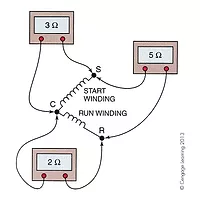
3. The four-way valve magnetic coil can also be checked with an ohmmeter for continuity or short circuits (Figure 2). If the coil shows continuity and will not cause the valve to change positions, you may want to check the coil and compare it to another coil. Remember, this valve is a pilot operated valve and the system pressure difference is what changes the valve position. The coil energizes the small pilot solenoid. When you can hear it click, the pilot valve is doing its job. If it will make a clicking sound, you should make sure the system is running and has a pressure difference from the low to the high side to change the valve position.
4. There are two categories of indoor thermostat, mercury bulb and electronic. Both types can be checked in the same manner. Remove the thermostat from the sub-base and use a jumper to jump from one function to another. Place one jumper lead on the hot terminal and then jump to the fan terminal and the fan should start, unless the circuit board has a time delay built in. There may also be a time delay when you jump to the heating or cooling terminals. These time delays are used to improve system performance and short cycling, but can slow down troubleshooting.
5. Compressor checks can require the use of an ammeter and ohmmeter. The ammeter tells you how much current the compressor is drawing. You can compare it to the recommended current use for the compressor under the set of pressure readings. The voltage at the compressor will also be a factor that must be entered in the chart. This can be obtained from the manufacturer’s performance curves. If the current draw is lower than recommended, the compressor may not be pumping to capacity.
6. There are several temperature sensor possibilities. They may be bimetal or thermister types. The defrost sensor may indicate when to start defrost and when to terminate defrost or the temperature of the compressor to stop the compressor from overheating. You should be familiar with the temperature ranges for the particular unit. These can be obtained from the service literature or the manufacturer.
7. The contactors and relays should be checked once a year for good contact surfaces. The contact surface is a base metal that is silver plated. Every time the contacts function an arc is formed and some of this surface is deteriorated. After many functions, the contact surface must be replaced. With larger contactors or motor starters, just the contacts may be replaced (Figure 3). Smaller contactors and relays are changed as an assembly because it is more economical.
8. Circuit boards are really only a switch in the line for every function that the board operates. A 24-volt circuit goes in and, if the fan is called for, the fan will start if all is well. If it is to start the compressor, the 24V signal goes in and when it comes out it will energize the compressor contactor and start the compressor when functioning properly. The manufacturer’s literature should be used to check the circuit board. Oftentimes, there is a sequence of blinking lights that will give you the code for the problem.”
Tim said, “That is a lot to remember. I know that I am learning it a day at a time. I am glad that I am riding with you to help me learn these things. I will eventually get it together.”
Bob said, “These subjects are just some of the basic situations that you may encounter. There is a lot to this service industry. That is why good service technicians have good incomes and are always in demand. Every service technician gains a reputation. Make sure that yours is a good one by doing good work and staying up to date and you will always be in demand.”
Publication date: 1/20/2014
Want more HVAC industry news and information? Join The NEWS on Facebook, Twitter, and LinkedIn today!
Looking for a reprint of this article?
From high-res PDFs to custom plaques, order your copy today!