ACHR News
search
Ask ACHR NEWS AI
cart
facebook twitter instagram linkedin youtube
  • Sign In
  • Subscribe
  • Sign Out
  • My Account
ACHR News
  • NEWS
    • Breaking News
    • New HVAC Products
    • Featured Products
    • Manufacturer Reports
    • HVAC Data
    • Legislation
    • ACHR NEWS Centennial
  • RESIDENTIAL
    • Air Conditioners
    • Furnaces
    • Residential Heat Pumps
    • Ductless
    • Residential IAQ
    • Testing, Monitoring, Tools
    • Components & Accessories
  • COMMERCIAL
    • Air Handlers
    • Rooftop Units
    • Chillers and Cooling Towers
    • Commercial Heat Pumps
    • Boilers and Hydronics
    • VRF/Ductless
    • Commercial IAQ
  • REFRIGERATION
    • Refrigerants
    • Refrigerant Regulations
    • Leak Management
  • CONTRACTOR PRO
    • Geothermal
    • Homeowner Study
    • VRF and VRV Ductless
    • Unitary Trends
  • EDUCATION
    • Training and Education
    • Business Management
    • Service and Maintenance
    • Continuing Education
    • Market Research >
      • HVAC Brand Awareness Report
      • VRV, VRF, VRVZ Report
      • Unitary Trends Report
      • Water Heat Professionals Report
    • Webinars
    • Sponsor Insights
    • eProducts Info
    • White Papers
  • EVENTS
    • HVAC Contractor Forum
    • Industry Events and Webinars
  • MEDIA
    • Videos
    • AHR Expo 2025 Videos
    • Podcasts >
      • ACHR News Podcast
      • HARDI Podcasts
      • AHR Expo Podcasts
      • ACCA Podcasts
    • Interactive Spotlights
    • Quizzes
    • eBooks
    • HVAC Talkback
  • HVAC GROUP
    • ACHR NEWS >
      • Current Issue
      • Digital Edition
      • Subscribe
    • Distribution Trends
    • SNIPS NEWS >
      • Join SNIPS NEWS
    • Engineered Systems News >
      • Join ES News
    • HVACR Directory
    • Contests
    • Newsletters
    • Contact
    • Advertise
    • My Account
HVAC ContractingService and MaintenanceHeat Pumps

Btu Buddy 189: Heat Pump Motor Wiring Problems
By Bill Johnson
EE_Btu Buddy 1

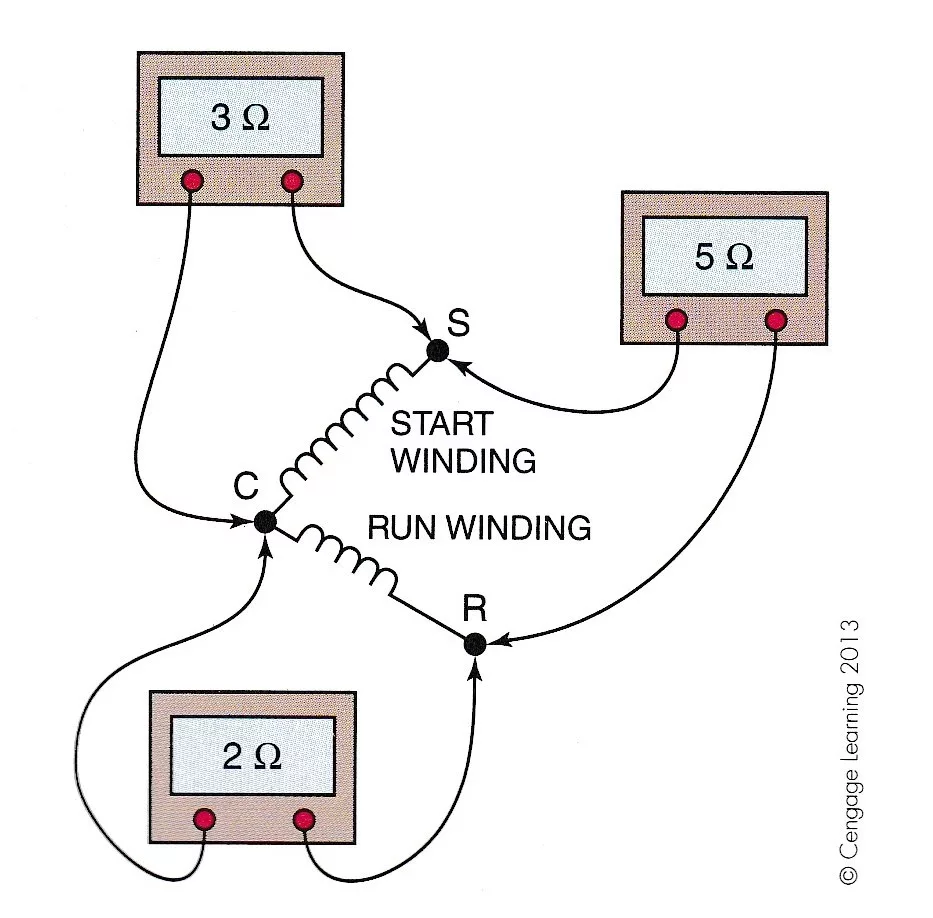
Figure 1: This diagram shows what a typical compressors windings would look like using an ohmmeter to check the windings. Each motor will have a different set of numbers, but the relationship of common, run, and start will be the same. (Figures are from Refrigeration & Air Conditioning Technology, 7th Edition, by William Whitman, William Johnson, John Tomczyk, and Eugene Silberstein, published by Delmar Cengage Learning). (©Delmar Cengage Learning).
EE_Btu Buddy 2

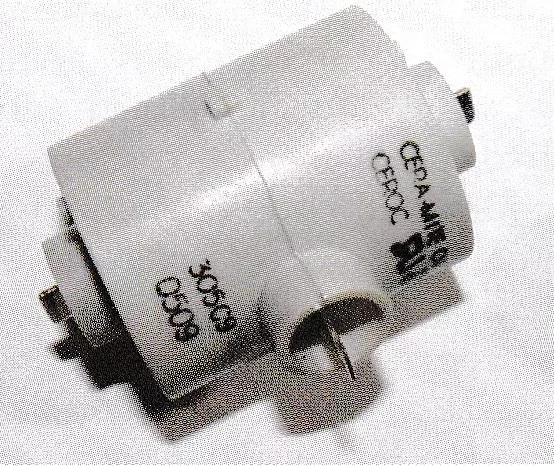
Figure 2: This is an example of a PTC Positive Temperature Coefficient device. Inside is a set of discs that would resemble flat 50 cent pieces stacked together. They are solid state materials compressed into the discs. When the discs are cool, they will allow full current flow. When the motor is started, the current flow will heat the discs immediately and they will go to a high resistance, taking the compressor out of the start mode to the run mode. It effectively creates a circuit around the run capacitor during the start cycle.(Figures are from Refrigeration & Air Conditioning Technology, 7th Edition, by William Whitman, William Johnson, John Tomczyk, and Eugene Silberstein, published by Delmar Cengage Learning). (©Delmar Cengage Learning).

EE_Btu Buddy 1
EE_Btu Buddy 2
December 24, 2018

Bob and Tim are at a job where a technician from another company could not figure out the electrical, so he just put the panel back on the electrical compartment and left the job. It is a heat pump and the compressor wiring is all loose. They need to figure out how to wire it back and find out the problem. The homeowner said the original call to the other service company was because of ice build up on the outdoor coil.

Bob and Tim talked to the homeowner and explained that because the weather was cold and damp, ice buildup was expected on any heat pump in this kind of weather, but they would check the unit and see what was going on. The heat pump compressor was not running and the home was being heated with the auxiliary heat, so the first order of business was to get the heat pump operating.

They went outside and noticed the ice had melted from the outdoor unit due to an above freezing day. The compressor was not running; however, the fan was running. They looked at the compressor and discovered the wires to the compressor were all disconnected, and the ends were taped to make them safe.

“That explains why the compressor is not running, but why are the wires not connected?" Tim asked. "The technician must have been on some kind of trail, got lost, made it safe, and just pulled out. How do we know which wire goes to what terminal on the compressor?”

“I have seen this type of thing happen before," Bob said. "I think the technician removed the wiring looking for something, did not mark the wires, and could not figure out how to rewire it. The technician was probably embarrassed and just pulled out rather than look for help. We can tell which wire goes to which terminal by the unit wiring diagram. The question is, which terminal is common, run, and start. We will have to use an ohmmeter to determine that."

“What do we do?” Tim asked.

"The first things we need to do are check the compressor electrically and make sure it is safe to start; after making sure the compressor is safe to start, we need to reconnect it and see if it will start — the start assist (PTC) device may be defective; and when and if the compressor starts, we need to give the system a thorough check up to see why the technician was even doing what he was doing to cause him to disconnect the compressor,” Bob replied.

Looking for quick answers on air conditioning, heating and refrigeration topics? Try Ask ACHR NEWS, our new smart AI search tool. Ask ACHR NEWS →

“How can we make sure the compressor is safe to start?” Tim asked.

“We want to make sure that it is safe to apply power to the terminals," Bob said. "Use the Ohmmeter set on RX10K (10,000 Ohms). Second, fasten one lead to a good ground, scrape any scale or paint off the suction line, for example, and firmly hold the lead to the bare spot. Then, touch the other lead to one of the compressor terminals and record any reading. There should not be a reading. If there is a reading, the compressor has a ground circuit in the compressor. A circuit from the motor windings to ground.

"To illustrate how your meter works, you should be able to read a slight reading through your body if you hold one lead in each hand," Bob continued. "That is showing a slight circuit through your body. Your body has a high resistance, but a meter with an RX 10,000 scale will read through the body. When you hold the two leads apart in the air, you will get an infinity reading, or a resistance so high that it will not register on the meter. That is the kind of reading you want from a compressor motor to ground, infinity.”

They checked the motor for a ground circuit and it checked out good.

“We are going to use the next procedure for two functions," Bob said. "To determine that the windings are okay to apply power to, they must have a measurable resistance between the terminals before applying power. A short circuit between terminals would overload the circuit and trip a breaker. An open circuit means the winding is burned out, no circuit and current won’t flow. Next, is how to wire the disconnected wires to their correct terminals." 

Bob explained, "You have to draw a diagram of the terminal arrangement looking straight into the terminal box. Now, label the terminals 1, 2, and 3. Now set your Ohm meter to RX1 and check the Ohms reading from 1 to 2 and write it down. Now check from 1 to 3 and write it down. Now check from 2 to 3 and write it down.”

Tim wrote it down as,

  • 1 to 2, 2 Ohms;
  • 1 to 3, 5 Ohms; and
  • 2 to 3, 3 Ohms.

The largest reading was from 1 to 3, and would be the reading through both windings so that would be from 1 through common to 3. This tells you that the 2 terminal is the common terminal. (Figure 1)

“You have identified the “C” the common terminal as the number 2 terminal," Bob explained. "Now we know from process of deduction what the other 2 terminals are. The shortest winding with the least resistance is the run winding so terminal 2 to terminal 1 is the smallest resistance making the 1 terminal the “R” run terminal. The only terminal we have left is the “3” terminal and that makes it the start terminal. You can now take the red wire and put it on the run terminal, the white wire on the common terminal and the black wire on the start terminal.

“We need to check the start assist device, the PTC device (Figure 2)," Bob continued. "This device can be checked visually and with an ohmmeter at room temperature. It looks good visually. I have seen them fail, and usually you can see damage from the outside. This one seems good on the outside. Since the PTC is so cold from being outside, I think we will just try to start the compressor with an ammeter on the PTC circuit and it will either show current flow or not. If it doesn’t show current flow, we will replace it. You are now ready to start the compressor.”

Tim had an ammeter on the compressor circuit and on the PTC circuit. He then engaged the unit disconnect and the unit started normally, so they let it run.

They let the unit run for about 30 minutes while they changed the air filter and checked to see that all of the air registers were open. The unit seemed to be operating properly with an air discharge temperature (without the strip heat operating) of 103° F.

"Why did we check all of the air registers for air flow?” Tim asked.

“Some owners will shut some of the registers to save money," Bob replied. "That reduces the total air flow through the system, and it's not good for a heat pump. Reduced air flow will cause the head pressure to rise and lower the heat pump efficiency”.

After the system had operated for about 45 minutes, they put the system through a forced defrost and it operated correctly. They declared the system was good to go.

“I am not real clear about some of the motor check ups that we do," Tim said to Bob as they were leaving the job. "Could we get together and discuss other electrical checks that we do with motors?”

“That is a good idea," Bob said. "We could discuss motor winding short circuits and current readings. We will get together soon.”

To be continued next month.

Publication date: 12/24/2018

Want more HVAC industry news and information? Join The NEWS on Facebook, Twitter, and LinkedIn today!

KEYWORDS: motors for HVACR troubleshooting and HVACR

Share This Story

Looking for a reprint of this article?
From high-res PDFs to custom plaques, order your copy today!


Active in the HVACR industry since the 1950s, Bill Johnson graduated in gas fuel technology and refrigeration from the Southern Technical Institute, a branch of Georgia Tech (now known as Southern Polytechnic Institute). He taught HVAC classes at Coosa Valley Vocational & Technical Institute for four years. He moved on to become service manager for Layne Trane, Charlotte, N.C. He taught for 15 years at Central Piedmont Community College, part of this time as program director. He had his own business for five years doing installation and service work. Now retired, he is the author of Practical Heating Technology and Practical Cooling Technology, and continues as a co-author of Refrigeration & Air Conditioning Technology, seventh edition, all published by Delmar Cengage Learning. For more information, he can be reached at 704-968-0000 or thebillj1@gmail.com.

Btu Buddy Notebook is a collection of more than 50 service call scenarios in book form covering both cooling season and heating season troubleshooting. For more information and to purchase the book, visit the HVACR Industry Store.

Recommended Content

JOIN TODAY
To unlock your recommendations.

Already have an account? Sign In

  • HVAC-enrollment

    The Trades Are Back: HVACR Programs See Nearly 30% Enrollment Spike

    A new wave of future technicians is entering the pipeline.  
    News
    By: Matt Jachman
  • 2025 Top 40 Under 40

    2025 Top 40 Under 40 HVACR Professionals List

    The 11th annual Top 40 Under 40 list highlights those...
    HVAC Contracting
    By: Hannah Belloli-Oster
  • LG Ductless Mini-Split Systems

    The 9 Types of Heat Pumps

    As the U.S. moves toward electrification, heat pumps are...
    HVAC Commercial Market
    By: Joanna R. Turpin
Subscription Center
  • Create an Account
  • Start a Subscription
  • Manage My Account
  • Sign Up for Newsletters
  • Visit Customer Service
  • Update Preferences

More Videos

Sponsored Content

Sponsored Content is a special paid section where industry companies provide high quality, objective, non-commercial content around topics of interest to The News audience. All Sponsored Content is supplied by the advertising company and any opinions expressed in this article are those of the author and not necessarily reflect the views of The News or its parent company, BNP Media. Interested in participating in our Sponsored Content section? Contact your local rep!

close
  • An illustration shows a house with a geothermal heating system. Pipes are depicted running underground.
    Sponsored byClimateMaster

    Residential Tax Credits Are Ending, But Demand Continues

  • Piggy Bank
    Sponsored byWatercress Financial

    Energy Prices, Inflation, and HVAC: What Today’s Homeowners Care About

  • Refrigerated Food
    Sponsored bySolstice Advanced Materials

    R-455A Refrigeration: A Cold Storage Solution for the Future

Popular Stories

HVAC-Price-Increase-graphic

HVAC Price Increase List: July 2026

price-raising-practices.jpg

Rising Costs Force Contractors to Take a Harder Look at Pricing

DOE-sign.jpg

HVAC Groups Support DOE’s Rulemaking to Cut Energy Efficiency Mandates

Industry-Ethics_-Service-Calls.jpg

HVAC Contractor Agrees to $300K Settlement Over Alleged Deceptive Sales Practices

Daikin Applied CEO Yu Nishiwaki

Daikin Applied Announces New Top Leadership

View The ACHR NEWS
Centennial Anniversary Timeline

The ACHR News Timeline Chart
Submit a Letter
Submit a letter to our editors.

Events

November 6, 2025

Next-Gen Data Center Cooling: HVAC Innovation and Real-World Solutions

On Demand As AI workloads and high-density computing push traditional cooling methods to their limits, the data center industry is accelerating the adoption of next-generation HVAC technologies.

July 22, 2026

Designing VRF Systems Using A2L Refrigerant

In this session, we will cover how to design VRF systems for the U.S. market using new A2L refrigerants. These systems provide an advanced zoning solution by using inverter technology to deliver precise heating and cooling control across multiple zones and spaces.

View All Submit An Event

Poll

Summer Staff

Are you fully staffed for the summer season?
View Results Poll Archive

Products

BNI Mechanical/Electrical Square Foot Costbook, 2026 Edition

BNI Mechanical/Electrical Square Foot Costbook, 2026 Edition

See More Products
Designing Systems Using A2L Refrigerant - Free Webinar - 7/22/2026

Related Articles

  • Fig 1

    Btu Buddy 175: Control Wiring Problems

    See More
  • Btu Buddy 130: Heat Pump Electrical Problems

    See More
  • Btu Buddy 129: Heat Pump Service Tips

    See More

Related Products

See More Products
  • HPOIS.png

    Heat Pump Operation, Installation, Service

  • A-Heat-Pump-Thats-Not-Delivering-Any-Air-DVD-Cover-218x300.jpg

    A Heat Pump That’s Not Delivering Any Air

  • A-Heat-Pump-That-Won__t-Cool-DVD-Cover-214x300.jpg

    A Heat Pump That Won't Cool

See More Products

Related Directories

  • BP Porter Inc. (Heat Pump Controls/Thermostats)

    BP Porter Inc., the products of this company BPC-1 Bill Porter Control (a fossil fuel control) and BPC-ODS micro'stat was developed (invented) by Bill Porter, an HVAC technician in early 1994.
  • IGSHPA-International Ground Source Heat Pump Assn.

    IGSHPA is an association of companies, professionals and users dedicated to promoting the science, utility and use of geothermal (ground source) heating and cooling technology.
  • Pelican Wire

    Pelican Wire is an employee-owned manufacturer of Resistance Wire, Thermocouple Wire & custom wire solutions for application-specific designs.
×

Sign Up. Stay Informed.

The #1 trusted source for the HVACR industry since 1926

SUBSCRIBE
  • RESOURCES
    • Advertise
    • Contact Us
    • Advisory Board
    • Classifieds
    • Submit a Letter
    • Directories
    • Store
  • ACCOUNT CENTER
    • Create an Account
    • Start a Subscription
    • Manage My Account
    • Sign Up for Newsletters
    • Visit Customer Service
    • Update Preferences
  • SERVICES
    • Marketing Services
    • Reprints
    • Market Research
    • List Rental
    • Survey/Respondent Access
  • STAY CONNECTED
    • LinkedIn
    • Facebook
    • Instagram
    • YouTube
    • X (Twitter)
  • PRIVACY
    • PRIVACY POLICY
    • TERMS & CONDITIONS
    • DO NOT SELL MY PERSONAL INFORMATION
    • PRIVACY REQUEST
    • ACCESSIBILITY

Copyright ©2026. All Rights Reserved BNP Media, Inc. and BNP Media II, LLC.

Design, CMS, Hosting & Web Development :: ePublishing