ACHR News
search
Ask ACHR NEWS AI
cart
facebook twitter instagram linkedin youtube
  • Sign In
  • Subscribe
  • Sign Out
  • My Account
ACHR News
  • NEWS
    • Breaking News
    • New HVAC Products
    • Featured Products
    • Manufacturer Reports
    • HVAC Data
    • Legislation
    • ACHR NEWS Centennial
  • RESIDENTIAL
    • Air Conditioners
    • Furnaces
    • Residential Heat Pumps
    • Ductless
    • Residential IAQ
    • Testing, Monitoring, Tools
    • Components & Accessories
  • COMMERCIAL
    • Air Handlers
    • Rooftop Units
    • Chillers and Cooling Towers
    • Commercial Heat Pumps
    • Boilers and Hydronics
    • VRF/Ductless
    • Commercial IAQ
  • REFRIGERATION
    • Refrigerants
    • Refrigerant Regulations
    • Leak Management
  • CONTRACTOR PRO
    • Geothermal
    • Homeowner Study
    • VRF and VRV Ductless
    • Unitary Trends
  • EDUCATION
    • Training and Education
    • Business Management
    • Service and Maintenance
    • Continuing Education
    • Market Research >
      • HVAC Brand Awareness Report
      • VRV, VRF, VRVZ Report
      • Unitary Trends Report
      • Water Heat Professionals Report
    • Webinars
    • Sponsor Insights
    • eProducts Info
    • White Papers
  • EVENTS
    • HVAC Contractor Forum
    • Industry Events and Webinars
  • MEDIA
    • Videos
    • AHR Expo 2025 Videos
    • Podcasts >
      • ACHR News Podcast
      • HARDI Podcasts
      • AHR Expo Podcasts
      • ACCA Podcasts
    • Interactive Spotlights
    • Quizzes
    • eBooks
    • HVAC Talkback
  • HVAC GROUP
    • ACHR NEWS >
      • Current Issue
      • Digital Edition
      • Subscribe
    • Distribution Trends
    • SNIPS NEWS >
      • Join SNIPS NEWS
    • Engineered Systems News >
      • Join ES News
    • HVACR Directory
    • Contests
    • Newsletters
    • Contact
    • Advertise
    • My Account
RefrigerationRefrigerants

Detecting Costly Refrigerant Leaks

Balancing Environmental Responsibilities, Energy Savings, System Resiliency
October 21, 2013
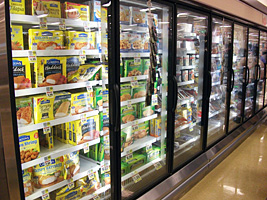
refrigerated display cases
Supermarkets have lots of refrigerated equipment, so the ability to detect refrigerant leaks is especially important with so many perishable products needing to maintain proper temperature.
Over the course of recent years, the HVACR industry has been focused and made strong progress on developing and advancing refrigeration equipment and systems responsible-use practices. Manufacturers and end users alike are seeking ways to improve efficiency and reduce energy use and global warming potential for both direct and indirect emissions.

Today, new refrigerant replacements are being introduced to the market in an effort to make headway on global warming potential (GWP) and direct emissions reductions, and to help companies find a balance between environmental responsibility, energy savings, and system resiliency.

Responsible Use

The principles of responsible use include:

• Containing refrigerants in tight systems and containers to minimize release into the environment;

• Minimizing the amount of refrigerant in a system without sacrificing performance;

• Designing, installing, and operating equipment and systems to optimize energy efficiency;

• Sizing equipment to match an application’s specific needs;

• Minimizing the number of fittings through which refrigerant flows to reduce the number of potential leak points;

• Leak-testing new installations; and

Looking for quick answers on air conditioning, heating and refrigeration topics? Try Ask ACHR NEWS, our new smart AI search tool. Ask ACHR NEWS →

• Monitoring application performance to minimize operational refrigerant leaks.

For supermarkets and other food retail locations that largely depend on refrigeration capacity and performance and often on very large refrigeration systems, the prevention of refrigerant leaks is critical not only because of the negative environmental impact of such leaks, but also for reasons of cost. Many systems hold hundreds of pounds of refrigerant at one time, so even the smallest leak can mean significant, unexpected costs in refrigerant loss and environmental health. Responsible use means conducting routine maintenance to ensure refrigerant life and keeping leakage from draining the bottom line.

Monitoring

Keeping track of refrigerant levels alone is not a sufficient or accurate method of leak detection, as the system receiver is influenced by many variables, including outside temperature, split condenser, and heat reclaim. On any given day, the level reading may fluctuate, thereby making it difficult to detect a reduced receiver level, especially when a leak is small and occurs over the course of several weeks or even months. In these cases, by the time a leak is suspected, substantial loss can have already occurred, and the task of locating the point(s) of leakage is more difficult and tedious. Often, it is very difficult to know where or when the gas was lost. Even a handheld detector may not pick up on this kind of leak as the leak may only occur at specific times, such as during defrost or heat reclaim.

The best way to detect leaks is through real-time monitoring which requires a detector that operates 24/7, constantly sampling the surrounding air. In supermarkets, where the piping and systems are located throughout the store, it is advantageous to employ a detector that can sample the air in strategic locations such as refrigeration pits, racks, air handlers, and cases/coolers/freezers.

Detectors

This can be accomplished through two primary types of detectors available on the market today.

One is an infrared detector that covers a refrigeration zone by sampling through a tube, which is then tested in a chamber known as a bench.

Another is a solid state detector that is placed at a strategic location and signals to the facility’s energy management system (EMS) via wired connection.

In addition, some local regulations require enclosed refrigerated areas, such as walk-ins and prep areas, to have some method to warn people working in these areas to evacuate if a refrigerant leak occurs. Some refrigerants can cause asphyxiation in enclosed environments and are flammable. This requires supplemental use of an audible and visual alarm device that is activated when a set parts per million (ppm) level is reached.

Regardless of which type of leak detector is ideal for an application, they are designed to deliver ppm data to an EMS controller to monitor and determine any required action. This can include local alarming and safety shutdown, plus the ability to transmit the alarm to appropriate parties and maintain a log of times and levels for future review. Both detectors can keep a history of all alarms. These capabilities are critical for an on-site operator or technician to take immediate action as needed, and provide the store’s history and patterns, which can be important in determining and aiding in system repairs.

EDITOR’S NOTE: This material was prepared by Danfoss which, through its Electronic Delivered Services business, offers customers a dashboard on the history of multiple operational data points including refrigerant liquid levels (in percentage), refrigerant loss (in ppm), refrigerated area temperature levels, refrigerant rack pressure levels, power consumption, and other options.

Publication date: 10/21/2013

KEYWORDS: energy efficiency refrigerant leaks Refrigerated display cases refrigeration cycle

Share This Story

Looking for a reprint of this article?
From high-res PDFs to custom plaques, order your copy today!


Recommended Content

JOIN TODAY
To unlock your recommendations.

Already have an account? Sign In

  • HVAC-enrollment

    The Trades Are Back: HVACR Programs See Nearly 30% Enrollment Spike

    A new wave of future technicians is entering the pipeline.  
    Training and Education
    By: Matt Jachman
  • 2025 Top 40 Under 40

    2025 Top 40 Under 40 HVACR Professionals List

    The 11th annual Top 40 Under 40 list highlights those...
    HVAC Contracting
    By: Hannah Belloli-Oster
  • LG Ductless Mini-Split Systems

    The 9 Types of Heat Pumps

    As the U.S. moves toward electrification, heat pumps are...
    Heat Pumps
    By: Joanna R. Turpin
Subscription Center
  • Create an Account
  • Start a Subscription
  • Manage My Account
  • Sign Up for Newsletters
  • Visit Customer Service
  • Update Preferences

More Videos

Sponsored Content

Sponsored Content is a special paid section where industry companies provide high quality, objective, non-commercial content around topics of interest to The News audience. All Sponsored Content is supplied by the advertising company and any opinions expressed in this article are those of the author and not necessarily reflect the views of The News or its parent company, BNP Media. Interested in participating in our Sponsored Content section? Contact your local rep!

close
  • Piggy Bank
    Sponsored byWatercress Financial

    Energy Prices, Inflation, and HVAC: What Today’s Homeowners Care About

  • Refrigerated Food
    Sponsored bySolstice Advanced Materials

    R-455A Refrigeration: A Cold Storage Solution for the Future

  • Airex Rooftop Units
    Sponsored byAirex Manufacturing Inc

    Consolidating Roof Penetrations: A Growing Trend in Multifamily HVAC Design

Popular Stories

HVAC-Price-Increase-graphic

HVAC Price Increase List: June 2026

Trump-Section-232.jpg

Trump Reduces Section 232 Tariffs on HVAC Equipment to 15%

Refrigerants-and-gauge.jpg

HVAC Industry Warns of Counterfeit Refrigerants Entering U.S. Supply Chain

Heat-pump-cutaway.jpg

PFAS Rules and A2L Building Codes Continue to Evolve

Midea-training.jpg

HVAC Workforce Crisis Expands Beyond Technicians to Instructor Shortages

View The ACHR NEWS
Centennial Anniversary Timeline

The ACHR News Timeline Chart
Submit a Letter
Submit a letter to our editors.

Events

November 6, 2025

Next-Gen Data Center Cooling: HVAC Innovation and Real-World Solutions

On Demand As AI workloads and high-density computing push traditional cooling methods to their limits, the data center industry is accelerating the adoption of next-generation HVAC technologies.

June 17, 2026

Decarbonization Without Disruption

This webinar will explore practical HVAC decarbonization strategies that minimize disruption while maximizing long-term performance and ROI.

View All Submit An Event

Poll

Summer Staff

Are you fully staffed for the summer season?
View Results Poll Archive

Products

BNI Mechanical/Electrical Square Foot Costbook, 2026 Edition

BNI Mechanical/Electrical Square Foot Costbook, 2026 Edition

See More Products
Decarbonization Without Disruption - Free Webinar - 6/17/2026

Related Articles

  • Case In Point

    Energy Company Eliminates Costly Refrigerant Leaks with Monitoring System

    See More
  • On the Trail of Refrigerant Leaks

    See More
  • Joanna's Point of View

    Reducing Refrigerant Leaks Should Be Top Priority for HVACR Contractors

    See More

Related Directories

  • Spectronics Corp./Spectroline Leak Detection

    Established in 1955, Spectronics Corporation is the inventor of UV fluorescent leak detection technology and manufacturer of leak detection tools for AC&R systems. Our fluorescent dyes and system additives are OEM-grade, universal (POE), co-solvent free, and NSF-certified.
×

Sign Up. Stay Informed.

The #1 trusted source for the HVACR industry since 1926

SUBSCRIBE
  • RESOURCES
    • Advertise
    • Contact Us
    • Advisory Board
    • Classifieds
    • Submit a Letter
    • Directories
    • Store
  • ACCOUNT CENTER
    • Create an Account
    • Start a Subscription
    • Manage My Account
    • Sign Up for Newsletters
    • Visit Customer Service
    • Update Preferences
  • SERVICES
    • Marketing Services
    • Reprints
    • Market Research
    • List Rental
    • Survey/Respondent Access
  • STAY CONNECTED
    • LinkedIn
    • Facebook
    • Instagram
    • YouTube
    • X (Twitter)
  • PRIVACY
    • PRIVACY POLICY
    • TERMS & CONDITIONS
    • DO NOT SELL MY PERSONAL INFORMATION
    • PRIVACY REQUEST
    • ACCESSIBILITY

Copyright ©2026. All Rights Reserved BNP Media, Inc. and BNP Media II, LLC.

Design, CMS, Hosting & Web Development :: ePublishing