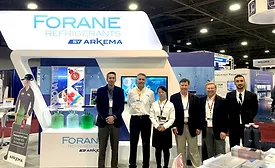
At its booth this year, Arkema took the opportunity to promote R-32 as a transition refrigerant for the air conditioning market. Arkema’s global business director of fluorochemicals, Matthew Ritter, said that while the company does not necessarily believe that R-32 will be the final answer, it is a very good choice for that segment of the market.
As applications for CO₂ refrigeration systems expand, the industry must increase its competences regarding its use. To help address this growing need, Danfoss developed the Mobile CO₂ Training Unit in 2016.
Daikin’s new Creard R-407H refrigerant is an economical, low GWP blend designed for new refrigeration systems and as a replacement for R-22, R-404A, and R-507 in existing systems.
The three-day event featured educational sessions and panel discussions that covered everything from technology and market trends to regulatory updates to what the future of the refrigeration industry may look like.
As more states — and possibly the federal government — move to restrict the use of HFCs, it is likely that end users will soon start moving over to these alternative refrigerants, which means contractors should be prepared for that transition.
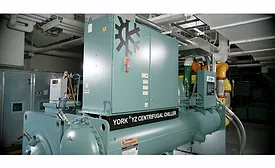
Chillers, much like the rest of the HVAC world, have seen a push to increase operational efficiency. These increasingly energy-efficient products, along with the need to replace aged units, have steadily driven growth in the chiller market. In fact, the global chiller market is projected to reach $11.33 billion by 2022.
R-410A entered the scene as the replacement HFC-based, binary refrigerant blend for R-22 in “new” light commercial and residential air conditioning and heat pump applications.
The unit will be constantly updated to reflect these changes
May 1, 2017
As the applications for CO2 refrigeration systems expand, there is a need to increase competences around its use in the industry. To help address this growing need, Danfoss has developed the Mobile CO2 Training Unit. The Danfoss Mobile Training Unit is packed with CO2 solutions and interactive learning modules, and it will be making stops in the Pacific and Mountain regions as it travels the U.S. to support the industry.