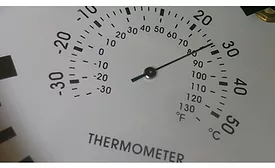
This product now features mercury-free temperature elements as an option in any 8- or 12-inch case configuration, in ranges between minus 30˚ and 600˚F.
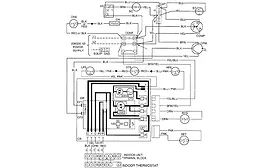
In this troubleshooting situation, the equipment is an air source heat pump and the customer’s complaint is that even though the thermostat is set at 70° F, the temperature in the conditioned space remains near 65°.
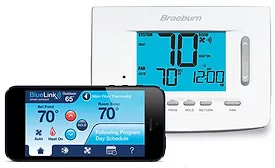
Thermostats have gotten seriously smart in the last decade. While they’re a great improvement over traditional thermostats, smart thermostats still cannot affect air distribution across a building to adjust for hot or cold spots, leaving a lot to be desired in terms of making the home a comfortable place.
This product measures relative humidity and temperature in the range of minus 40° to 180°C (40° to 356°F) and calculates further physical quantities such as dew point temperature, absolute humidity, or mixing ratio.
It features a polymer capacitance humidity sensor in order to deliver a proportional analog output, and models can be configured with a 2 or 3 percent accuracy.
Before we convert temperature scales, let’s take a step back and think about what temperature is in the first place.
Temperature is proportional to the average kinetic energy of the random microscopic motions of the constituent microscopic particles, such as electrons, atoms, and molecules.
HVAC contractors poised to reap benefits as Wi-Fi enabled thermostat prices drop
January 23, 2017
Despite the availability of quality Wi-Fi enabled products from leading thermostat manufacturers, a mere 10 to 15 percent of residential and light commercial installations involve such models. The primary objection: a wholesale price point that is four to five times the cost of a traditional thermostat.
The product works like a thermostat and can measure the output of almost any analog sensor. It has the ability to work with a wide variety of possible sensor inputs, such as ultrasonic distance, temperature, barometric pressure, humidity, and more.
Temperature sensing has been gaining importance, particularly in industrial settings and R&D
May 27, 2016
The North America temperature sensors market is forecast reach a value of $2.2 billion by 2020, growing at a compound annual growth rate (CAGR) of 6.45 percent over the period 2015-2020, according to a report from Research and Markets.