ACHR News
search
Ask ACHR NEWS AI
cart
facebook twitter instagram linkedin youtube
  • Sign In
  • Subscribe
  • Sign Out
  • My Account
ACHR News
  • NEWS
    • Breaking News
    • New HVAC Products
    • Featured Products
    • Manufacturer Reports
    • HVAC Data
    • Legislation
    • ACHR NEWS Centennial
  • RESIDENTIAL
    • Air Conditioners
    • Furnaces
    • Residential Heat Pumps
    • Ductless
    • Residential IAQ
    • Testing, Monitoring, Tools
    • Components & Accessories
  • COMMERCIAL
    • Air Handlers
    • Rooftop Units
    • Chillers and Cooling Towers
    • Commercial Heat Pumps
    • Boilers and Hydronics
    • VRF/Ductless
    • Commercial IAQ
  • REFRIGERATION
    • Refrigerants
    • Refrigerant Regulations
    • Leak Management
  • CONTRACTOR PRO
    • Geothermal
    • Homeowner Study
    • VRF and VRV Ductless
    • Unitary Trends
  • EDUCATION
    • Training and Education
    • Business Management
    • Service and Maintenance
    • Continuing Education
    • Market Research >
      • HVAC Brand Awareness Report
      • VRV, VRF, VRVZ Report
      • Unitary Trends Report
      • Water Heat Professionals Report
    • Webinars
    • Sponsor Insights
    • eProducts Info
    • White Papers
  • EVENTS
    • HVAC Contractor Forum
    • Industry Events and Webinars
  • MEDIA
    • Videos
    • AHR Expo 2025 Videos
    • Podcasts >
      • ACHR News Podcast
      • HARDI Podcasts
      • AHR Expo Podcasts
      • ACCA Podcasts
    • Interactive Spotlights
    • Quizzes
    • eBooks
    • HVAC Talkback
  • HVAC GROUP
    • ACHR NEWS >
      • Current Issue
      • Digital Edition
      • Subscribe
    • Distribution Trends
    • SNIPS NEWS >
      • Join SNIPS NEWS
    • Engineered Systems News >
      • Join ES News
    • HVACR Directory
    • Contests
    • Newsletters
    • Contact
    • Advertise
    • My Account
Service and MaintenanceRefrigeration

Purging Air From Refrigeration Systems

May 28, 2003
There are good reasons for purging air from your refrigeration system, operating efficiency being the main one; increased equipment lifespan is another. It’s important, however, that correct purging procedures are used.

This article will examine why air should be purged, and how it should be done.
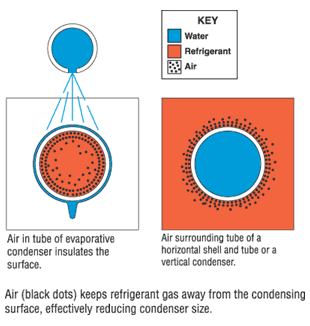
Figure 1. Air (black dots) keeps refrigerant gas away from the condensing surface, effectively reducing condenser size.

Efficiency Down, Maintenance Up

Air in the condenser will raise head pressure, mainly due to its insulating properties. Air molecules in the gas from the compressor will be blown to the quiet end of the condenser. This air accumulates on the heat transfer surfaces. (See Figure 1.)

When condenser surfaces are insulated with air, the effective condenser size is reduced. This size reduction is offset by increasing the temperature and pressure of the refrigerant gas, which is an expensive luxury.

For each 4 pounds of excess head pressure caused by air, there is an increase of compressor power costs by 2 percent and reduced compressor capacity by 1 percent. Losses caused by reduced capacity may far exceed the extra costs while operating the compressor. More cooling water will improve condenser performance, but cooling water is also expensive.

Excess head pressure also puts more strain on bearings and drive motors. Belt life is shortened and gasket seals are ruptured.

Increased pressure leads to increased temperature, which shortens the life of compressor valves and promotes the breakdown of lubricating oil. Increased head pressure increases the likelihood of premature gasket failures.

Some so-called “ammonia explosions” have actually been traced to the accumulation of noncondensable hydrogen.

How Air Gets Inside

Air can enter any refrigeration system:

  • By leaking through condenser seals and valve packings when suction pressure is below atmospheric conditions;

  • When the system is open for repairs, coil cleaning, equipment additions, etc.;

  • When charging by refrigerant trucks;

  • When adding oil;

  • By the breakdown of refrigerant or lubricating oil; or

  • From impurities in the refrigerant.

    To determine the amount of air in a refrigeration system, check the condenser pressure and temperature of the refrigerant leaving the condenser against the data in a temperature-pressure chart. If, for example, your ammonia temperature is 85 degrees F, the theoretical condenser pressure should be 151.8 psig.

    If your gauge reads 171 psig, you have 20-psi excess pressure that is increasing power costs 10 percent and reducing compressor capacity by 5 percent.

    If you do not have digital readouts or a liquid line mercury well, reasonably good readings can be obtained by strapping the bulb of an immersion thermometer to the liquid line. Cover the bulb with about 1 inch of Presstite Permagum, then insulate it with heavy cloth. In three to four minutes, it should be possible to take a reading accurate to within one-half to three-fourths of a degree.

    Note: Air is not the only cause of excessive condenser pressure. A condenser that is too small or a condenser with fouled and scaled tubes will give high pressure readings without any air in the system. Air, however, is by far the most likely cause of excess condenser pressure. The air must be purged before the head pressure can be reduced to the proper level.

    Proper Purge Procedures

    Manual purging is too expensive and troublesome, except for very small systems. It doesn’t take a large percentage of air to cause a noticeable increase in high-side pressure. Manual purging at the condenser or receiver will discharge much more refrigerant than air into the atmosphere.

    Worse yet, as the air is purged from the system, even larger quantities of refrigerant must be wasted to get rid of the remaining air.

    Besides wasting refrigerant, manual purging:

  • Takes a lot of valuable time;

  • Does not totally eliminate air;

  • Permits escape of refrigerant gas that may be dangerous and disagreeable to people and the environment, and may also be illegal; and

  • Is easily neglected until the presence of air in the system causes problems.

    Table 1. This table is based on an ammonia system. In lines 1-4, the temperature is held constant while the amount of air varies. Total pressure (high-side pressure) rises (columns E and F). In lines 5-10, the total pressure is held constant.


    Refrigerated purging: Table 1 illustrates the principles of refrigerant purging and why it is needed. The table is based on an ammonia system. In lines 1-4, the temperature is held constant while the amount of air varies.

    Note how the total pressure (high-side pressure) rises (columns E and F). Even when there is enough air to significantly raise the high-side pressure, the gas mixture is still mostly refrigerant (columns I and J).

    In lines 5-10, the total pressure is held constant. As the purger is chilled, the refrigerant pressure drops. The balance of the pressure is due to the air, so this means that the concentration of air inside the purger is increasing. (See Figure 2.)

    Line 2 represents a moderately low amount of air in the system. Achieving this condition by manual blowdown means that 28 pounds of ammonia is lost for every pound of air removed. By keeping the same total pressure as line 2, but cooling the gas to 0 degrees as shown in line 8, only 0.13 pounds of ammonia is lost when purging 1 pound of air. This means the refrigerant purge is 215 times as effective.

    Table 2. This table is based on an R-134a system. Note that obtaining low weight ratios of refrigerant gas-to-air may require lower temperatures than for ammonia systems.


    Similar gains will be seen in an R-134a system. (See Table 2.) Note, however, that obtaining low weight ratios of refrigerant gas to air may require lower temperatures than for the ammonia system.

    The pressures and required purger temperatures will vary with other refrigerants, but the principles remain the same.

    Figure 2. “Foul gas” is refrigerant vapor contaminated with air. Blowing down at this point wastes large amounts of refrigerant. When foul gas is subcooled, most of the refrigerant gas condenses, leaving a high concentration of air.

    Where To Make Purge Connections

    A refrigerated purger does not have magic fingers that can reach into a refrigeration system and find air. It is a device that will separate air from refrigerant gas in a purge system. Therefore, purge point connections must be located at places where air will collect.

    Refrigerant gas enters a condenser at high velocity. By the time the gas reaches the far (and cool) end of the condenser, its velocity is practically zero.

    This is where the air accumulates and therefore where the purge point connection should be made. Similarly, the purge point connection at the receiver should be made at a point furthest from the liquid inlet. (Purge point connection locations are based on thousands of successful purge installations.)

    Be prepared to purge from the condensers and receivers. Air will migrate from the condenser to the receiver and back again, depending on the load and plant conditions.

    Air will remain in the condensers when the receiver liquid temperature is higher than condenser liquid temperature. This can happen when:

  • The receiver is in a warm place.

  • Cooling water temperature is falling.

  • Refrigerating load is decreasing.

    Conversely, air will migrate to the receiver when the condenser liquid temperature is higher than the receiver temperature. This can happen when:

  • The receiver is in a cold place.

  • The cooling water temperature is rising.

  • The refrigeration load is increasing.

    The material was prepared by Armstrong International and is based on its publication, “The Guide to Refrigerated Purging,” Bulletin 702-D. Armstrong can be contacted at www.armstrong-intl.com.

    Publication date: 06/02/2003

  • Looking for quick answers on air conditioning, heating and refrigeration topics? Try Ask ACHR NEWS, our new smart AI search tool. Ask ACHR NEWS →

    Share This Story

    Looking for a reprint of this article?
    From high-res PDFs to custom plaques, order your copy today!


    Recommended Content

    JOIN TODAY
    To unlock your recommendations.

    Already have an account? Sign In

    • HVAC-enrollment

      The Trades Are Back: HVACR Programs See Nearly 30% Enrollment Spike

      A new wave of future technicians is entering the pipeline.  
      Training and Education
      By: Matt Jachman
    • 2025 Top 40 Under 40

      2025 Top 40 Under 40 HVACR Professionals List

      The 11th annual Top 40 Under 40 list highlights those...
      HVAC Light Commercial Market
      By: Hannah Belloli-Oster
    • LG Ductless Mini-Split Systems

      The 9 Types of Heat Pumps

      As the U.S. moves toward electrification, heat pumps are...
      HVAC Commercial Market
      By: Joanna R. Turpin
    Subscription Center
    • Create an Account
    • Start a Subscription
    • Manage My Account
    • Sign Up for Newsletters
    • Visit Customer Service
    • Update Preferences

    More Videos

    Sponsored Content

    Sponsored Content is a special paid section where industry companies provide high quality, objective, non-commercial content around topics of interest to The News audience. All Sponsored Content is supplied by the advertising company and any opinions expressed in this article are those of the author and not necessarily reflect the views of The News or its parent company, BNP Media. Interested in participating in our Sponsored Content section? Contact your local rep!

    close
    • Piggy Bank
      Sponsored byWatercress Financial

      Energy Prices, Inflation, and HVAC: What Today’s Homeowners Care About

    • Refrigerated Food
      Sponsored bySolstice Advanced Materials

      R-455A Refrigeration: A Cold Storage Solution for the Future

    • Airex Rooftop Units
      Sponsored byAirex Manufacturing Inc

      Consolidating Roof Penetrations: A Growing Trend in Multifamily HVAC Design

    Popular Stories

    HVAC-Price-Increase-graphic

    HVAC Price Increase List: June 2026

    Trump-Section-232.jpg

    Trump Reduces Section 232 Tariffs on HVAC Equipment to 15%

    R410A-Refrigerant-Cylinder.jpg

    Refrigerant Recovery is a Revenue Opportunity

    Heat-pump-cutaway.jpg

    PFAS Rules and A2L Building Codes Continue to Evolve

    Midea-training.jpg

    HVAC Workforce Crisis Expands Beyond Technicians to Instructor Shortages

    View The ACHR NEWS
    Centennial Anniversary Timeline

    The ACHR News Timeline Chart
    Submit a Letter
    Submit a letter to our editors.

    Events

    November 6, 2025

    Next-Gen Data Center Cooling: HVAC Innovation and Real-World Solutions

    On Demand As AI workloads and high-density computing push traditional cooling methods to their limits, the data center industry is accelerating the adoption of next-generation HVAC technologies.

    June 17, 2026

    Decarbonization Without Disruption

    This webinar will explore practical HVAC decarbonization strategies that minimize disruption while maximizing long-term performance and ROI.

    View All Submit An Event

    Poll

    Summer Staff

    Are you fully staffed for the summer season?
    View Results Poll Archive

    Products

    BNI Mechanical/Electrical Square Foot Costbook, 2026 Edition

    BNI Mechanical/Electrical Square Foot Costbook, 2026 Edition

    See More Products
    Decarbonization Without Disruption - Free Webinar - 6/17/2026

    Related Articles

    • Joanna's Point of View

      Refrigeration Systems Are Going Au Naturel

      See More
    • FMI Conference

      Grocers Prepare for HFC Phasedown, New Refrigeration Systems

      See More
    • FROSTlines

      Five Rules for Charging Refrigeration Systems

      See More

    Related Products

    See More Products
    • Evaluating-and-Troubleshooting-Refrigeration-Systems-Video-Cover-210x300.jpg

      Evaluating Refrigeration Systems Troubleshooting & Identifying Problems CONTINUED

    • Troubleshooting Tips for Servicing Refrigeration Systems

    • Understanding TXV Refrigeration Systems: Superheat and Subcooling DVD

    See More Products

    Related Directories

    • Phoenix Air Systems

      Manufacturer of hygienic air handlers, penthouse refrigeration units, air diffusers for critical process,and indoor air hygiene applications such as food processing facilities.
    • Air Systems Inc

      Reviewed April 15, 2021 Rotations helped me earn tons of relationships that I have used to this day. I would prefer if the classes were a little bit smaller to get more one on one time with instructors, but I was able to keep up non the...
    ×

    Sign Up. Stay Informed.

    The #1 trusted source for the HVACR industry since 1926

    SUBSCRIBE
    • RESOURCES
      • Advertise
      • Contact Us
      • Advisory Board
      • Classifieds
      • Submit a Letter
      • Directories
      • Store
    • ACCOUNT CENTER
      • Create an Account
      • Start a Subscription
      • Manage My Account
      • Sign Up for Newsletters
      • Visit Customer Service
      • Update Preferences
    • SERVICES
      • Marketing Services
      • Reprints
      • Market Research
      • List Rental
      • Survey/Respondent Access
    • STAY CONNECTED
      • LinkedIn
      • Facebook
      • Instagram
      • YouTube
      • X (Twitter)
    • PRIVACY
      • PRIVACY POLICY
      • TERMS & CONDITIONS
      • DO NOT SELL MY PERSONAL INFORMATION
      • PRIVACY REQUEST
      • ACCESSIBILITY

    Copyright ©2026. All Rights Reserved BNP Media, Inc. and BNP Media II, LLC.

    Design, CMS, Hosting & Web Development :: ePublishing