Hospital's Step-By-Step Approach Updates Chiller Plant
Kingston General Hospital is the major tertiary care referral facility complementing community hospitals and other health care providers serving southeastern Ontario. Integrally linked with Queen's University in Kingston, the 452-bed hospital supports a comprehensive array of acute and ambulatory clinical services in a vibrant and dynamic academic and medical environment. The hospital has a long history, reaching back to the 1830s, and today is one of Ontario's most important healthcare resources.
Multiple Wings Over the Years
The hospital comprises over 1 million square feet in a central Kingston location. Like many hospitals, it is composed of multiple wings constructed at different times in the hospital's history. Some of the spaces go back to the turn of the last century, and the newest wing is over 30 years old. Over the last 30 years, various sections have been extensively renovated, the most recent being the emergency department, which underwent a complete renovation in 1998. Also like many other hospitals, the HVAC and chilled water systems for the facility were built in stages. Most of the chilled water equipment is in a central plant area, with some also at two remote locations. The main mechanical plant is located on the hospital's eighth floor.According to Carr-Braint and maintenance supervisor Chris Rousseau, numerous developments came together in 2002 which made action necessary. Three of the four chillers serving the hospital were over 30 years old, and used R-11 refrigerant. These three machines had operating efficiencies in the area of 1.0 kW per ton, and under the best circumstances were unable to carry the peak cooling load of the hospital.
Chilled Water Deficiencies Cancelled Surgeries
In fact, Carr-Braint remarked, "On some of the hot days in the summer of 2002, we had to cancel surgeries in several of the operating rooms because the cooling plant was unable to meet required cooling levels. This is a serious problem in a hospital, and it made immediate action necessary." In addition, Carr-Braint was advised by the hospital's Planning Department that in the near future a hospital additions were being planned, and this would further tax the existing chilled water plant.At this point, the hospital brought in an Ottawa consulting firm, Goodkey, Weedmark and Associates, to evaluate the situation and make recommendations for system improvements. George Carscallen, a senior engineer with Goodkey, Weedmark, headed up this review process and developed recommendations for extensive improvements by the hospital. Working with the Department of Physical Plant and the Joint Planning Office, the firm made recommendations for improvements which could be made in stages, allowing the hospital to prioritize work. Its review indicated that numerous improvements in the chilled water plant and air distribution system would be required.
The first priority, according to Carscallen, was to upgrade the chiller plant. The existing plant had been designed for chilled water ∆Ts of approximately 10 degrees F, but because of an unbalanced primary/secondary pumping arrangement, on the hottest days the ∆Ts were as low as 7 degrees F, and the system simply couldn't keep up with cooling demand. Rousseau noted that the temperature and humidity levels in July and August would frequently creep up well above levels appropriate for the surgical suites and patient care areas.
Chiller Conversion Not Practical
Because of the age and inherent inefficiency of three of the existing chillers, conversion to alternate refrigerants was not a practical option, and in any case, additional capacity was needed. For this reason, Carscallen's firm recommended replacing three of the existing chillers. In addition, the engineering firm found that the cooling towers supplying the main mechanical plant were physically in poor condition and needed replacement. Additionally, they recommended installing a chiller plant management system to optimize operation of the chillers, pumps, and cooling towers.The firm also made recommendations to modify the primary/secondary pumping arrangement, to extend the secondary loop, to upgrade airside equipment, and to replace the remote chillers. Goodkey, Weedmark also recommended improving system controls and making changes in the distribution of conditioned air to spaces within the hospital. The recommendations were made in late 2002, and the hospital forwarded them for review and approval by the provincial board that must approve capital expenditures for healthcare facilities. An approval was received for the first stages of the project, and the hospital and engineering firm immediately began planning for work to solve the most urgent problems before the coming summer of 2003.
Engineer Involved in Detailed Planning
The hospital's engineering and maintenance department conferred extensively with Goodkey, Weedmark and concluded that the first priority should be the two chillers in the main mechanical plant, their associated cooling towers, and necessary piping and control arrangements. Goodkey, Weedmark felt that because of the very tight schedule, it would make the most sense for the new plant to be provided on a turnkey basis by a single supplier. Carscallen pointed out, "We felt that it would require strong support from the manufacturer to have equipment ready to meet the summer cooling demand."The proposals by vendors were received by January 22, 2003, and the hospital selected Ottawa Trane for the project. According to Carr-Braint, one factor in the decision was the hospital's previous successful experience with Trane, as well as the fact that Trane had a preventive maintenance package to go along with the new chillers. A second factor was the fact that the existing mechanical plant had some significant constraints based on the space footprint available and weight limitations. Further, there were restrictions in the size of the available electric service. The electric utility had service amperage limitations on the site, so the machines selected had to fit within this electric constraint. The Trane proposal would squeeze the greatest available tonnage into those physical and electrical constraints.
First Stage: Two New Chillers
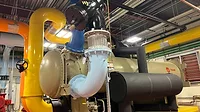
The machines selected were two Trane CenTraVacâ„¢ centrifugal chillers, Model CVHF, rated at 515 and 777 tons. These would replace the old machines, which had been rated at 337 and 445 tons, for an increase in capacity of 510 tons within the same floor area. Further, these machines would not require an electrical service upgrade. The challenge now was to meet demanding delivery and installation requirements so the upgraded system could be available for the summer peak cooling period.Ottawa Trane worked with the manufacturing group in La Crosse, Wis., to secure the best possible delivery schedule for the machines, and to assure that the new machines would fit the site constraints. Another major part of the project handled by Ottawa Trane was the installation of two new Evapco cooling towers on the building rooftop, replacing the old, failing towers. The new towers not only have more capacity, but would have variable speed fan drives, which allows tower operation to be optimized for cooling load and weather conditions.
Looking for quick answers on air conditioning, heating and refrigeration topics? Try Ask ACHR NEWS, our new smart AI search tool. Ask ACHR NEWS
A third improvement was the installation of a Trane Tracer Summitâ„¢ chiller plant management system. This system optimizes operation of the chillers, pumps, and cooling towers, and communicates with the hospital's existing Siemens building automation system. All of these improvements were done in the spring, before the peak cooling season. The first chiller, the 515 ton machine, was delivered in April and was installed and on-line by the first week of July. The second (777 ton) machine was received in May and was on-line by early August.
Confidence In Reliability Of New Chillers
According to Carr-Braint, the immediate effect of the plant improvement project was improved confidence in the reliability of the machines, and improvement in the chilled water temperatures. "Although the low ∆T problem is not yet resolved, we can actually produce colder water than we ever have before." Colder chilled water also permits more effective dehumidification. He noted that the new system will actually achieve a 14-degree ∆T as planned additional system improvements are completed. "We have the potential for even greater energy efficiency in the future, when we eliminate some pumping restrictions on the secondary loop."Carr-Braint pointed out that another important effect is reduced system operating costs. "We've seen a 40 percent reduction in energy use by our comfort system during cooling operations. That's very impressive." Also important is the fact that it was no longer necessary to cancel surgeries because of inadequate temperature control in the surgical suites.
More Plant Improvements Coming
Continuing improvements in the mechanical plant are coming in the future. Carr-Braint especially looks forward to the completion of the plan to put all of the chillers on a common chilled water loop. "That way," he said, "we will be able take the fullest advantage of the Tracer Summit System, optimizing the entire plant, not just individual chillers." But he pointed out that in healthcare facilities, facility managers have to be patient. Partial approval of funding requests is common. "That's why we ask for the designs to be suitable to be done in stages."Kingston General Hospital is already well on the way to having a modern comfort system. As the funding dollars are released, an old and respected name in Canadian healthcare is also leading the way in comfort system efficiency and control.
Publication date: 09/27/2004
Looking for a reprint of this article?
From high-res PDFs to custom plaques, order your copy today!