Wake Forest University South Chiller Plant: Vertical Innovation and Campus Impact
A vertical redesign and collaborative planning helped Wake Forest University expand its chilled water system by 33%
SOUTH CHILLER: The newly completed South Chiller Plant features a brick-clad, steel superstructure and custom cooling towers, boosting Wake Forest’s campus cooling capacity by 33%.
Wake Forest University, in partnership with RMF Engineering and Vannoy Construction, has completed a transformative upgrade to its South Chiller Plant – an effort highlighted in the Fall 2025 issue of Facilities Manager magazine and celebrated on both companies’ social channels.
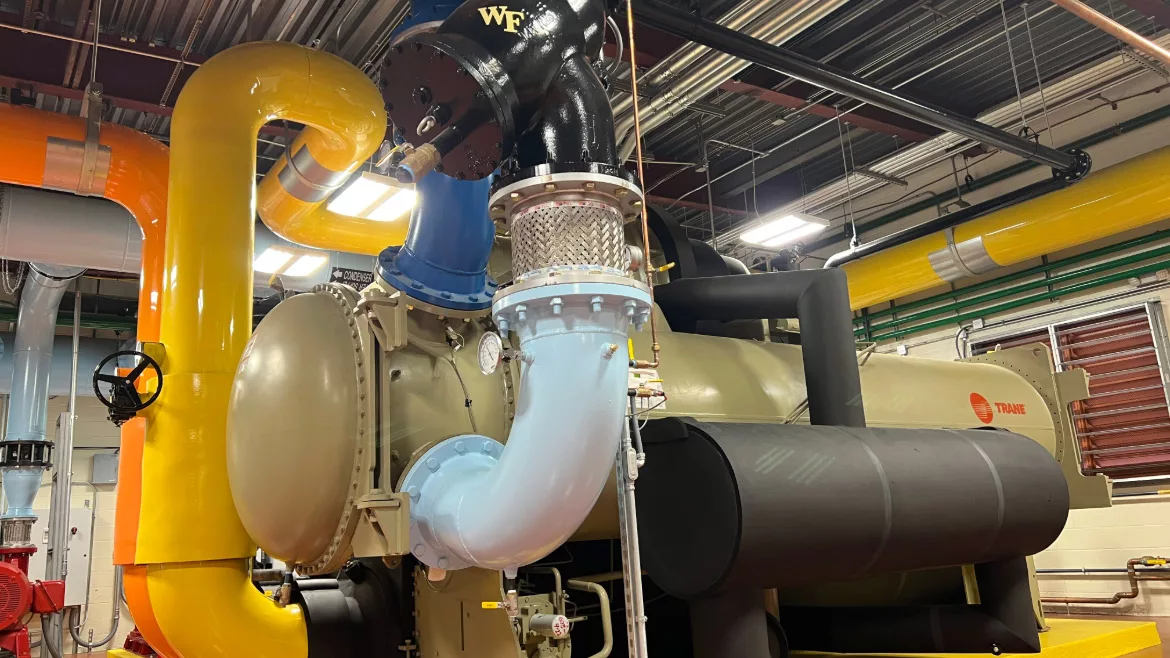
Chase Davis, PE, CEM, mechanical engineer and project manager at RMF, described the project as “an important step in the plant’s renovation: building vertically to free up real estate while expanding cooling capacity and bringing much-needed improvements in resiliency and efficiency for WFU’s main campus.” The renovation increased the plant’s capacity by 33%, from 3,600 to 4,800 total tons, by replacing two 600-ton chillers with two 1,200-ton units and adding new custom towers, pumps, and piping.
The decision to “go vertical” with a brick-clad steel superstructure, according to RMF, was not the original plan. Feasibility studies – conducted with facilities staff and operators deeply involved from the outset – revealed that this approach addressed not only operational needs, but also preserved vital real estate near expanding athletics facilities. “Each decision in the process, from planning to execution, was made with the intent of blending the plant to the campus while minimizing the chilled water system disruption, especially through the intensity of a Carolina summer,” Davis explained.
This vision-driven approach required upfront commitment and flexibility, especially as post-COVID supply chain issues put schedules and budgets to the test. RMF highlighted that without the early concept development, “the plant we have today” might not have been possible due to the pressure not to deviate from original plans.
A key part of the project was redesigning the electrical system. The new power feed and transformers were carefully planned to allow the plant to remain at least partially operational even if a major transformer goes offline, maintaining critical campus cooling capacity.
Vannoy Construction, sharing project photos, wrote: “Thank you to our project partners for their contributions in bringing this project to life!”
Aesthetics remained central, as RMF worked closely with Michael Graves Architecture to “seamlessly blend the addition into campus sightlines through a thoughtful approach to architecture and materiality.” The custom cooling towers – built using fiberglass reinforced polymer for custom color-matching and a smooth finish – were designed so their colors, finish, and placement aligned perfectly with adjacent campus buildings, even allowing for future branding displays.
The result is a chiller plant that stands as a “critical milestone in the University’s journey to optimize chilled water systems,” according to RMF. Since its completion, the project has been well received by the WFU community, demonstrating the value of collaboration between engineering, architecture, and operations. As of September 2025, the new plant is already delivering energy savings “well over $100K per year (in savings) during peak summer operation,” with further reductions expected as optimization continues.
Looking for a reprint of this article?
From high-res PDFs to custom plaques, order your copy today!