ACHR News
search
Ask ACHR NEWS AI
cart
facebook twitter instagram linkedin youtube
  • Sign In
  • Subscribe
  • Sign Out
  • My Account
ACHR News
  • NEWS
    • Breaking News
    • New HVAC Products
    • Featured Products
    • Manufacturer Reports
    • HVAC Data
    • Legislation
    • ACHR NEWS Centennial
  • RESIDENTIAL
    • Air Conditioners
    • Furnaces
    • Residential Heat Pumps
    • Ductless
    • Residential IAQ
    • Testing, Monitoring, Tools
    • Components & Accessories
  • COMMERCIAL
    • Air Handlers
    • Rooftop Units
    • Chillers and Cooling Towers
    • Commercial Heat Pumps
    • Boilers and Hydronics
    • VRF/Ductless
    • Commercial IAQ
  • REFRIGERATION
    • Refrigerants
    • Refrigerant Regulations
    • Leak Management
  • CONTRACTOR PRO
    • Geothermal
    • Homeowner Study
    • VRF and VRV Ductless
    • Unitary Trends
  • EDUCATION
    • Training and Education
    • Business Management
    • Service and Maintenance
    • Continuing Education
    • Market Research >
      • HVAC Brand Awareness Report
      • VRV, VRF, VRVZ Report
      • Unitary Trends Report
      • Water Heat Professionals Report
    • Webinars
    • Sponsor Insights
    • eProducts Info
    • White Papers
  • EVENTS
    • HVAC Contractor Forum
    • Industry Events and Webinars
  • MEDIA
    • Videos
    • AHR Expo 2025 Videos
    • Podcasts >
      • ACHR News Podcast
      • HARDI Podcasts
      • AHR Expo Podcasts
      • ACCA Podcasts
    • Interactive Spotlights
    • Quizzes
    • eBooks
    • HVAC Talkback
  • HVAC GROUP
    • ACHR NEWS >
      • Current Issue
      • Digital Edition
      • Subscribe
    • Distribution Trends
    • SNIPS NEWS >
      • Join SNIPS NEWS
    • Engineered Systems News >
      • Join ES News
    • HVACR Directory
    • Contests
    • Newsletters
    • Contact
    • Advertise
    • My Account
HVAC ContractingTechnical

Motor Tips: Overload And Speed Change

August 7, 2005
Figure 1. Overload.

How To Tell When A Motor Is Overloaded

A good indication that a motor may be overloaded is overheating, or in some cases not starting at all. For HVAC motors it can be as simple as belts that may be too tight, inadequate wiring, or voltage that's too low. Possible corrective actions can include: readjusting belt tension, increasing the motor size, and corrective adjustments to the power situation.

How do you know that the motor is overloaded? The first sign that a motor is the wrong size for the application is frequent nuisance tripping of the thermal reset (also called a thermal protector). Check to see if the applied voltage agrees with the nameplate. If it does, check to see if the motor and drive turn freely. If the voltage to the motor looks good, and the drive system has free motion, there may be a need to increase the horsepower of the motor. Check the power supply to make sure there is enough capability to go up one horsepower rating.
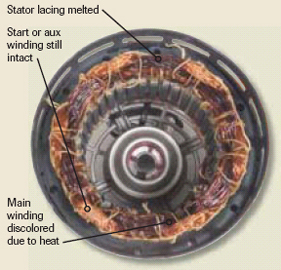
Figure 2. Major overload.
Visible signs that a motor has seen overload conditions include discolorization of the motor's shell - typically a uniform brown ring around the outside. If the motor has a Mylar nameplate, it sometimes shows shrinking, bubbling, or discolorization due to heat. If the motor is taken apart, you will see melted Mylar slot liners throughout the stator and uniform discolorization of the windings (Figure 1). If the motor experiences major overloading, the actual lace wrapping will show signs of melting (Figure 2).

For situations where the motor's overload condition was extreme - possibly a frozen shaft - you'll see a start winding failure. This is when the motor never left the start winding and failed to come up to speed. The internal analysis will show the start winding to be discolored from extreme heat prior to its opening. The main winding will still be intact (Figure 3).

Figure 3. Frozen shaft.
There are many reasons a motor shaft or the drive system can freeze up. One is moisture contamination, or rust, causing mechanical parts to seize. Another is dirt contamination where dirt buildup increases the actual load. In some cases the wrong amount of lubrication will cause a bearing system failure. Motors that sit in applications for a long period of time with no power applied tend to experience higher failure rates. It's good practice to have a regular cycle routine to keep the parts free and lubricated.

What Effect Does Speed Change Have On Motor Performance?

What can be done with a new replacement direct drive fan or blower motor where little or no speed change can be detected from one connection to the next?

This could be a result of:

1. The replacement motor's horsepower rating is greater than the original motor.

2. The replacement motor's speed rating is lower than that of the original motor (e.g., 1,075 rpm compared to the original 1,625 rpm).

3. The original motor was tailored to the application and was designed for a greater speed change than the replacement.

4. The ventilation system was changed in some way, which reduced the load on the motor.

Speed change for a multi-speed shaded pole or permanent split capacitor motor is achieved by weakening the motor at lower speed connections, causing it to operate at lower speeds. If the motor is not adequately loaded, or is too large for the application, little or no speed change will be apparent at lower speed connections.

Looking for quick answers on air conditioning, heating and refrigeration topics? Try Ask ACHR NEWS, our new smart AI search tool. Ask ACHR NEWS →

To remedy the situation, the replacement motor must have the same horsepower and nominal full load speed rating as the original motor. Attempting to alter the air delivery or other characteristics of the fan or blower by replacing with a higher (or lower) horsepower or speed-rated motor could result in rapid motor failure. Do not undersize the motor to achieve a greater speed change than the original.

If the replacement motor is equivalent to the original and the speed separation still is not apparent, the ventilation system may have been changed, reducing the system load and the load on the motor.

  • To increase the system load for a blower, the air delivery must be increased by increasing the total exhaust opening and/or by reducing restrictions by opening dampers in the duct system.

  • To increase the system load for a propeller fan, the air delivery must be decreased by reducing the total exhaust opening and/or by closing dampers in the duct system.

    Too much motor loading to achieve a greater speed change may overload the motor. System alterations must be made in small steps to prevent overloading.

    Reprinted with permission from On the Job, May 2005, Grainger's quarterly newsletter for professional contractors. For more information, visit www.grainger.com/contractor.

    Note: This information has been checked for suitability. However, a successful solution depends on individual accuracy, skill, and caution. For this reason, W.W. Grainger Inc. does not guarantee the result of procedure compliance or assume responsibility for personal injury or property damage to persons following these procedures.

    Publication date: 08/08/2005

  • Share This Story

    Looking for a reprint of this article?
    From high-res PDFs to custom plaques, order your copy today!


    Recommended Content

    JOIN TODAY
    To unlock your recommendations.

    Already have an account? Sign In

    • HVAC-enrollment

      The Trades Are Back: HVACR Programs See Nearly 30% Enrollment Spike

      A new wave of future technicians is entering the pipeline.  
      News
      By: Matt Jachman
    • 2025 Top 40 Under 40

      2025 Top 40 Under 40 HVACR Professionals List

      The 11th annual Top 40 Under 40 list highlights those...
      HVAC Commercial Market
      By: Hannah Belloli-Oster
    • LG Ductless Mini-Split Systems

      The 9 Types of Heat Pumps

      As the U.S. moves toward electrification, heat pumps are...
      Ground Source Heat Pumps
      By: Joanna R. Turpin
    Subscription Center
    • Create an Account
    • Start a Subscription
    • Manage My Account
    • Sign Up for Newsletters
    • Visit Customer Service
    • Update Preferences

    More Videos

    Sponsored Content

    Sponsored Content is a special paid section where industry companies provide high quality, objective, non-commercial content around topics of interest to The News audience. All Sponsored Content is supplied by the advertising company and any opinions expressed in this article are those of the author and not necessarily reflect the views of The News or its parent company, BNP Media. Interested in participating in our Sponsored Content section? Contact your local rep!

    close
    • Piggy Bank
      Sponsored byWatercress Financial

      Energy Prices, Inflation, and HVAC: What Today’s Homeowners Care About

    • Refrigerated Food
      Sponsored bySolstice Advanced Materials

      R-455A Refrigeration: A Cold Storage Solution for the Future

    • Airex Rooftop Units
      Sponsored byAirex Manufacturing Inc

      Consolidating Roof Penetrations: A Growing Trend in Multifamily HVAC Design

    Popular Stories

    HVAC-Price-Increase-graphic

    HVAC Price Increase List: June 2026

    Trump-Section-232.jpg

    Trump Reduces Section 232 Tariffs on HVAC Equipment to 15%

    Refrigerants-and-gauge.jpg

    HVAC Industry Warns of Counterfeit Refrigerants Entering U.S. Supply Chain

    Heat-pump-cutaway.jpg

    PFAS Rules and A2L Building Codes Continue to Evolve

    Midea-training.jpg

    HVAC Workforce Crisis Expands Beyond Technicians to Instructor Shortages

    View The ACHR NEWS
    Centennial Anniversary Timeline

    The ACHR News Timeline Chart
    Submit a Letter
    Submit a letter to our editors.

    Events

    November 6, 2025

    Next-Gen Data Center Cooling: HVAC Innovation and Real-World Solutions

    On Demand As AI workloads and high-density computing push traditional cooling methods to their limits, the data center industry is accelerating the adoption of next-generation HVAC technologies.

    June 17, 2026

    Decarbonization Without Disruption

    This webinar will explore practical HVAC decarbonization strategies that minimize disruption while maximizing long-term performance and ROI.

    View All Submit An Event

    Poll

    Summer Staff

    Are you fully staffed for the summer season?
    View Results Poll Archive

    Products

    BNI Mechanical/Electrical Square Foot Costbook, 2026 Edition

    BNI Mechanical/Electrical Square Foot Costbook, 2026 Edition

    See More Products
    Decarbonization Without Disruption - Free Webinar - 6/17/2026

    Related Articles

    • Karim Muri Insulated Metal Panels

      Efficiency, Cost and Speed: Addressing Construction Industry Challenges with IMPs

      See More
    • Tecumseh Products Co.: Replacement Relay and Overload Kits

      See More
    • Variable-Frequency Drives And AC Motor Speed

      See More

    Related Products

    See More Products
    • fanfelaysdvd.jpg

      Understanding Fan Relays and Multiple Speed Motors

    • compressormotorwindingsdvd.jpg

      UNDERSTANDING COMPRESSOR MOTOR WINDINGS

    • Green Tips for Building Maintenance Engineers

    See More Products

    Events

    View AllSubmit An Event
    • April 24, 2014

      Motors, Variable Speed Drives and Energy Efficiency

      The introductory course on motors and variable-speed drives will give participants a better understanding of motors and the theory behind how they work.
    View AllSubmit An Event

    Related Directories

    • SpeedClean

      SpeedClean manufactures and markets HVAC maintenance tools like portable coil cleaning systems, biodegradable coil cleaners, tube cleaners, mini-split cleaning systems and much more.
    ×

    Sign Up. Stay Informed.

    The #1 trusted source for the HVACR industry since 1926

    SUBSCRIBE
    • RESOURCES
      • Advertise
      • Contact Us
      • Advisory Board
      • Classifieds
      • Submit a Letter
      • Directories
      • Store
    • ACCOUNT CENTER
      • Create an Account
      • Start a Subscription
      • Manage My Account
      • Sign Up for Newsletters
      • Visit Customer Service
      • Update Preferences
    • SERVICES
      • Marketing Services
      • Reprints
      • Market Research
      • List Rental
      • Survey/Respondent Access
    • STAY CONNECTED
      • LinkedIn
      • Facebook
      • Instagram
      • YouTube
      • X (Twitter)
    • PRIVACY
      • PRIVACY POLICY
      • TERMS & CONDITIONS
      • DO NOT SELL MY PERSONAL INFORMATION
      • PRIVACY REQUEST
      • ACCESSIBILITY

    Copyright ©2026. All Rights Reserved BNP Media, Inc. and BNP Media II, LLC.

    Design, CMS, Hosting & Web Development :: ePublishing