Contractor accelerates refrigerant service work
Because of the volume of work and the shortage of skilled technicians, many contractors simply don’t have the time to assess all of the options available to them.
A few, however, have learned how to evaluate and take advantage of the new technologies. One such contractor is MacDonald-Miller Building Services of Seattle, WA. MacDonald-Miller has found ways to use leading-edge technology to streamline their projects and improve their profit picture.
“The new tools and equipment aren’t that hard to assess if you just keep on top of what’s available,” said Scott Groff, senior account manager for MacDonald-Miller. “We track key websites and attend the important trade shows.
“It isn’t as hard to evaluate the new products as you might think. We identify the key benefits that would affect us, and determine if the increased performance they would give us justifies the added expense of a new purchase. More often than not, it doesn’t. But when we find a new product that has value, we jump at it.
“The secret is to keep on top of everything out there instead of waiting for a salesman to call on you, otherwise you get overwhelmed.
“But the area we have found new technologies to be truly useful,” Groff continued, “are those offered from outside vendors. These guys are constantly developing new equipment and services that we can use to speed up our jobs and offer better service to our customers.”
Groff said his company works with “high-tech subcontractor” Hudson Technologies. “They have developed patented, high-speed equipment that decontaminates refrigerant at the jobsite. They not only speed cleanup on the refrigerant side, they also free our technicians for more profitable work. And we are able to turn them into a profit center for us while saving money for our clients.”
Looking for quick answers on air conditioning, heating and refrigeration topics? Try Ask ACHR NEWS, our new smart AI search tool. Ask ACHR NEWS
Water, the most dangerous contaminant
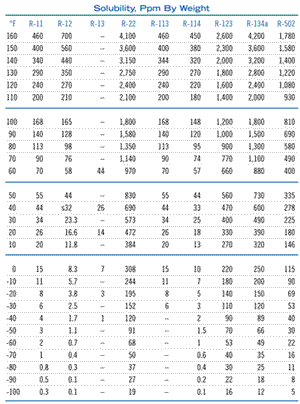
Services like these are of particular use where water is involved as a contaminant. Recent studies show that even a small amount of water in the refrigerant can cause significant damage.Whether from a slow leak or a catastrophic one, moisture is the worst form of contamination. Even the smallest amounts can:
- Combine with lubricating oil in the compressor to form acids that attack the motor windings, leading to burnout;
- Remove copper ions from tubing and deposit them on hot surfaces, causing bearings to seize;
- Join with oil to form a sludge that blocks oil flow passages, pits polished surfaces, and restricts metering devices;
- Significantly reduce chiller efficiency; and
- Freeze in expansion valves, capillary tubes, and evaporators in low-temperature systems.
In one case, MacDonald-Miller was called in to service a totally flooded 40-ton R-22 comfort cooling system on the fifth floor of an office complex.
Complete dehydration is, of course, critical in these cases. The company called in Hudson, which wheeled its portable decontamination system onto the service elevator and up to the chiller.
After removing the bulk of the water, technicians began a meticulous process to locate and remove all residual moisture. Because of the capillary effect, minute amounts of water can escape notice and contaminate refrigerant after repairs are made.
Hudson used its ZugiBeast decontamination system to circulate R-22 through the refrigerant side, removing moisture from the refrigerant as it passed through.
When repairs were complete and all traces of moisture removed, Hudson pulled the system down to final vacuum for MacDonald-Miller to recharge.
“Actually, we had their technicians dehydrate it twice,” said Groff, “because there were several leaks and we needed to be sure we had found them all. It still only took one week to have the chiller up and running. A conventional approach would have taken at least three weeks.”
Another account manager for MacDonald-Miller agrees. Mike Morceau says his clients have also benefited from his company’s strategy of using new technology from subcontractors and other outside vendors.
“Particularly with the shortage of qualified techs,” he said, “it’s imperative for us to find ways to take the burden off our own technicians and provide our clients with the kind of service they need.”

Speedy removal of ice, moisture
“We have a client who runs a chlorine processing plant and uses two old 14,000 pound R-12 centrifugal process chillers that run at minus 60°F,” said Morceau. “They knew they had a water leak, that most of it was trapped as ice, and that it could cause serious problems, but they were reluctant to shut down the process because of the costs involved.”The client’s choices were to do a quick fix and recover the contaminated refrigerant, remove the suspended water, and replace it with new R-12 at a cost of $23/lb (with four to five days’ downtime), convert to R-134a at a cost of over $1 million, or to listen to MacDonald-Miller’s proposal to remove all the water on-site and, possibly, keeping the chillers on-line.
The client was skeptical of the on-line capability and requested a test. They gave MacDonald-Miller two 8-hr windows on consecutive days to prove that they could remove moisture on-line.
MacDonald-Miller again called in Hudson, first to analyze the refrigerant for contaminants. Technicians drew refrigerant samples and sent them to Hudson’s laboratory.
The results were worse than anticipated. The tests showed 33 ppm (parts per million) of moisture in the refrigerant, with much more trapped as ice and therefore undetectable. There were also very high quantities of excess oil and particulates.
Morceau scheduled an on-line decontamination for two 8-hr periods on consecutive days.
Hudson technicians first used a chemical dehydrant to thaw the ice and to suspend the moisture in the refrigerant. Samples were analyzed and showed moisture levels at 125 ppm.
Technicians arrived on the scheduled days, connected their high-speed on-line decontamination equipment to the chiller, and ran for the specified 8 hrs on two consecutive days. Analysis after the decontamination revealed that the moisture content of the R-12 had been reduced to less than 20 ppm, along with greatly reduced amounts of oil and particulate contamination.
“The client was so impressed by the speed and efficiency, and so shocked by the amount of contamination,” said Morceau, “that they decided to solve all of their problems at once and have both chillers shut down completely for repairs, decontamination, and recharge.
“It’s one more way that new technology works out well for everyone when properly applied. And, by the way, the charge to the client for those two eight-hour sessions was less than $10,000 and saved them a small fortune in future downtime. It also gave MacDonald-Miller a new profit opportunity.”

Fast response increases client satisfaction
One advantage of using outside subcontractors for difficult situations is their response time. “Everybody is in competition and has competitors nipping at their heels,” said Morceau. “With these high-tech subs, it’s even more intense because they’re always coming up with new ideas. So response time is critical for them to keep customers like us ready to call on them.”One recent job just completed in late June involved a hospital with three 800-ton comfort-cooling chillers. The backup was not working well and the primary was heavily oil-logged, to the point that the primary and backup chillers could not provide sufficient cooling for the hospital. MacDonald-Miller received an urgent call from hospital maintenance to correct the problem immediately because hot weather was in the forecast.
“When are maintenance people going to realize that when you have to keep adding oil to a chiller, the oil that was already there has to have gone someplace,” said Morceau. “Oil doesn’t really create physical damage, but it does have a major effect on power use and on heat transfer, as can be seen from our hospital client.”
MacDonald-Miller again called Hudson, and the company was on-site the next day. The leak was serious enough to require a system shutdown, but since the hot weather had not yet arrived, the backup system provided sufficient cooling.
Hudson pulled out the refrigerant, decontaminated it of oil and other substances simultaneously, stored it in cylinders, and weighed it. The problem turned out to be failed oil seals, which MacDonald-Miller technicians repaired. The system was back on-line in five days.
“The key to assessing the new high-tech vendors and subcontractors,” said Morceau, “is to determine their ability to offer solutions that make our lives easier and to provide better solutions for our customers while creating new profit opportunities.
“There are a lot of smart companies out there ready to offer services that alleviate our shortage of skilled technicians. We just have to identify them. The secret is staying ahead of the game.”
Links
Looking for a reprint of this article?
From high-res PDFs to custom plaques, order your copy today!