Can Geothermal Technology Decarbonize Data Centers?
Industry experts examine geothermal energy and its applications for data centers
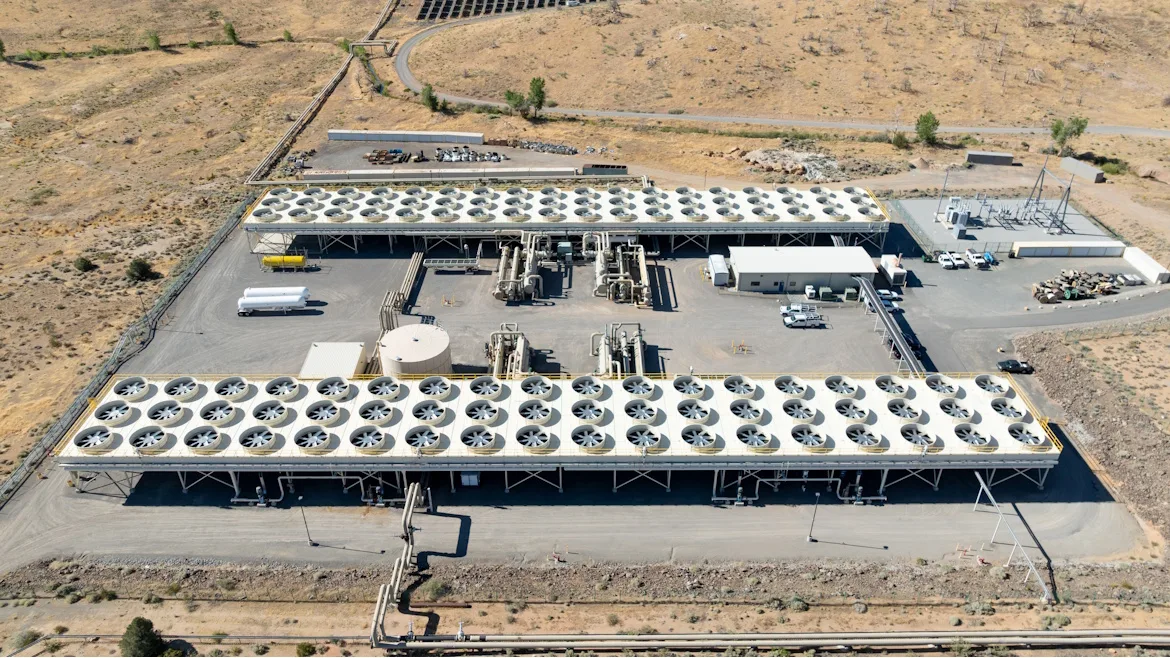
DATA CENTERS: Geothermal could play a key role in decarbonization when applied to data center cooling or power generation.
HVAC experts believe geothermal technology could be a solution to decarbonizing data centers while also providing opportunities for on-site power generation.
Data centers are big business for the HVAC industry and could require $6.7 trillion in global infrastructure investment by 2030, according to McKinsey & Company. But the impact of these centers on the environment and electrical grids is creating backlash.
According to the Department of Energy’s Geothermal Technologies Office, data center U.S. electricity consumption more than doubled from 1.9% in 2018 to 4.4% in 2023 and is projected to reach 12% by 2028. Communities in a growing number of regions are protesting them, and lawmakers are halting or banning their construction.
Enter geothermal. The DOE has said geothermal energy has the potential to add reliable power to the grid, including through enhanced geothermal systems and cold underground thermal energy storage. Last April, the DOE announced a $14 million project in Pennsylvania to support field tests of enhanced geothermal systems.
“What direct-use and geothermal heat pumps do is we use the energy we already own, the energy under the ground,” said Jack DiEnna, founder of the Geothermal National & International Initiative. “That’s all-American energy. We’re not burning anything.”
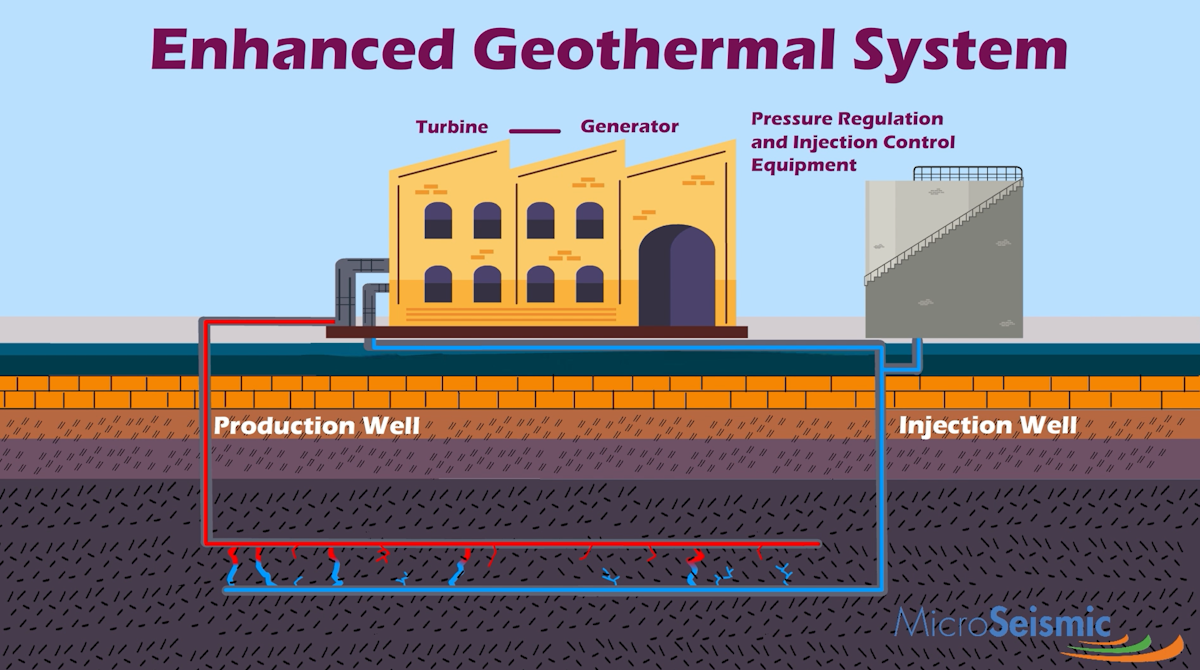
ENHANCED GEOTHERMAL SYSTEM: Technology like enhanced geothermal systems is demonstrating that man-made hydrothermal wells can help expand geothermal power generation. (Courtesy of World Geothermal Energy Day)
Meanwhile, recent bipartisan federal legislation, including the Geothermal Cost-Recovery Authority Act, aims to expedite geothermal projects without compromising community input or environmental protections.
A 2023 joint analysis by Oak Ridge National Laboratory and the National Renewable Energy Laboratory found that broad geothermal heat pump deployment across U.S. building stock could displace up to 7 gigatons of cumulative CO₂-equivalent emissions by 2050. That roughly equates to an entire year’s worth of greenhouse gas emissions by the United States.
Looking for quick answers on air conditioning, heating and refrigeration topics? Try Ask ACHR NEWS, our new smart AI search tool. Ask ACHR NEWS
Clearing Up Misconceptions
Before diving too deep into geothermal, there are a few misconceptions to clear up as it relates to data centers.
Joe Parsons, founder of Resonant Energy Strategies, said there is a mistaken belief that geothermal can’t handle data center heat rejection loads. While it can indeed handle it, he cautioned that it requires honest load analysis and properly sized borefields.
“Data centers are cooling-dominant by definition: nearly all the electricity they consume becomes waste heat that must be rejected continuously. That requires deliberate engineering, not assumed ground conductivity,” he said.
The other misconception is that geothermal is commonly discussed in terms of power generation.
Geothermal heat pumps are a thermal-efficiency technology — they move heat; they don’t generate electricity.
“Contractors who can make that distinction clearly will close more deals,” he said.
Mike Kapps, regional sales manager with Climate Control Group, said geothermal is applicable in multiple regions, not just areas where the ground temperature is constantly cold.
“I’ve done geothermal applications in the desert southwest … where the ground temperature was 85 degrees,” he said. “There are pure cooling applications [that] have been done with geothermal. I mean, you can do geothermal in the hottest parts of the world.”
Decarbonization of Data Centers
DiEnna said deep direct-use and geothermal systems don’t produce emissions, while geothermal heat pumps reduce energy usage by moving heat. Geothermal uses thermal energy from either the ground or the water to cool.
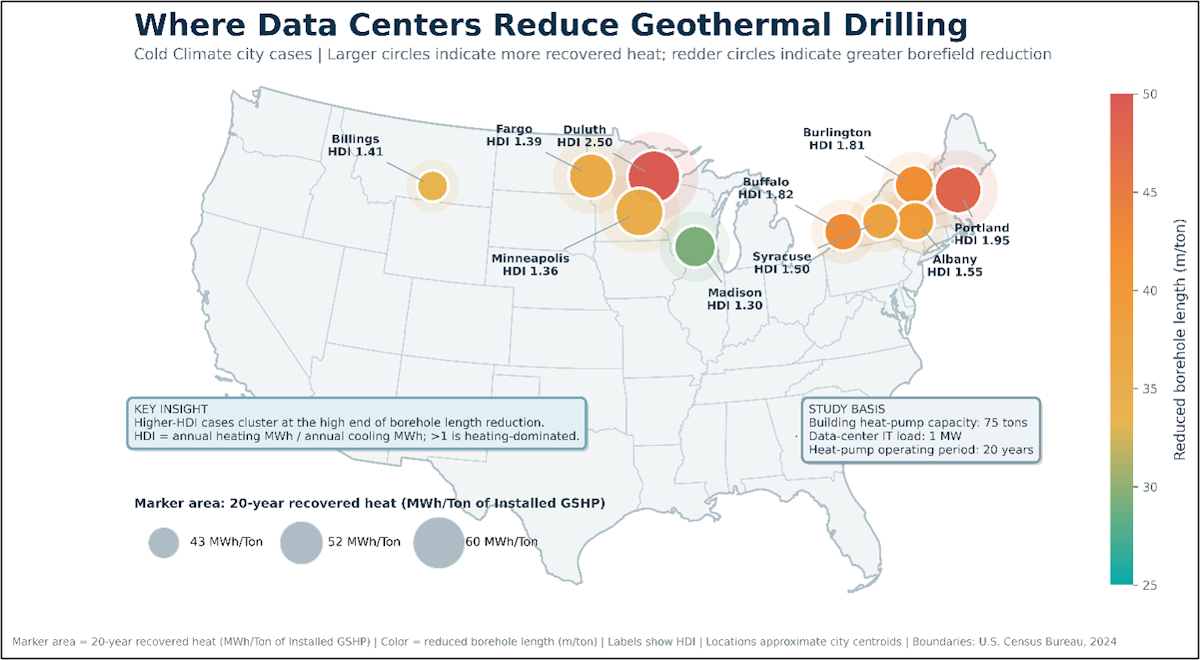
HEAT RECOVERY: Cold-climate cities show strong potential for heat recovery. (Courtesy of Trane Technologies)
Direct-use geothermal uses the energy already stored in the ground without combustion, while geothermal heat pumps use electricity to transfer heat more efficiently than conventional systems.
“It gives us energy stability and security … it gives us environmental stability because we’re not emitting any emissions. And the other thing is, it gives us economic stability because it creates jobs,” he said.
There are two primary ways geothermal energy can be applied to data centers: direct-use power generation and cooling.
On-Site Power. Instead of relying on electrical grids, there has been talk of developing on-site power generation for data centers. Among the sources discussed is geothermal.
If geothermal power generation is used for a data center, it would reduce strain on the grid, but it’s very regional, said Kapps.
“It’s probably not a practical application for 100% cooling of 100 megawatts in a small, dense area,” he said.
Enhanced geothermal systems are a power generation technology that delivers 24/7 electricity, using new drilling technology developed for oil and natural gas production. The U.S. Geological Survey estimates that 135 gigawatts of potential electric power generation is available from these systems in the Great Basin of the U.S. Southwest alone.
Geothermal Heating and Cooling. Cold underground thermal energy storage can be used for cooling purposes. Chilled water stored in the subsurface and is dispatched during peak demand.
DiEnna said large data centers are reported to use billions of gallons of water annually, about the same as a 50,000-person city. Most are built on large expanses of land. By developing large, subsurface water storage on the premises, geothermal can be used for cooling the system via a “lake loop.”
Additionally, the heat generated by data centers can be used via geothermal technology. It can heat surrounding houses or pipe it to operations requiring processed heating.
As an example, Kapp said if a data center were near a hospital or another facility requiring hot water demand, that would create a system where all the heat rejection is essentially free hot water.
Ground-source heat pumps routinely achieve COPs of 4 to 5, meaning they deliver four to five units of thermal energy delivered for every unit of electricity consumed, said Parsons.
“At that efficiency, even a grid with meaningful carbon content produces dramatically lower lifecycle emissions than combustion-based systems,” he said.
Overall, Kapps said geothermal applications for data centers are currently in a place where a more supplemental approach is more feasible than full geothermal systems.
“It is feasible for maybe as part of it and more of a hybrid application, but you can’t reject heat 24/7 into the ground for years and not expect to have thermal saturation,” he said.
Overcoming Drawbacks
There are limitations the industry must manage and overcome if geothermal energy is to gain traction.
Geothermal projects are slow to develop, taking about five to 10 years, said Kapp, due to permitting and proper engineering. High upfront costs are a limiting factor, though the One Big Beautiful Bill does include a provision for third-party ownership of ground loops, which can include data centers.
That creates a system where interested parties can own those loops.
“Geothermal for HVAC is capital-intensive. That’s why there’s the federal tax credit. There’s a lot of local tax credits,” said Kapps. “But I don’t see how it would cover the entire thing. There could be feasibility done depending on the size of the data center.”
Geography plays a role as well. Underground heat exists nearly everywhere, but many locations lack adequate water or the conditions needed to facilitate the fluid flow required for recovering heat energy.
Technological advances could help bridge these gaps. Geothermal heat pumps can be used nearly anywhere, and EGS creates human-made underground reservoirs to generate that heat for energy. NREL’s enhanced geothermal shot analysis projects a 90% reduction in EGS drilling costs through 2035 via automation and improved bit technology.
John Zhao, senior modeling and simulation engineer, Trane Technologies, said locations with stronger heating demand generally experience greater geothermal benefits from data center heat recovery.
“The trend suggests that the value of recovered data-center heat increases as heating loads become more dominant,” Zhao said. “In other words, in colder climates, the waste heat becomes more meaningful. This finding may be particularly relevant as data center development expands into regions with abundant land, lower electricity costs, and growing demand for resilient energy infrastructure.”
Research and development are taking place that would combine different portions of geothermal technology for data center usage.
“I think the industry needs a couple of good examples, a couple of successful projects where somebody’s done it, and more conversation,” Kapps said. “My experience has been the more you educate people, you make them more comfortable, the more willing they are to use the application.”
Data center operators also measure projects based on lifecycle cost, internal rate of return, and investment tax credit monetization, so learning those metrics may slow down industry involvement.
“Contractors who can only quote equipment and labor will struggle in that sales process. The technical barrier is real, but the financial fluency gap may be the bigger obstacle,” said Parsons.
Contractor Involvement
Installation is the most immediate entry point for contractors. Established geothermal shops have a leg up over general HVAC companies.
“The contractors most likely to capture this market are those already displaced from the residential sector after the One Big Beautiful Bill Act eliminated Section 25D credits; they have the borefield competency and need a new channel,” said Parsons.
None of this can happen unless there’s an HVAC workforce ready to install and maintain these geothermal systems. However, it’s not as simple as buying geothermal equipment and taking bids.
Geothermal heat pump installation, for instance, requires verified competency that general HVAC licensing doesn’t cover. Commercial borefield work adds drilling to the mix, which most HVAC contractors have never encountered.
“Keep abreast of what’s going on … getting the training, preparing yourself for what’s coming,” DiEnna said. “You want to be proactive, not reactive.”
The other main point of entry is geothermal as a service. As mentioned, the One Big Beautiful Bill removed roadblocks from contractors being able to own and lease systems in buildings they don’t own. This opens up recurring revenue opportunities.
“How do you differentiate yourself? Educate yourself on that. Be the geothermal champion,” Kapps said.
Looking for a reprint of this article?
From high-res PDFs to custom plaques, order your copy today!