Breaking Into Data Centers: What HVACR Contractors Need to Know
AI-driven data center growth is creating major opportunities for HVACR contractors
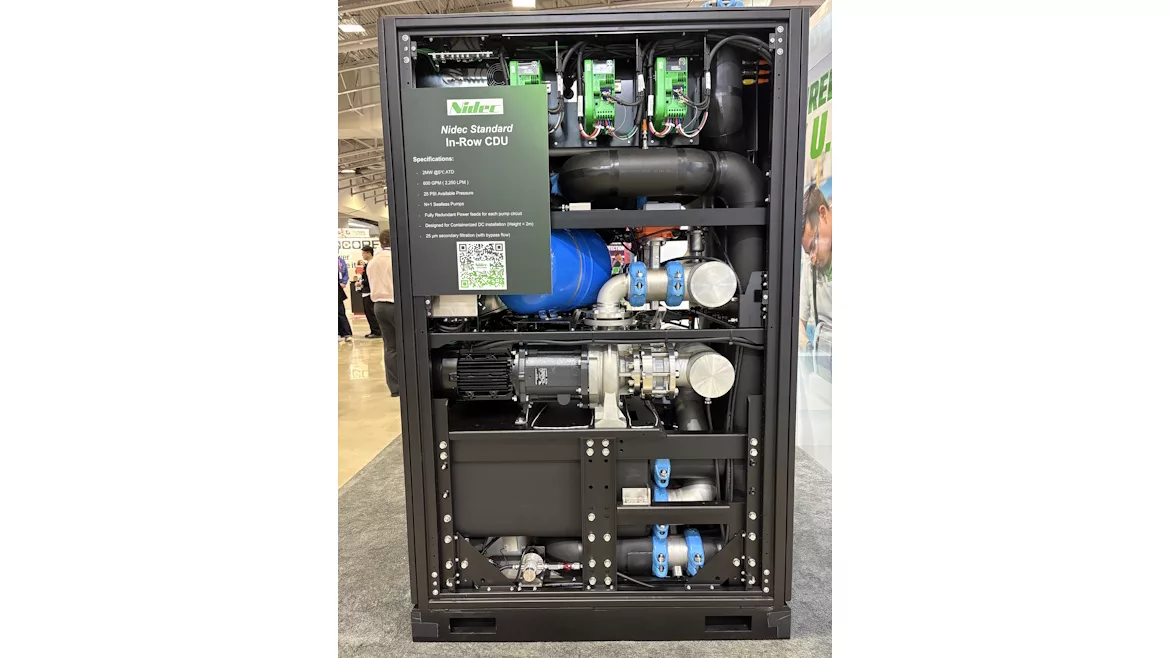
DRIVE: Coolant Distribution Units (CDUs) include motors, drives, and other components to keep server equipment cool.
Data centers have quickly moved to the forefront of the HVACR industry, becoming one of its biggest revenue opportunities. This is driven largely by the continued expansion of artificial intelligence, cloud computing, and digital infrastructure. But while this market is gaining attention from contractors, it’s not the easiest to break into, and doing so requires a very different mindset than traditional commercial HVAC work.
For starters, unlike office buildings, schools, or retail applications, data centers operate on a 24/7 basis — demanding continuous operation, tighter environmental control, and faster response times. That means both technical expectations rise, as well as the financial stakes for contractors toying with the idea of entering this market.
Why Data Centers Are Different
Before contractors can break into this viable market, there’s one thing they have to understand right from the get-go: Data center work is fundamentally different than traditional commercial HVAC applications.
“The separation is the risk profile for data center installations,” said Alex Khor, business development manager, data centers, at Danfoss Climate Solutions. “If any part of the system fails, it could be a catastrophic financial event, while in traditional commercial projects it would likely be an inconvenience.”
One major difference is operational demand. Data centers work around the clock, placing a far greater demand on HVAC systems and the cooling infrastructure in place.
“Traditional commercial projects generally require forced air HVAC systems to heat, cool, and ventilate the facility, whereas data centers have that requirement plus the additional need to cool the server equipment around the clock, seven days a week,” said Mark Gaskill, senior market manager, Nidec/U.S. MOTORS.
That constant operation means precision becomes a critical component. Fluctuations in temperature, humidity, or airflow can directly impact sensitive server equipment, making reliability another priority.
Looking for quick answers on air conditioning, heating and refrigeration topics? Try Ask ACHR NEWS, our new smart AI search tool. Ask ACHR NEWS
“In data centers, more precision of air flow, temperature, and humidity is required, as variations can drastically impact the performance of the server equipment,” Gaskill said.
According to Gaskill, cooling infrastructure inside data centers also differs significantly from conventional commercial buildings. Data centers often rely on computer room air handlers (CRAHs), coolant distribution units (CDUs), primary loop pumping systems, variable frequency drives (VFDs), and redundant backup equipment designed to minimize downtime risk.
“The need for reliable motors and drives cannot be overstated,” said Gaskill. “Downtime at data centers has been estimated to cost an average of $9,000 per minute. Because the motor is the heart of the system, it needs to be energy efficient and backed by an experienced manufacturer.”
Gaskill added that contractors should carefully vet replacement equipment and avoid focusing only on low-cost options.
“We’re noticing an increase in low-cost motors from brands we’ve never heard of, with no track record of reliability or performance, so we urge contractors to do their due diligence when selecting replacement motors,” Gaskill said.
Space constraints are also becoming increasingly important inside data centers — creating demand for smaller, higher-efficiency equipment that can handle greater loads within tighter footprints. Meaning that those contractors who can provide flexibility on equipment size will stay ahead of the game.
Where Contractors Can Get Their Foot In The Door
Though the market can be complex, there are multiple entry points for contractors trying to establish themselves in the data center space. Yet success typically hinges on building technical expertise before pursuing projects as such.
According to Peter Fung, director of sales for Addison, contractors interested in data center work need technicians who can handle a broad range of HVAC systems and controls.
“Multi-skilled start-up, service, and commissioning technicians qualified on all types of HVAC equipment, chilled water, DX, controls, valves, etc.,” said Fung.
Ross Miglio, chief growth officer for Madison Air, the parent company of Addison, said service work, commissioning, and new construction are some of the most common entry points for contractors.
But, as with most things in HVACR, technical knowledge alone is not enough. Contractors need to understand data centers at all levels — from deployment, to testing, to integration.
Khor said contractors should become familiar with deployment phases ranging from factory witness testing to integrated systems testing, often referred to as levels one through five. He also recommended that technicians pursue certified data center technician training offered through OEMs and recognized institutions.
For contractors looking to gain traction in the market, being a jack of all data center trades — and offering multiple capabilities — can give them a leg up.
“Being able to offer service and maintenance alongside commissioning,” said Khor. “Having a large field service team dedicated to ensuring prompt emergency response.”
Responsiveness is also key because many large hyperscale operators already maintain long-term service agreements with established contractors, creating difficulty when trying to enter the market.
“Contractors who can demonstrate advanced knowledge of the specific needs of data centers, including the best technologies to reduce energy costs and ensure reliability, will always have an advantage over others,” said Gaskill.
Contractors should also be wary of overextending themselves too early. Fung said one of the biggest mistakes contractors make is “overpromising on what and when they can deliver,” along with “underestimating the scale and pace.”
His advice instead is “Under-promise and over-deliver, forward thinking/planning to handle scale/ramp-up.”
Partnerships For The Win
The relationships contractors build also play a major role in winning and maintaining data center work. Partnerships with OEMs, engineers, and data center operators can help contractors establish credibility while also positioning themselves for future expansion opportunities
“Partnerships are key, as they simplify and quicken the speed of deployment of data center buildouts,” said Khor.
These partnerships become increasingly valuable as operators scale their operations and expand into multiple regions and replicate facility designs across different locations.
“As data centers grow and expand to different geographical areas, they often repeat the designs and have identical HVAC needs throughout different facilities in different locations,” said Gaskill. “A national contracting firm with a local presence is a plus for data centers.”
But these relationships don’t just happen overnight. They take time and effort and are earned through performance, not just low bids or aggressive sales efforts.
“Strong relationships are established after proof of quality and on time, once scheduled projects are delivered,” said Fung. “Trust is built through demonstrated performance to critical timeframes.”
Challenges To Prepare For
Adding another layer of complexity for contractors is the fact that data center cooling technologies are evolving rapidly.
“The trend is toward liquid cooling of server rooms using CDUs, rather than forced-air cooling,” said Gaskill. “The latter requires keeping the rooms at 50°F, 24 hours a day, seven days a week.
Using CDUs places less demand on the facility’s HVAC system. CDUs are necessary because you cannot efficiently blow enough cold air across a server to remove the heat that is being generated.”
Miglio agreed, noting that the growing use of AI is shifting expertise to chillers, dry coolers, and CDU systems, while reducing reliance on traditional CRAH and CRAC units.
Khor said that cooling technologies are moving towards a hybrid approach of liquid and air.
“Contractors should have robust processes to detect leaks, check cleanliness levels, and ensure that everything has been installed to specification,” said Khor.
Looking for a reprint of this article?
From high-res PDFs to custom plaques, order your copy today!