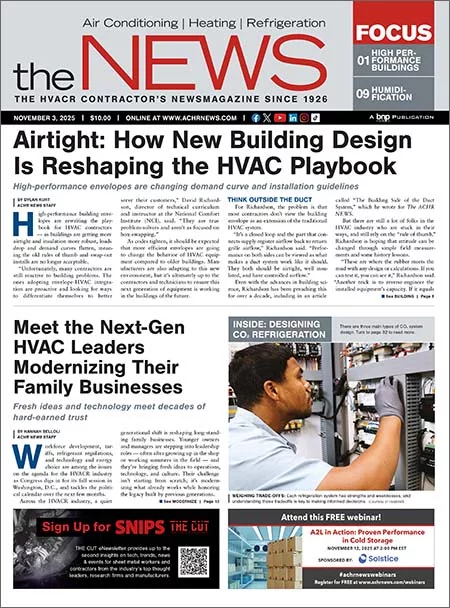
How Contractors Are Weighing Ownership Decisions
Timing, culture, and long-term vision are shaping ownership paths
.webp?t=1776094112)
HARD CHOICES: The decision to sell or not sell is a deeply personal one, Chris Hoffmann said.
Over the last few years, ownership transitions have become a familiar part of HVAC. Increased interest from investors, strong company valuations, and an aging workforce have pushed many business owners to take a closer look at succession planning.
For some contractors, that means remaining independent. For others, it may involve restructuring ownership or pursuing a business buyout. Either way, what’s driving these conversations isn’t just a single factor. It’s a convergence of market opportunity, personal timing, and responsibility — to employees, customers, and communities.
As contractors evaluate their options, the decision often comes down less to whether a transaction is available, and more to whether it aligns with their long-term goals, values, and vision for the business.
Selling: When It Makes Sense — And What It Really Looks Like
Ray Isaac understands the emotional and practical weight of ownership decisions firsthand. Five years ago, Isaac and his three brothers sold their 80-year-old family HVAC company in Rochester, New York. Today, Isaac is executive vice president of industry relations at Northwinds Services Group, formerly Isaac Holdings — a company he helped build and later transitioned through a business buyout.

FIELD TRIP: The team at the independently owned Hoffman Brothers. (Courtesy of Hoffmann Brothers)
The decision wasn’t made lightly. While the business was performing well, Isaac said timing played a significant role. The brothers were older, valuations were strong, and the HVAC industry, while resilient, carried increasing risk.
“Also the liability factor — you build something to almost $70 million and in an instant — my dad used to joke of getting tired of stupid people doing stupid stuff and having to pay for it — it’s one of those things where you have all of this liability and if somebody makes a mistake, all of a sudden your life’s work is on the line,” Isaac said. “We were always afraid of that 800-pound gorilla coming in and eating into our market share, even at the size and scale that we were.”
In 2020, Isaac began quietly exploring options, speaking with multiple parties, and educating himself on potential paths forward. He’d heard horror stories of people who had sold their business, and the buyer ended up selling it for parts, so he pursued other avenues.
Looking for quick answers on air conditioning, heating and refrigeration topics? Try Ask ACHR NEWS, our new smart AI search tool. Ask ACHR NEWS
“My brothers didn't even know that I was looking, and I was president and CEO, so I figured I'd at least get some options for them,” Isaac said.
The brothers shared a “gentleman’s agreement” — if one exited, the others would follow. Once they were on board, they came up with a list of non-negotiables. They wanted to protect employees, preserve the company’s legacy, and maintain involvement beyond the transaction.
“Ironically, private equity was probably the last option on my list,” Isaac said. “But it became the most lucrative and the only option that was really able to accomplish all of our goals. … You got to look at what I call my triple bottom line — my team, my clients, and my community.”
Ultimately, Isaac said TruArc Partners aligned with those priorities. The brothers rolled equity into the new holding company, remained involved, and created opportunities for long-term employees to do the same.
“So we’re investors, and some of our employees are investors, as goes with the other partners we’ve purchased since we sold,” Isaac said. “We are the platform. … We wanted to make sure that we're still able to support the charities that we support, and make sure that the Isaac name would continue — that our brand, our logo, our legacy still continue — that we weren't going to get rebranded.”
The Tradeoffs Of Staying Independent
For every contractor exploring a sale, others are intentionally choosing not to — even as offers pile up.
Remaining independently owned can be a strategic decision. One such contractor is Chris Hoffmann, CEO of Hoffmann Brothers, serving St. Louis and Nashville, Tennessee.
“Financially, we’re fortunate to operate a healthy, growing business that allows us to reinvest thoughtfully and plan for the long term without external pressure,” Hoffmann said. “Operationally, independence gives us the freedom to make decisions based on what’s best for our customers, our team, and our reputation — not just what optimizes near-term financial metrics.”
On a more personal level, Hoffmann said ownership is deeply tied to identity and responsibility. The culture they’ve built, how they treat people, and the trust they’ve earned isn’t an accident.
Still, Hoffmann Brothers does receive several inbound inquiries each week from potential buyers, and Hoffmann said he regularly engages in conversations with the more reputable firms — not necessarily with the intent to sell, but to understand what’s happening in the market, what structures are evolving, and how others in the industry are thinking about growth.
“Private equity itself isn’t inherently good or bad,” he said. “Just like with independently owned or family-owned businesses, outcomes are determined by the quality of the leaders involved. That said, private equity often earns a negative reputation for a reason. Short-term thinking ahead of a transaction, prioritizing profits at all costs, trading long-term brand equity for short-term financial gains, and treating people with cold indifference are real concerns — and they’re not uncommon.”
While independence remains the right fit for some contractors, others have explored alternative ownership structures that prioritize long-term stewardship without a traditional business buyout. For Adam Smith, chief operating officer at HB Mechanical Group, employee ownership emerged not as a financial maneuver, but as a practical and cultural solution to succession.
“We attempt to place decision-making for the businesses we own and operate as close to where the work happens as possible,” Smith said. “An ownership culture is a big part of what we are trying to accomplish, and we are approaching the business with a generational view. In other words, we are making decisions based on the long run versus making a quarterly number.”
What The Decision Comes Down To
As contractors weigh different ownership paths, the decision often comes down to a series of tensions rather than a simple yes-or-no calculation — speed versus control; liquidity versus legacy; growth timelines versus cultural timelines.
Hoffman said outside investors can bring in capital, expertise, and acceleration, but they also introduce new priorities.
“Leadership control often shifts, planning horizons compress, and cultural decisions may be influenced by financial timelines,” Hoffmann said. “None of these paths are inherently right or wrong, but they are meaningfully different. Clarity around how each model impacts people, planning, and authority is essential before making a decision.”
Patrick Lange, president of Business Modification Group, said a misconception contractors have is assuming there’s only one way to structure an ownership transition.
“Every deal is unique, and if they have built a good business, there will be a lot of buyer interest, so what may not work for some buyers may work for others,” Lange said.
That flexibility becomes especially important as long-term “buy and hold” investment approaches gain attention in the industry.
“Many of the previous ‘financial buyers’ have very strict timelines of when their investors expect their money back, so as a result, they are often not in a position to buy and hold,” Lange said. “They are interested in growth and maximizing profit quickly, so they can sell their investment at a profit. With a longer-term approach, a buyer is not forced to be making a decision regarding short-term profitability but rather what is better for the business long term. This typically leads to more stability, and a more consistent experience for not just the employees but the customers as well.”
Ultimately, the right decision depends on what the owner values most.
“A buyout or partnership can provide liquidity, risk diversification, and scale, which may be the right outcome for some owners at a certain stage of life,” Hoffmann said. “Independence, on the other hand, offers autonomy, cultural continuity, and the ability to prioritize long-term stewardship over short-term results.”
What Separates A Good Deal From A Regret
Whether a contractor stays independent or pursues a business buyout, preparation plays a defining role in the outcome. Lange said owners should begin by clarifying their personal and financial goals.
“What they need to get out of the sale financially to achieve their goals, understanding what their business is really worth in today’s market, and understanding what they want the transaction to look like,” Lange said. “Do they want to sell and walk right away, or remain in the company?”
But numbers alone aren’t enough. Contractors also need to evaluate the people behind the deal and ask the right questions.
“When professional buyers are talking with sellers, they are on their best behavior and are trying to put a deal together,” Lange said. “I am not saying they will be dishonest (although some might), but they are not going to say something that they feel will mess up the deal. Owners who have already sold to that buyer would be a good to talk to.”
Isaac experienced that reality firsthand. In a final meeting with a company he nearly partnered with, one answer raised a red flag he couldn’t ignore.
“I have a saying that whenever somebody begins an answer with ‘well’ or ends it with ‘but,’ just forget everything else they say,” Isaac said.
So that was the end of that.
Hoffmann said the right advisors can help contractors avoid similar missteps.
“Take the time to gain clarity on what truly matters to you beyond price,” Hoffmann said. “Ask for references, speak with other operators who have partnered with the same investors, and surround yourself with strong legal and tax counsel. Good advisors don’t just help you close a deal — they help you avoid the wrong one.”
Looking for a reprint of this article?
From high-res PDFs to custom plaques, order your copy today!



.webp?height=200&t=1709822120&width=200 "presentation at MEP Innovation 2024")