How contractors are using mixed reality to improve construction and communication
ES Magazine sits down Jared Redelman, VDC and project controls team leader at Bowen Engineering, to discuss his recent presentation at MEP Innovation 2024
VDC and Project Controls Team Leader at Bowen Engineering, Jared Redelman, recently presented on mixed reality at MEP Innovation 2024 – a conference where building professionals convene to discuss innovations in design among mechanical, electrical, plumbing, service, and sheet metal contractors.
He recently sat down with ES Magazine to discuss his talk and how Bowen Engineering is using mixed reality headsets to adjust design parameters and communicate with owners in the pre-construction process.
Could you just describe how you’ve used mixed reality and what you mean by it?
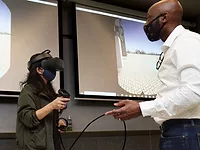
Mixed reality is the technology of being able to project a 3D image in the space you're standing in through a headset, so we use both Microsoft HoloLens and the Magic Leap in terms of hardware, and Bowen uses mixed reality just to get a better understanding through the design and construction process of the work that we have to put in place. Practically speaking, we've done a lot of design review, meetings, using mixed reality technology. And we involve our engineering partners and our owners in that process, and it gives everyone a much clearer understanding of what the design is and ultimately what the finished product will look like after construction is complete.
The new piece to this story is the Apple Vision Pro VR headset. Have you used that yet?
We're not using that for a couple of factors. One, the mixed reality devices that we have currently are what I refer to as pass-through technology, you can see your environment just with your own eyes, through a clear lens. You're not fully enclosed in a VR device and relying on cameras to view your surroundings, so you have a better peripheral vision. And our main reason for that is just for safety reasons. On an active construction site, we want the most awareness possible for the user that's using the technology, just so they have a true understanding of their surroundings and what risks they might encounter as they're walking around an active construction site.
I personally have not had one of the Apple devices on, but from my understanding, Apple has, in a good way, tailored the experience to the user to get the best experience a user can get, but they are somewhat customized to each user in terms of fitting to your face and adjusting to your eyes. And we share these devices a lot amongst people, in passing it from one to the next. If you have to go through a timely calibration process, or whatever that looks like, it may not be feasible for the Apple Vision Pro to be passed from person to person. That's yet to be seen. I mean, they've only been on the market for I think just a few days but, yes, I am curious about it. Curious to see where it goes. I have no concern. Apple made a phenomenal product. I think it’s just, how it's going to be implemented into the industry is to be determined.
Could you describe how a product like this being released to consumers compared to being used by business and being adopted by businesses?
That's kind of a big tipping point with some of this technology. I consider it, from a business standpoint, a fairly low cost of entry. Anywhere from $3-6,000 range for the hardware. That’s an expensive laptop or computer, something that's fairly common from a price point for businesses to invest in technology. From the personal application, I'm sure there's some market, I just don't know how much market there is for people to buy a $3-5,000 device for pleasure. The concern I have, is if the industry doesn't adopt this technology and really get companies invested in buying more, there may not be the appeal for producers and manufacturers to continue making those devices.
Can you describe the reception of owners and some of these other users of it on the job site and maybe what it's helped inform them of?
I've implemented a few technology workflows internally to our company. And I feel like this mixed reality technology is one of the quickest adoptions I've experienced. Because it's pretty quick and simple to pull up a model, to pull up those 3D images on a job site, and it's easy to pass the technology off to other users once things are set up and in place, and to scale. And once you put the technology on a new user, it's like the buy-in is immediate. They immediately see what's there in front of them, and they can interact with it. They can walk through it, and truly understand what they're seeing. In no other way. You can look at models on a computer screen, on the TV monitor, and they look great. They always look great, but what you're missing is that full-scale reality of what it's going to look like when you're walking through the space. You never see that on a computer screen. And for people to be able to stand there and act like they're going to grab something physically, that's floating in the air in front of them, it's that interaction with the technology that you can get only through the mixed reality technology.
What's the extra workload involved in modeling or scaling the model for real life?
It's pretty quick and painless for projects that are already being designed in 3D. I've seen a lot more engineering firms move that direction in the industry over the last number of years. At Bowen, we still have projects quite a few projects that are designed just in 2D and we’re issued 2D documents. We do have a team of VDC engineers that produce some models on some projects, but not all. But for any job that has a model, we will typically use this technology, go out to the site and walk the site in some capacity. It's pretty quick and easy to do and very much worthwhile in our experience.
Photography is still a big part of the construction process, like it or not, and I think it always will be. I mean, it's a different purpose. It's a different function. Tons of pictures are taken every day that will never be touched or looked at again, which is fine. But I think the mixed reality technologies is kind of a different focal point. It's more for, understanding what's to come or what's to be built that may not be there yet. We have also used it for like a QA/QC check to verify existing construction has been put in place according to the model, according to the plan. And we've caught some stuff here and there doing those functions as well. But our primary purpose, so far, has been much more on the pre-construction side and upfront planning.
Does this help facilitate communication between the different specialized trades? Maybe prevent them from potentially making a mistake that requires somebody else to go back and undo some of the work of another trade?
Absolutely. Bowen self performs a large majority of the work we put in place. So we don't have the specialty trade contractors that many general contractors do. But I do think implementing this technology, if you are that general contractor who hires out a majority of your work to subcontractors, implementing this technology with your subcontractors involvement and buy in, I do think would be huge for everyone involved.
Watch the video above to hear an example of Bowen Engineering using mixed reality to communicate with a water treatment plant customer ahead of construction, resulting in the customer requesting changes in pipe valve location that make operations run smoother and the workplace safer.
Listen to the full interview in the podcast below.
Looking for a reprint of this article?
From high-res PDFs to custom plaques, order your copy today!