Construction Management Researchers Use Virtual Reality to Improve Industry Knowledge Transfer
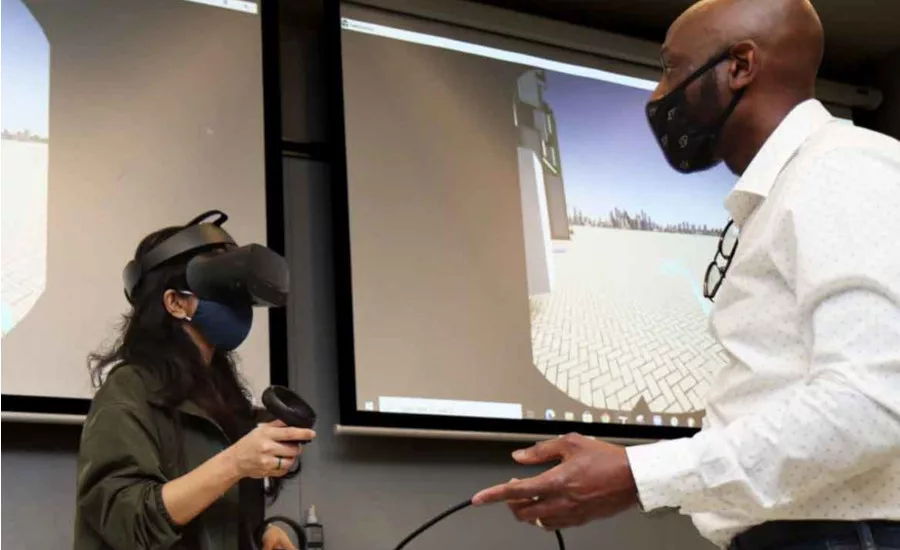
Virtual reality could help make engineering education more efficient.
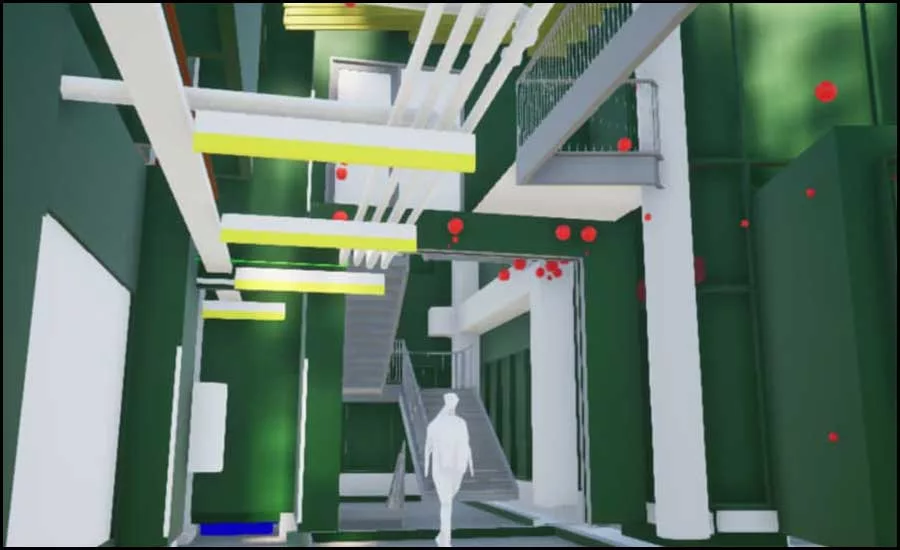
Virtual reality (VR) technology could help trainees more efficiently learn useful techniques and skills from senior industry professionals. This scene depicts a corridor in Purdue’s Engineering & Polytechnic Gateway Complex, which is under construction and expected to open for students in January 2023. Wearing VR goggles, a student can look in any direction or “walk” through the virtual 3D scene, an immersion not possible using traditional blueprints. Image courtesy of Ramyani Sengupta
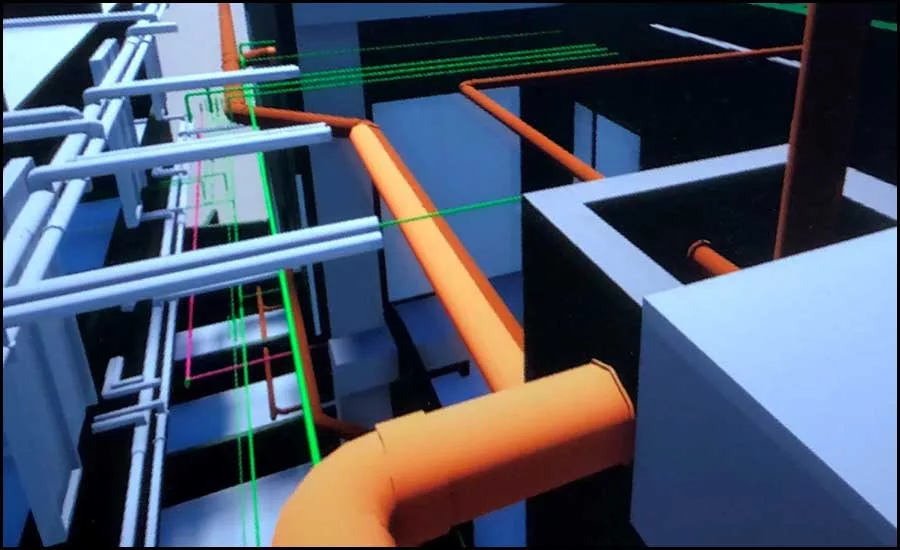
VR technology can help construction industry professionals see the routing of mechanical and electrical systems in 3D inside the walls of a structure. Image courtesy Ramyani Sengupta
With construction spending on the rise and skyrocketing demand for sustainable energy and other new technologies in building projects, jobs are plentiful in the construction industry. However, the existing workforce is aging, open positions remain unfilled, and new workers who replace retirees are sometimes perceived by experienced professionals as lacking the necessary experience and skill.
A professor in Purdue University’s Polytechnic Institute is researching using virtual reality (VR) to modernize the construction industry’s traditional ways of transferring knowledge to next-generation professionals.
“It’s about building a better workforce,” said Anthony Sparkling, assistant professor of construction management technology. “With newer processes, practices, and systems, we hope to help companies develop their people more efficiently.”
Before earning a master’s degree in construction management and a Ph.D in planning, design, and construction at Michigan State University, Sparkling spent more than 20 years working in industry, first as an electrician apprentice and later as a project foreman, superintendent, and other positions in management. Sparkling’s long experience helped him recognize challenges the construction industry faces in creating the workforce it will need for the next several decades.
Explicit vs. Tacit
Sparkling said the industry struggles between successfully imparting two kinds of knowledge to new workers. People who want to work in the industry’s various skilled trades often receive classroom training from an instructor, learning from explicit knowledge — techniques and skills that are codified, written down, and/or recorded in books, videos, or other media. Subsequent (or simultaneous) hands-on training at construction sites, under the guidance of mentors, helps develop each person’s skills.
Throughout years of on-the-job training — from early days as apprentices to earning journeyman status and eventually to being acknowledged as masters of the craft — repeated observation, imitation, and practice helps workers develop deeply ingrained habits and skills. This experience becomes tacit knowledge and is difficult for masters of a craft to convey to apprentices.
“Technologies like virtual reality could help the industry find the right blend of traditional and modern training techniques,” Sparkling said. “Compared to explicit knowledge, the tacit dimension is relatively unexplored in the construction industry. We’re trying to help potential retirees convey what is second nature to them through virtual reality experiences, to educate new professionals, and transfer that knowledge from one generation to another. It can take 20 years to be recognized as an expert in the field, so we’re trying to shorten that timeline.”
Construction professionals become acclimated over time with converting 2D drawings of mechanical and electrical systems, for example, to built systems in the real (3D) world. Ramyani Sengupta, a graduate research assistant in the Polytechnic’s School of Construction Management Technology, is working with Sparkling on the research, transforming construction drawings from 2D plans into 3D virtual reality scenes and comparing how students learn using both kinds of tools.
“We measure how people perceive things differently,” said Sengupta. “Do trainees need less time to learn a new skill through an immersive, three-dimensional experience versus reading about it or seeing it in ordinary slides? Virtual reality could help make their learning more efficient.”
Additionally, increased use of virtual reality could help decrease the use of real-world resources like metal and wood.
“Organizations like the National Electrical Contractors Association [NECA] are really interested in this,” Sparkling said. “NECA’s research foundation is looking for better tools for training newer people. Traditionally, students train using real products such as electrical metallic tubing [EMT or conduit] that generate waste in the field. A VR training module could prevent those materials from being consumed.”
Sengupta earned a bachelor’s degree in construction and civil engineering at Jadavpur University and a master’s degree at Johns Hopkins University. She hopes to continue researching the use of virtual reality in construction management education after completing her doctoral studies in Purdue Polytechnic.
“We were conducting VR sessions with students, and I saw how they reacted to it,” Sengupta said. “Compared to just sitting in regular classes, they reacted very differently. It clearly improves education, and there’s a lot of room to expand the use of this technology in the construction industry.”
Looking for a reprint of this article?
From high-res PDFs to custom plaques, order your copy today!


.webp?height=200&t=1709822120&width=200 "presentation at MEP Innovation 2024")