1936: A Refrigeration World Tour
Reports on a burgeoning industry included names now left to history
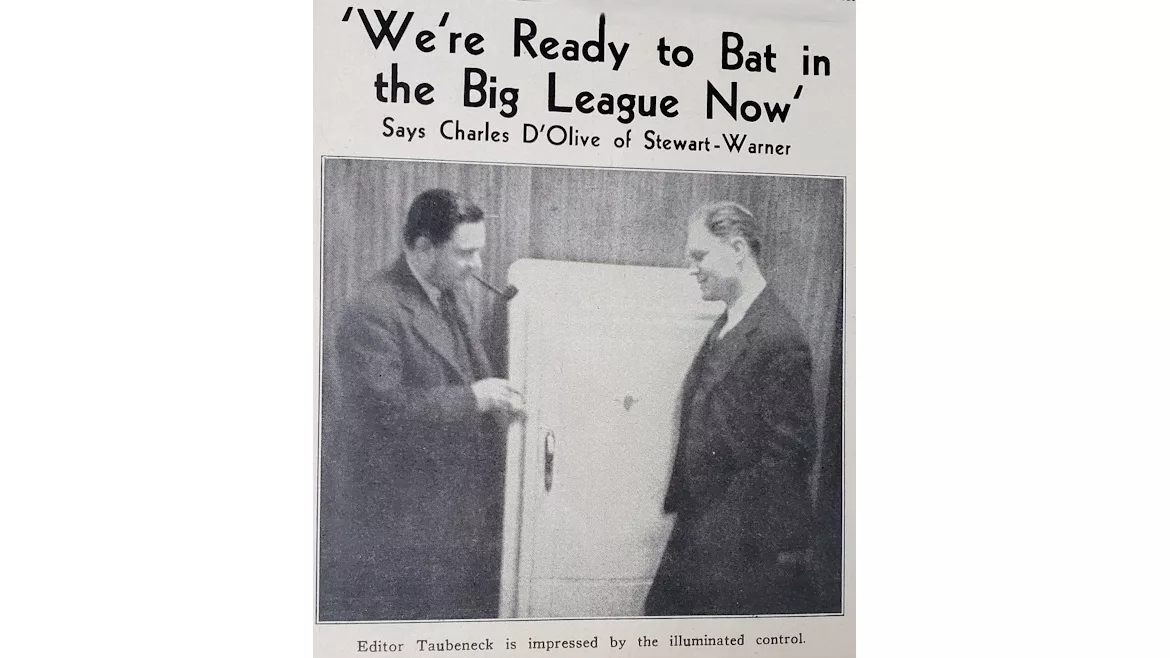
NEW TECHNOLOGY: Industry journalist George F. Taubeneck, right, checks out a Stewart-Warner refrigerator in January 1936 with company executive Charles d’Olive. Taubeneck reported being impressed with the model’s illuminated control feature. D’Olive had been a U.S. aviator during World War I. He was credited with five victories and later recognized as an ace.
The cooling technology of the 1930s was the AI of its day — developing rapidly, generating great public interest, and on the verge of widespread adoption. The companies behind that technology, like Copeland, Kelvinator, Frigidaire, and Stewart-Warner, were the tech giants of the era.
George F. Taubeneck was there to document it all.
Taubeneck, who hailed from the small town of Marshall in Southeastern Illinois, was recruited in 1930, just after graduating from the University of Illinois, to be an assistant editor at Electric Refrigeration News (the forerunner of The ACHR NEWS) in Detroit, Michigan. An uncle, F.M. Cockrell, founded the magazine in 1926.
Taubeneck soon became the top editor, traveling widely to represent the magazine and the industry — even circling the globe during a six-month grand tour — writing colorful, must-read columns, and helping lead the company through periods of growth and change over more than 40 years.
“He traveled quite a bit, and he was an ambassador to businesses that were loyal subscribers,” said his son, Greg Taubeneck, of Wilmette, Illinois.
For all that travel, though, he didn’t always have to go far to find the story. Some of the biggest names in refrigeration manufacturing were right in his backyard.
Detroit, best known 90 years ago for automobile manufacturing, was in the 1930s also a major node in an expanding U.S. refrigeration manufacturing base that was located largely in the Midwest. Kelvinator Corp. made household refrigerators in the city, the compressor company Copeland Products Inc. was founded there (and later moved to Sidney, Ohio), and Frigidaire Corp., owned by General Motors Corp., was at one point headquartered in Detroit.
Looking for quick answers on air conditioning, heating and refrigeration topics? Try Ask ACHR NEWS, our new smart AI search tool. Ask ACHR NEWS
Frigidaires were in the 1930s made near Dayton, Ohio, and Crosley Corp., better known at the time for making radios, made refrigerators in Cincinnati. The Sparks-Withington Co. made Sparton brand refrigerators in Jackson, Michigan, and Stewart-Warner Corp. and Fairbanks, Morse & Co. made refrigerators in Chicago. Borg-Warner Corp. (no connection to Stewart-Warner), headquartered in Detroit, manufactured Norge refrigerators in Fort Wayne, Indiana.
Household refrigerators, though they had been around for a few years, were still uncommon in the early 1930s, and reports in Electric Refrigeration News excitedly reported how many units had been sold in various cities and quoted experts’ predictions about future sales.
A 1933 article in The Cincinnati Enquirer raved about Crosley’s Shelvador feature, a storage space in a recessed door panel of a Crosley refrigerator. The author suggested the Shelvador was for storing “eggs, butter, bacon, lemons, oranges” and other small items.
“Instead of searching, reaching and groping through cluttered-up shelves in the refrigerator for these articles, the housewife merely opens the door of her Crosley refrigerator and there they are — right at her finger tips, in neat rows on the shelves,” the article said.
George Taubeneck was the authority on the refrigeration beat. With lively prose and colorful anecdotes, he wrote about the industry and the “refrigeration men” who led it. His friends included E. Cloud Wampler of Carrier, who became chairman and led the company through the expansion of the air-conditioning industry, and C.E. Buchholzer, president of Chrysler Corp.’s Airtemp division, which pioneered automobile air-conditioning.
“He was really good friends with some people in the business,” Greg Taubeneck said.
In 1936, Electric Refrigeration News sent Taubeneck on a six-month trip to report on the state of the refrigeration industry around the world and to do what today would be called networking.
Setting out in his Auburn roadster on January 8, his first stop was Kelvinator headquarters in Detroit — later the home of carmakers Nash-Kelvinator Corp. and then American Motors Corp., but now demolished — where he checked out the 1936 refrigerator lineup.
“He was fairly loyal to the Kelvinator brand,” Greg Taubeneck said. “We might’ve had more than one over the years.”
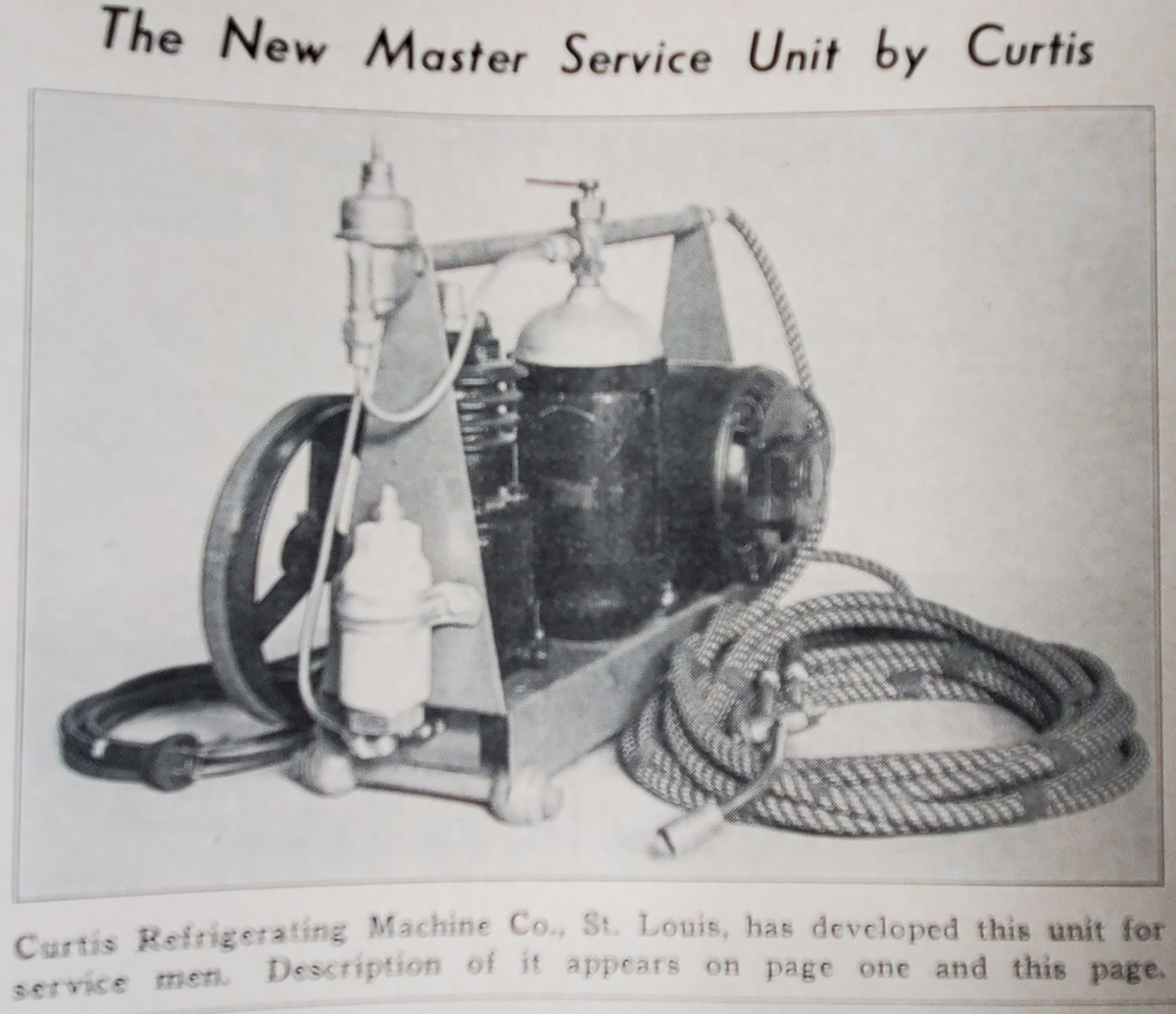
MULTITOOL: During a 1936 visit to the Curtis Refrigerating Machine Co. of St. Louis, George F. Taubeneck, editor of Electric Refrigeration News, saw the new Curtis Master Service Unit, a multitool for refrigeration technicians that, according to Taubeneck’s report, was used for testing, soldering and brazing, evacuating air, detecting leaks, and removing refrigerant gas. (File photo)
Other stops included Sparks-Withington, Fairbanks, Morse & Co., and the Curtis Refrigerating Machine Co. in St. Louis. Taubeneck sailed from San Francisco in late January and visited Hawaii, New Zealand, and Australia, then made more than a dozen stops in Asia (a train trip across India took 11 days), the Middle East, and Europe. His dispatches on the industry from those destinations were published in the magazine regularly during the first half of the year. “Great Appliance Market Waits Development in New Zealand,” read the headline of an April 1936 piece.
Taubeneck’s final stop before heading home was at the International Congress of Refrigeration at The Hague, Netherlands, in June. There, he presented a paper, “The Development of the American Household Electric Refrigeration Industry,” and heard many other speakers.
One of Taubeneck’s front-page reports from the conference must’ve been alarming at the time, as it noted the dictator Benito Mussolini had recalled the Italian delegation as a protest of sanctions, and that the Soviet delegation had boycotted the meeting because of poor relations with the host country. In addition, the report said, the chairmen of the British and German delegations had made passionate pleas for international peace.
Taubeneck continued to write for the magazine and travel on business for decades. He also wrote several books, including “Peace and Progress: How to Be Happy Despite the Politicians,” “Let’s Go to Australia,” and a joke book, “You’ll Love This One.” He was a founding member of the Detroit Press Club. He died in 1974, just months after retiring.
Oddly enough, Taubeneck never had air-conditioning installed at his own home in Grosse Pointe, Michigan.
“I can’t even tell you the reasoning,” Greg Taubeneck said. George’s wife, Willo, “very much would’ve appreciate air-conditioning,” he added.
Looking for a reprint of this article?
From high-res PDFs to custom plaques, order your copy today!