1936: Early Residential A/C
A pioneering architect installed central a/c at his New York home, now a landmark
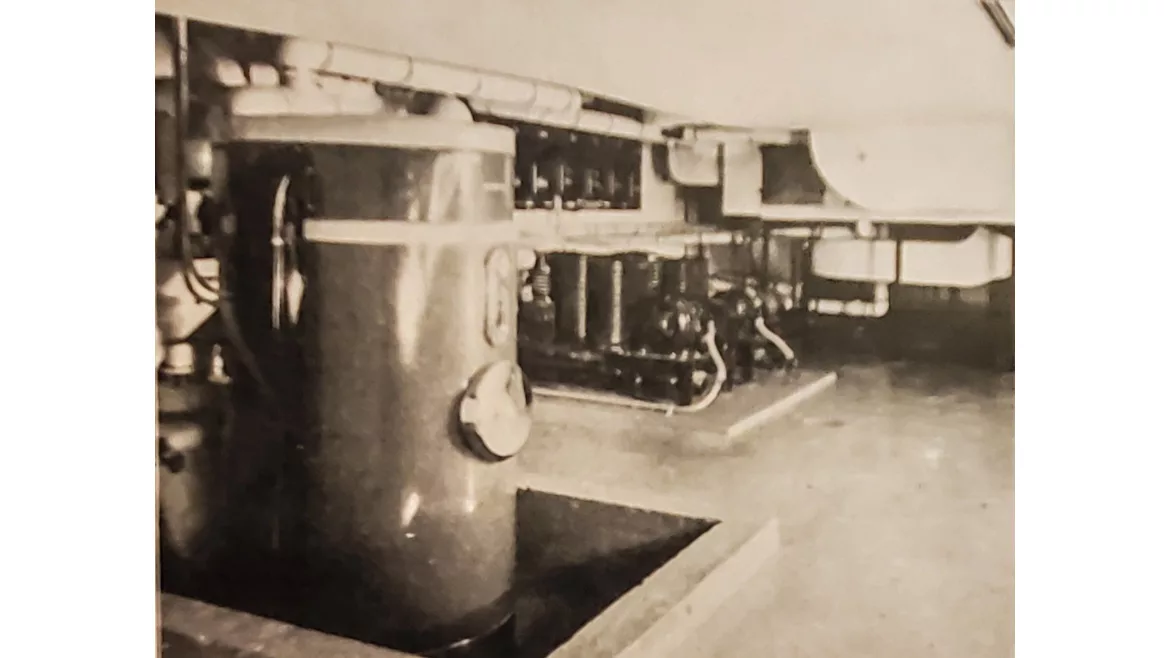
MECHANICAL ROOM: This photo from the January 15, 1936, Electric Refrigeration News shows major components of the HVAC system in the basement of the 1935 Morris B. Sanders house in Manhattan, now a city landmark. A General Electric oil furnace is at left, compressors are pictured in the center, and at right are what the magazine called “two separate conditioners.” Fewer than 1% of U.S. homes had air-conditioning in the 1930s.
Residential air conditioning was extremely rare in the 1930s. Fewer than 1% of U.S. homes had a/c of any kind during that decade, according to available estimates.
So when architect Morris B. Sanders, a pioneer of Modernism, included central a/c in the heating and cooling system in his new house in Manhattan, Electric Refrigeration News, which later became The ACHR NEWS, marked the technical achievement with a photograph in the edition of January 15, 1936.
The five-and-a-half-story house on East 49th Street was designed by Sanders as a ground-floor work space and two separate multistory apartments, one for the architect and his family, another for a renter. The top story consisted of a rooftop terrace and the maid’s quarters. Construction was completed in late 1935, according to the New York City Landmarks Preservation Committee, which designated the building a city landmark in 2008.
Central air, Sanders thought, would “eliminate the necessity for opening windows,” a landmarks committee report said. Many of the windows were made of glass block and could not be opened. The HVAC equipment in the basement, shown in the photo, included a General Electric oil furnace, compressors, and two “conditioners” that, according to the committee, were made by the Schwerin Air-Conditioning Corp. (The “conditioners” appear to be what in today’s central air systems would be called plenum and ductwork arrangements.)
The system took air from both inside and outside, filtered, cooled, and dehumidified it, and circulated it throughout the building, according to the Morris B. Sanders Studio & Apartment’s Wikipedia page.
Companies such as Carrier, Westinghouse, General Electric, and York Ice Machinery Corp. worked in air-conditioning in the ’30s, but central systems were found mostly in movie theaters and upscale office buildings and hotels and other high-end buildings. There was no mass-market equipment for residential a/c, so the few systems that existed were custom-made.
Other items in the Electric Refrigeration News of January 15, 1936, noted the installation of air-conditioning at the Tampa Tribune newspaper offices in Florida, the City Bank in Shreveport, Louisiana, and the S&S Coffee Shoppe in Augusta, Georgia.
Looking for quick answers on air conditioning, heating and refrigeration topics? Try Ask ACHR NEWS, our new smart AI search tool. Ask ACHR NEWS
The Morris Sanders house was praised upon its completion, won a silver medal from the Architectural League of New York City, and was the subject of articles in architectural journals. Sanders, who also designed furniture and other consumer goods, went on to design many other residential and commercial buildings, and co-designed a pavilion for the Distilled Spirits Institute exhibition at the 1939 World’s Fair in New York. He died in 1948.
Anthony Mason, a longtime CBS News journalist, lived in the house as a boy in the 1960s.
According to Wikipedia, the lot on which the Sanders house was built was purchased in 1934 for $11,500. That’s about $266,000 in today’s money. Design plans Sanders filed with the city estimated construction at $20,000, the equivalent of about $462,600 in 2026 dollars.
The house, which hasn’t changed owners since 1980, is currently on the market, with an asking price of $4.395 million.
Looking for a reprint of this article?
From high-res PDFs to custom plaques, order your copy today!