FROSTlines
Replacing the Power Element of a TXV
This solution may work if the valve is in a tight location
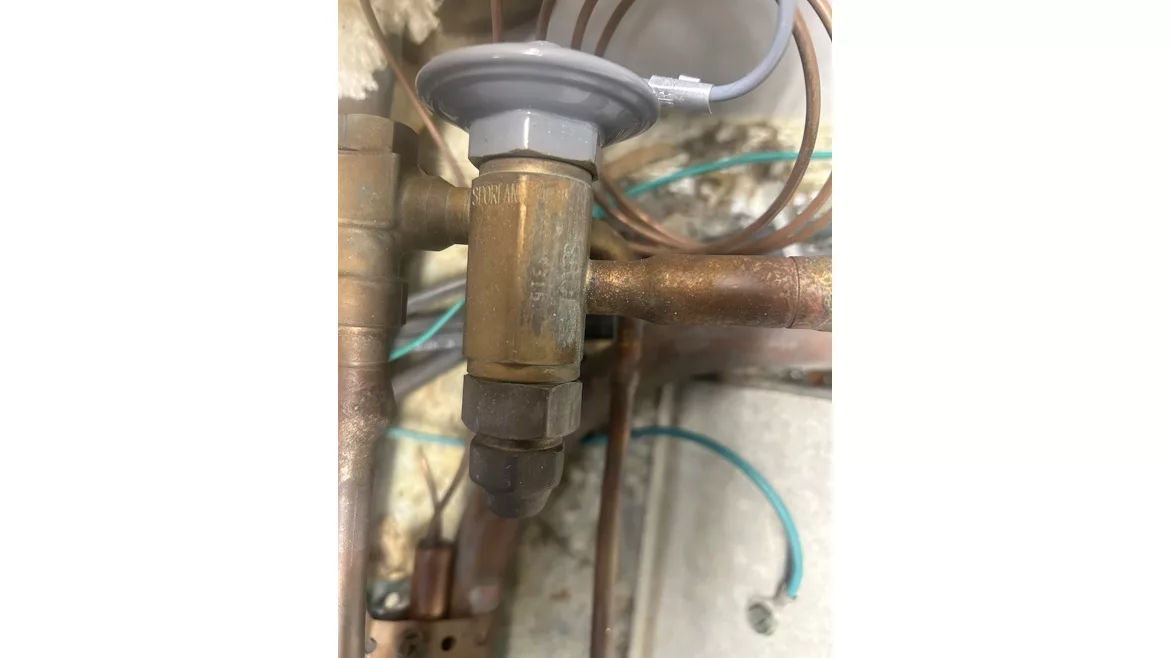
TRICKY REPAIR: Replacing an entire TXV can be tricky, as it is usually located in a tight space.
Replacing a thermostatic expansion valve (TXV) can be tricky at times. If the valve is in a tight location, removing and installing it can be problematic. If the valve’s connection is brazed, care must be taken not to damage any surrounding wiring, cabinet panels, or other components while heating the joints. If it is an older valve and has flared connections, getting a wrench onto the flare nuts can be difficult.
When faced with this situation, one choice is to just change the power element of the valve. However, this is not always possible and may not resolve the issue — and you may still need to change the entire valve and deal with the tight location. But when it is possible, and it is the defective component, it will save time and money on the job.
To determine if this is a possibility, the valve must first have a removable power element — not all of them do. Second, you need to determine if the reason for the TXV not controlling the refrigerant’s superheat value leaving the evaporator is the power element. A common failure of the power element is a loss of its fluid charge. The fluid charge within the power element applies the required pressure on the top of its diaphragm to move the valve’s port to a more open position. With the loss of this fluid, the valve may not be able to open enough to allow the correct amount of refrigerant to enter the evaporator. This will result in a higher-than-normal superheat value leaving the evaporator.
There are other issues involving the TXV that can lead to a higher-than-normal superheat value leaving the evaporator, which is why it is important to make sure that the TXV is causing the issue. Then you will need to decide if the power element or something else within the TXV is the issue, such as a stuck push rod or clogged strainer.
One possible test is to cut the pigtail of the sensing bulb. If no refrigerant or very little refrigerant comes out of the power element, it lost its charge. However, this is a one-time try; you will need to be ready to change out the entire valve if you find the power element has not lost its fluid charge. Also, I have seen some TXVs where the power element has lost its charge and the push rod was stuck, and we were forced to change out the entire valve anyway. So, it is always safest to change out the entire valve to ensure the problem is resolved — but the tradeoff is dealing with the tight location.
Unfortunately, there is no clear-cut choice when dealing with this scenario. It is up to the technician to make the best decision at the time and be ready for Plan B if replacing the power element does not solve the problem. But when replacing the power element solves the issue, it does make for a much simpler and easier repair.
Looking for quick answers on air conditioning, heating and refrigeration topics? Try Ask ACHR NEWS, our new smart AI search tool. Ask ACHR NEWS
Looking for a reprint of this article?
From high-res PDFs to custom plaques, order your copy today!