One Coil, Twice the Flexibility
Dual-refrigerant technology eases the transition to low-GWP solutions
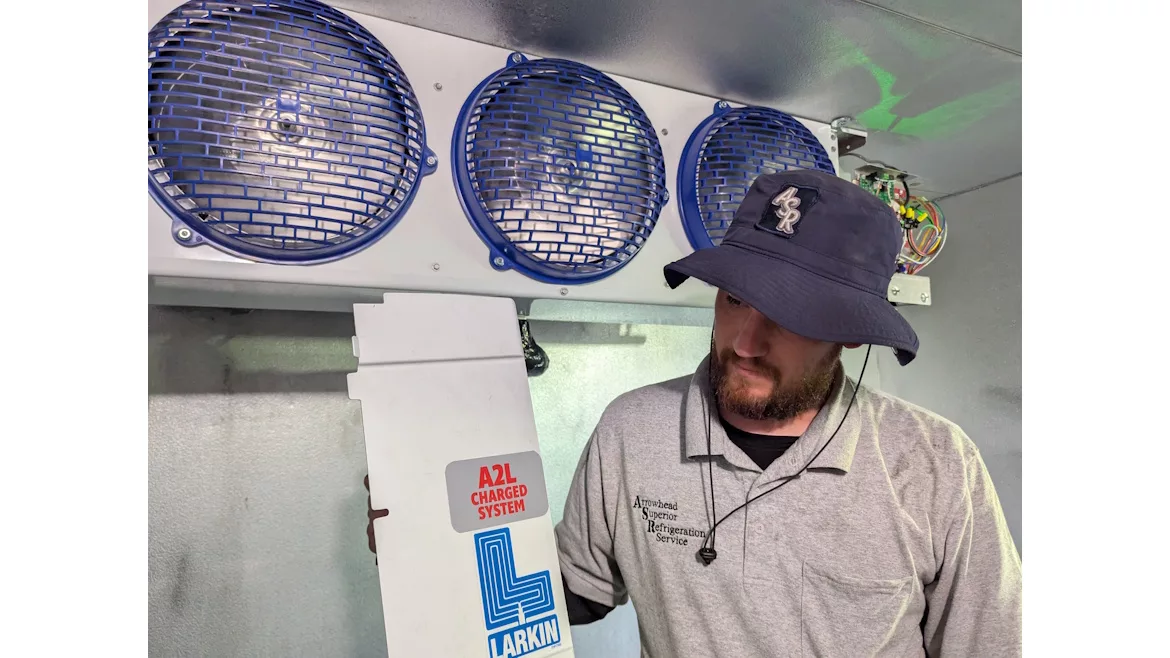
COOL FOR SCHOOL: Manuel Griego Jr., from Arrowhead Superior Refrigeration, recently installed a Heatcraft dual-refrigerant system at an Arizona elementary school.
As the HVACR industry navigates the transition from legacy HFCs to low-GWP A2L refrigerants, manufacturers are finding creative ways to make the shift less disruptive. Among the most significant innovations is the emergence of dual-refrigerant coils, which are engineered to operate efficiently with more than one type of refrigerant.
For an industry facing evolving standards and shifting deadlines, these adaptable coils are proving to be an elegant bridge between compliance and convenience.
Residential Flexibility
Advanced Distributor Product’s (ADP) evaporator coils with patent-pending dual-refrigerant sensor FlexCoil technology are designed for all A2L refrigerants (R-454B, R-32). They are factory-configured and can be field-converted, allowing contractors to easily adapt the coil to the specific refrigerant and system requirements of residential HVAC applications.
According to Augusto Zimmermann, director of engineering and product management at ADP, the idea for the FlexCoil was born in 2023 out of the EPA’s Technology Transitions rule, which limits R-410A products manufactured in 2025 to use only as replacement components. He added that feedback from HVAC distributors also played a major role, as many expressed concerns about how to manage inventory during the refrigerant transition. He noted that during times of change — whether related to efficiency standards or refrigerants — effective inventory and obsolescence management can make or break their year.
“The FlexCoil puts distributors’ minds at ease from having to match their coil and outdoor unit inventory and lets them focus on their high revenue drivers such as condensers,” said Zimmermann. “This also provides flexibility for dealers and contractors, who can now have readily available stock that can be easily converted from one refrigerant to another in as little as one step, depending on the original configuration.” This enables onsite adjustment and conversion at first install, he added, allowing technicians to carry minimal inventory, while still handling emergency replacements efficiently.
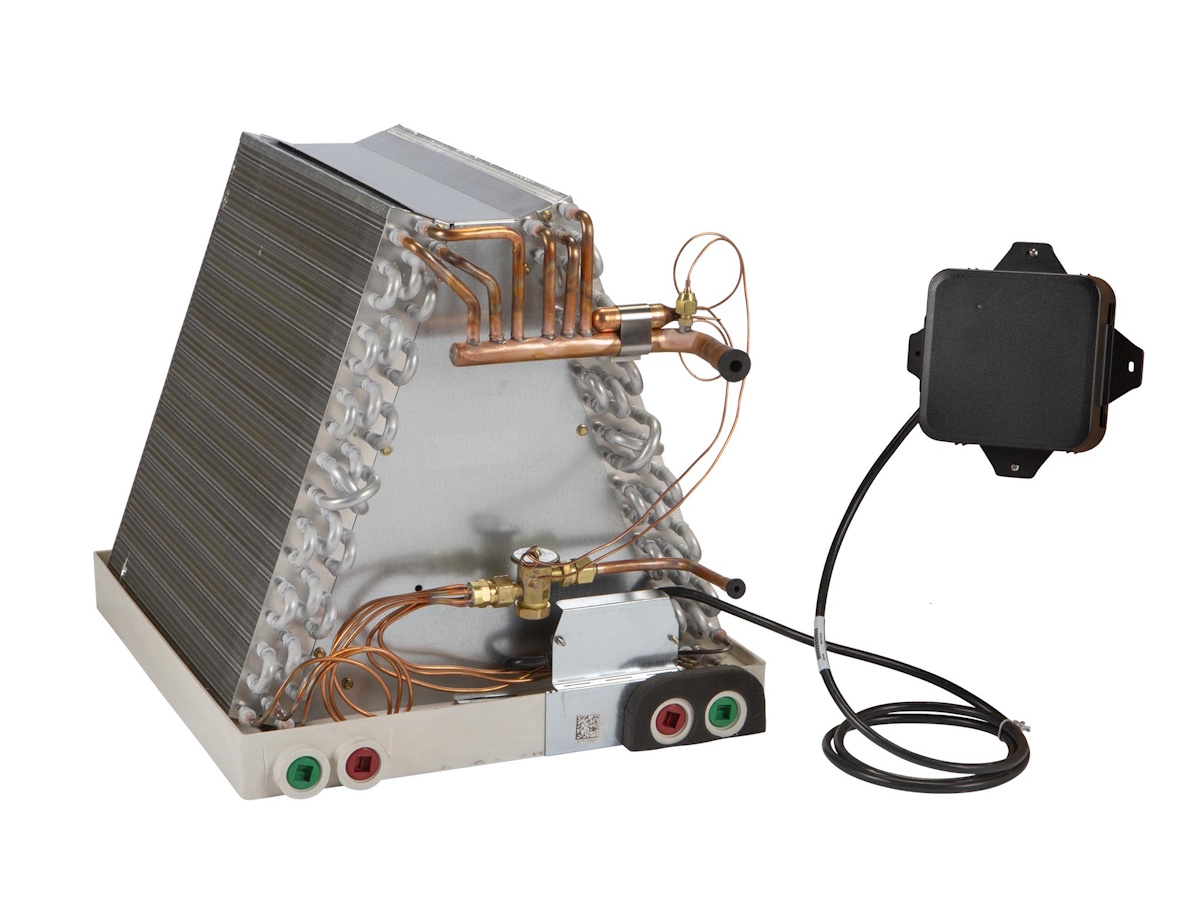
FLEXIBLE TECHNOLOGY: ADP’s HE Series evaporator coils utilize FlexCoil technology, which is designed for all A2L refrigerants. (Courtesy of ADP)
The conversion process is relatively simple. When converting from an A1 to an A2L refrigerant, contractors must adjust or replace the metering device, apply warning labels to the equipment, permanently mark the system with the new refrigerant type, and install a refrigerant detection system (RDS) in the field.
To convert between the two A2L refrigerants for coils with a 2025 manufactured date, contractors need only change the metering device and mark the appropriate final refrigerant installed on the unit. FlexCoil uses a single, certified sensor that is calibrated to detect both R-454B and R-32 within the same part number. Both the coils and the RDS are ETL-certified under UL 60335-2-40.
Looking for quick answers on air conditioning, heating and refrigeration topics? Try Ask ACHR NEWS, our new smart AI search tool. Ask ACHR NEWS
Designing a coil compatible with both A1 and A2L refrigerants wasn’t without challenges, as the ADP engineering team had to meet safety standards and ensure consistent performance across refrigerants with different thermodynamic properties. According to Zimmermann, this required changes to mechanical construction, circuiting optimization, metering device adjustments, and leak detection system qualification.
With its UL60335-2-40 certification and focus on flexibility, Zimmermann noted that FlexCoil technology will be a benefit for distributors and contractors navigating refrigerant regulations.
Refrigeration Versatility
For commercial refrigeration applications, Heatcraft Refrigeration Products recently started offering a dual-refrigerant system that is designed to operate with both A1 (HFC) and A2L (HFO) refrigerants, providing flexibility to meet current regulations while preparing for future mandates.
Heatcraft’s dual-refrigerant platform allows a single system to support either refrigerant class, eliminating the need for premature equipment replacement. Each system is compliant with UL 60335-2-89, the EPA Technology Transition rule, and SNAP 26 regulations. Its comprehensive safety features include an RDS, safety shut-off valves, and clear refrigerant labeling.
For distributors, the dual-refrigerant design offers significant advantages in inventory management. A single model can serve customers using either A1 or A2L refrigerants, reducing the number of SKUs required and simplifying stocking decisions. This streamlined approach also minimizes the risk of obsolescence as refrigerant rules evolve, freeing up warehouse space and lowering capital tied up in redundant inventory.
The design also reduces complexity for contractors. Familiar installation practices are maintained, and the transition from an A1 to an A2L refrigerant requires only minor field modifications — adjusting the metering device, installing the RDS, applying safety labels, and updating controller firmware. The process can typically be completed in about an hour, minimizing downtime and labor costs.
The technology has already been tested under demanding real-world conditions. A recent installation at a Glendale, Arizona, elementary school involved replacing a nearly 20-year-old walk-in freezer with a Heatcraft dual-refrigerant condensing unit and Larkin unit cooler. The system was first commissioned using the A1 refrigerant R-448A and then converted one week later to the A2L refrigerant, R-454A. The conversion was completed entirely in the field, and the system returned to normal operation the same day.
This demonstration underscored the system’s flexibility and safety. The conversion process followed all UL-approved procedures, and performance data collected afterward showed consistent temperature control and reliable operation, even under the extreme Arizona heat.
According to the installing contractor, Manny Griego Sr., founder of Arrowhead Superior Refrigeration in Peoria, Arizona, the elementary school installation went off without a hitch.
“With Heatcraft’s dual-refrigerant system, contractors can install a convertible unit cooler today using the existing A1 refrigerant,” he said. “Later, when the condensing unit goes down and it’s time to switch to A2L, they don’t have to touch the unit cooler — just convert it in the field. No waste, no double work, and the system is future-ready from day one. That’s the difference. That’s why this is a game changer.”
A2L Compatibility
Aspen Mfg.’s new convertible coils and air handler systems can be converted to use either R-32 or R-454B refrigerant. The systems can be converted at the factory or in the field with a proper metering device and an RDS. The company noted that this dual refrigerant capability provides flexibility for both new construction and retrofit applications, helping distributors and contractors adapt to the industry’s transition to low-GWP refrigerants.
The systems are ETL certified and engineered to maintain energy efficiency, while supporting evolving refrigerant standards. Built for performance and durability, these systems are intended to streamline installation, support compliance, and provide reliable operation across a range of applications.
“When HVAC contractors ask for Aspen, they expect industry-leading technology coupled with ease of installation,” said Jason Makowski, vice president of product management at Aspen. “Contractors can now confidently select coils and air handler systems that meet current standards, regardless of their preferred A2L refrigerant.”
Looking for a reprint of this article?
From high-res PDFs to custom plaques, order your copy today!