Guest Column
Dead Motors, Faulty Switches, and the Smarter Way to Diagnose Electrical Failures in HVAC Systems
Electrical Troubleshooting, Part 2: How to Verify Loads, Trace Circuits, and Diagnose Faulty Controls

THE RIGHT FIX: Strong electrical troubleshooting skills don’t just fix equipment — they protect your reputation.
In the first part of this electrical troubleshooting series, we discussed how a consistent approach to electrical troubleshooting can help HVAC technicians get a comprehensive assessment of what is wrong with the system. Part 2 will discuss how to test voltage loads, hopscotch, and check controls and switches.
Testing voltage loads
If there are nonfunctional components and the system has both line voltage and a control voltage signal (a call for heating, cooling, fan, etc.), the next step is to determine if these components are receiving voltage. You are trying to determine if the problem is in the component or the circuit to the part. If the component is receiving the correct voltage and is not operating, the problem is most likely that component. Be careful with single-phase motors, as most single-phase motors have components to help them start or continue to run capacitors, centrifugal switches, or starting relays. Failure of these components will keep a single-phase motor from operating. It is more common for these starting components to fail than for the actual motors to fail.
You should verify if a compressor/motor is defective before condemning it. First, turn off the power to the unit and disconnect the load from the circuit to check the load. Loads disconnected from the circuit can be checked using an ohmmeter to determine if they are electrically defective. Defective loads can be open, shorted, or grounded. A good load will have a measurable resistance. The exact value that indicates a good reading depends on the individual load. Generally, loads designed to operate at higher voltages will have higher resistances than loads designed for lower voltages.
Also, devices that use a small amount of current will have a higher resistance than devices that use a more considerable amount of current. The resistance of heaters and resistors can be accurately predicted using Ohm's law. However, any AC magnetic device will have a much lower resistance than Ohm's law would expect. Therefore, manufacturers' data is the only reliable way to know exactly what the resistance of a motor winding should be.


These images demonstrate the relay coil resistance increase as the coil voltage rating increases. (All courtesy of ACCA)
Regardless of the device, no loads should have a resistance of 0 ohms or infinite resistance. A reading of 0 ohms indicates a short; an infinite reading (OL) indicates an open winding; a measurable resistance somewhere between 0 and infinite (OL) indicates a good load. The exact resistance depends on the load. Manufacturer specifications should be checked to determine the precise resistance for any load. Loads should not have a measurable resistance between the power terminals and the case or frame of the unit. A load that has continuity between a power terminal and the frame is grounded.

A shorted motor (0.1 ohms). (Courtesy of ACCA)

An open motor (OL). (Courtesy of ACCA)

A motor with a good reading (11.6 ohms). (Courtesy of ACCA)
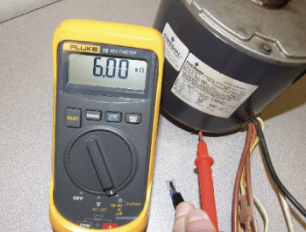
This motor is grounded. It shows a measurable resistance from the windings to the case. (Courtesy of ACCA)
Shorted or grounded loads will draw high amps and blow fuses. Open loads will draw no current and will not operate with voltage applied to them. It is also possible for motors to be mechanically defective even though they are electrically sound. If the nonfunctional component is not receiving voltage, the circuit to the part needs to be checked. The most effective method of locating a break in a circuit is a technique called hopscotching.
Hopscotching
This technique works by starting at a point where there is correct voltage and moving one lead at a time from point to point in the circuit toward the nonfunctional load until the voltage is lost. Most circuits put all the controls on one side of a load. Use the schematic diagram to identify all the controls in series. Including the load and the path that voltage takes to get to the load. Next, place the leads at a point in the circuit before the controls, where the correct voltage will be read. Follow the schematic and move the meter lead on the control side of the circuit from one control to the next, checking the voltage in and out of the control. The voltage will drop to 0 immediately after the control that is opening the circuit.
Looking for quick answers on air conditioning, heating and refrigeration topics? Try Ask ACHR NEWS, our new smart AI search tool. Ask ACHR NEWS
Next, you need to determine why the control is open. For example, if the control is a pressure switch, check the system pressures. If the control is a relay, check to see if the relay coil is receiving voltage. If it is not receiving voltage, you need to investigate the circuit to the
coil using the same hopscotching technique. Finally, if the control receives the correct input and is not closing, it needs to be replaced.
Checking controls and switches
After using the hopscotching technique to identify the specific control breaking the circuit, you must determine why the control is breaking the circuit. Common air conditioning
controls are switches that open or close based on a monitored condition such as pressure, temperature, or current. To determine if a control is defective, you will need to know when it should be closed and when it should be open.
For example, after determining that a high-pressure switch is open, the next step is to check the system's high side pressure and determine whether the pressure switch should be open. If the system's head pressure is high, the technician should look for causes of high discharge pressure, such as a dirty condenser.
Switches and controls can be checked with an ohmmeter when they are not in a circuit. When checking switches with an ohmmeter, a closed switch should have a resistance close to 0 ohms; an open switch should have a resistance of infinite ohms. A measurable resistance across a switch indicates faulty electrical contacts. Resistance measurements should always be done with the power off. Be sure to check the OEM guidance for the appropriate range readings.
Many technicians get confused by the voltage readings they get on switches. There should be no voltage drop across a switch when current flows through it. This means that a closed switch (switch turned on) should have no voltage reading from one side of the switch to the other when it is closed, and the circuit is energized. Any voltage reading indicates that voltage is being dropped or lost through the switch. A voltage reading more than 0 volts but less than the full applied circuit voltage indicates bad electrical contacts in the switch. An open switch (switch turned off) will have a voltage drop equal to the full applied circuit voltage if the switch is the only opening in the circuit.
One problem with diagnosing a switch by reading the voltage across it is that a reading of 0 volts does not always indicate the switch is closed. If the circuit has more than one opening, the voltage may read 0 even if the switch is open. However, a voltage reading across a switch always indicates an open switch or faulty contacts.
Conclusion
Strong electrical troubleshooting skills don’t just fix equipment — they protect your reputation. Mastering the basics helps reduce callbacks on both service and installation, builds trust with customers through informed recommendations, and lowers liability by ensuring electrical issues are handled safely. Fewer mistakes mean fewer risks of job site injuries. Investing the time to sharpen your troubleshooting skills makes you not only safer in the field, but also more valuable to your company and a more confident, capable technician.
Looking for a reprint of this article?
From high-res PDFs to custom plaques, order your copy today!