Worried About Airborne Contaminants? Optimizing Ventilation is Key
Additional dehumidification may be necessary in humid environments as well
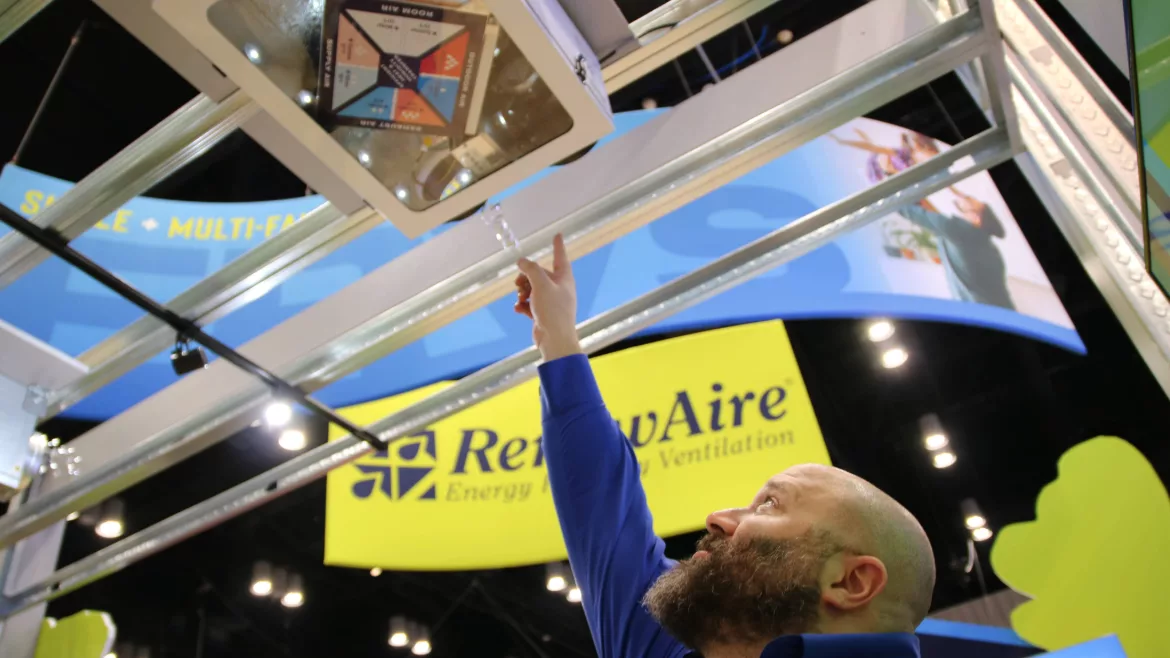
ERV: With built-in duct connections and self-balancing, this energy recovery ventilator (ERV) is built for ease of installation. (Staff photo)
In building codes, energy efficiency has come to dominate the list of priorities. But as economist Thomas Sowell once wrote, “There are no solutions. There are only trade-offs.” So, what is the tradeoff of improved energy efficiency?
The picture has taken time to develop in the dark room of an ever-tightening building envelope, but it is now clear the push for energy efficiency has created unintended consequences for human health and indoor air quality. Research shows that increased airtightness can prolong exposure to a laundry list of indoor contaminants in building materials, and can introduce vulnerabilities to other airborne contaminants as well. This makes ventilation more important than ever.
"New homes are often tightly sealed for energy efficiency, but this can trap moisture, creating a perfect environment for mold," explained Matt Matheny, COO at Home Ventilating Institute. He noted particulate matter in the range of 2.5-10 microns in diameter are the most harmful contaminants indoors, with cooking, mold, vacuums, and aromatics emitting particulates that then react with ozone to produce harmful compounds that persist in poorly ventilated environments.
The “low-hanging fruit” solution to this problem lies not in provisioning expensive non-toxic or anti-microbial building materials, or returning to draftier designs. As is so often the case in the HVAC industry, the most cost-effective solution here is to increase ventilation, Matheny said, concurring with his colleague Joe Medosch, treasurer at Healthy Air Research and Certification Authority.
Contaminants in the Air
The issue isn't just theoretical. Medosch and his team recently conducted lab testing on plywood samples from various garages, discovering concerning levels of formaldehyde and other chemicals that particularly harm children.
"In fact, one of them is called A-pinene, which is wood. They added wood to wood," he noted, highlighting one of many oddities of modern manufacturing practices.
"Multiple studies showed that higher ventilation rates were associated with lower concentration of formaldehyde in homes with new off-gassing sources such as carpets, cabinets, particle board, and furniture," added Matheny. "So again, ventilation is key for reducing these formaldehyde concentrations."
Looking for quick answers on air conditioning, heating and refrigeration topics? Try Ask ACHR NEWS, our new smart AI search tool. Ask ACHR NEWS
Medosch agreed, noting formaldehyde is hydrophilic – meaning high humidity and high temperatures speed up its release.
"We can't change a billion-dollar industry producing the chemicals that are in our homes,” he said. “The easiest solution is we just need really good ventilation."
Discounting wildfire events and areas with chronically poor air quality, outside air has a much lower volume of harmful contaminants than the average house’s air. And while an energy recovery ventilators (ERV) or heat recovery ventilators (HRV) can help reduce humidity, it's not a dehumidifier. So, for regions like Louisiana and Florida, Medosch recommends whole-home dehumidification.
A key factor in the slow adoption of ventilation standards in homes lies in the regulatory framework — or lack thereof. While commercial buildings must meet strict air quality standards, residential spaces operate under no state or federal requirements.
"Commercial properties are regulated by the EPA. You can't have bad air that has exposure to people who are working or outdoors," Medosch explained. "But your home? EPA is not in your house. They can't tell you anything about how to live. What that means is you can have all kinds of bad furniture, bad materials, and bad building products in homes.”
The distinction helps explain why commercial buildings often have more sophisticated ventilation systems and stricter air quality monitoring than residential spaces. It also highlights why the push for better residential ventilation has largely come through building codes and voluntary programs rather than federal regulation.

DEBATE: Dan Wildenhaus, senior technical manager at Center for Energy and Environment, moderated a debate between Joe Medosch, treasurer at Healthy Air Research and Certification Authority, and Matt Matheny, COO at Home Ventilating Institute. (Staff photo)
Control vs. One-Size-Fits-All
The industry has moved beyond searching for a universal solution, according to Dan Wildenhaus, senior technical manager at Center for Energy and Environment, who moderated a debate between Medosch and Matheny at AHR Expo 2025 in Orlando.
"The problem with past approaches is they were trying to find one magical number for every house that balanced energy use with indoor air quality," Wildenhaus explained. "What we've learned to do now is we have to control these things separately."
The modern approach is more nuanced: First, make the building as tight as reasonably possible to prevent outdoor pollutants, contaminants, temperature, and humidity from entering. Then, ventilate to a specific standard that ensures proper fresh and filtered air for residents.
"This is about control," Wildenhaus emphasized. "That is truly all we can sell to the homeowner — that you get to be in control of when your house ‘breathes,’ how much it ‘breathes,’ and whether or not it's filtered. And that is a far cry better than letting Mother Nature be in control."
Ventilation and Dehumidification’s Impact on Energy Consumption
Ventilation, which exchanges conditioned air in a building with outside air, as well as dehumidification, both add to energy bills and ding energy efficiency scores, requiring the savings to be made up elsewhere. While their value for human health is becoming increasingly apparent in reducing exposure risks from contaminants like PM 2.5 and, in the case of humidity, mold, there is no official building code for whole-home dehumidification.
In terms of ventilation, ASHRAE and the CDC now recommend a minimum of five air exchanges per hour in homes — much higher than the old standard of 0.35 — but the COVID-19 era ventilation recommendation is not widely adopted in the residential market. Most ERVs and HRVs replace the air in a home every three hours, matching the old standard.
Matheny pointed to significant progress in ventilation adoption. States like Washington, Minnesota, and Massachusetts mandate balanced ventilation systems like these in new buildings. Seventeen states have adopted the 2021 edition of the IECC, the 2019 edition of ASHRAE 90.1, or their own state building code requiring balanced ventilation. Colorado, parts of Arizona, and other areas are even moving to require ERVs outright.
"Market demand for HRVs and ERVs in new residential, non-transient dwellings has increased by roughly 140% over the last few years," he said, attributing this growth to HVI’s focused efforts to expand the market and building code adoptions.
However, implementation challenges persist.
"We routinely see that bathroom exhaust fans are installed improperly," Matheny explained. "They are often vented into the attic or installed with a complex and constrictive duct system. This results in a loud and inefficient ventilation system that does not move the amount of air it was designed to."
Medosch and Matheny emphasized that measuring indoor air quality isn't as straightforward as it might seem. While sensors can directly measure PM 2.5, smaller nanometer diameter particulates and VOCs present a more complex challenge.

SOLUTIONS: The most cost-effective solution to address hazardous contaminants in a home's air is to increase ventilation, Medosch and Matheny said at the AHR Expo in Orlando in 2025. (Staff photo)
"VOCs are not so easy to measure," Medosch explained. "Am I measuring your cologne or your candles, or am I measuring your furniture? They're all VOCs that have all interacted together. And then you bring sunlight in, and we're on a whole other level of what they become."
The experts also highlighted an often-overlooked aspect of ventilation systems: the importance of keeping them separate from existing HVAC.
"The best thing to do for a really good, balanced ventilation system, is keep it independent of the heating and cooling system," Medosch advised. "Don't try overcomplicating or think you're getting more out of it by combining it with another system performing separate functions."
Attempts to integrate ventilation with existing ductwork can "completely null out the entire ERV, or cause other problems, or moisture issues" when outdoor moist air is dumped directly into the HVAC system.
The Ventilation Vulnerabilities of HVAC Systems
Modern HVAC systems rely on a network of ducts and components to move air effectively. At the core of this network are air handlers that push treated air through supply ducts to various rooms, while return ducts pull air back for reconditioning. This continuous cycle is what keeps indoor spaces comfortable and healthy.
But maintaining this airflow is trickier than it might seem. Chad Herrick of Western Allied said that since MERV 13 filters are required in Southern California to address air quality from smog and wildfires, there is another unintended consequence: The higher-quality filter catches more contaminants. During a wildfire event, it can fill up within a day, and without swift replacement, this will result in a lower air exchange rate.
“The higher quality the filter, the denser the media, which means the faster it loads up. It arrests more particles,” Herrick said. “The days of the old horse hair, or washable, entrainment filters that you see on older homes, those days are done. It's all pleated and consumable now.”
HVAC systems don't just move air; they collect everything in that air over time. Coil and duct cleanings can dramatically improve airflow, according to new research published in Energy and Buildings Journal, but regular maintenance becomes even more crucial when you consider that HVAC systems can become sources of contamination themselves. As dust and particles accumulate on coils, in ducts, and on other components, they don't just reduce airflow — they can actually introduce new pollutants into the supposedly "clean" air being circulated.
Why the 'V' in HVAC Requires Specialization
A significant shift is occurring in how the industry views ventilation work. Cautioning it’s not meant derogatorily, Medosch has begun calling traditional contractors "HACs" — heating and air conditioning contractors — deliberately removing the 'V' for ventilation.
"If you do ventilation, you can claim it, but more of us are beginning to call them just heating and cooling contractors. The V is a ventilation contractor, a totally separate system and skill set," Medosch said.
The industry is moving to formalize this specialization through certification, Matheny added.
The separation makes sense given the complexity of modern ventilation systems; while new ERVs and HRVs are increasingly adopting a self-balancing feature, they still take training to design the system optimally. While traditional HVAC focuses on temperature control and general air movement, proper ventilation requires understanding of air exchange rates, balanced system design, and careful consideration of where fresh air should be introduced and stale air removed.
"People aren't realizing that my ventilation system, that my ERV, should have a design," Medosch emphasized. "Am I taking air out of bathrooms or high-moisture areas and providing the good, fresh air into bedrooms? That’s where self-balancing is really helpful.”
HVI has over 2,800 certified ventilating products in their directory, ensuring that ventilation equipment meets specific performance requirements for airflow, energy efficiency, and sound levels.
"If it's not listed in our directory, it's not certified," Matheny noted.
The brand new Aeri Series from RenewAire, an ERV constructed of a lightweight EPP foam enclosure that doubles as a cabinet structure and insulation, is in the process of getting HVI-Certified, said Timin Musallam of RenewAire. With built-in duct connections and self-balancing, it is built for ease of installation.
“It has five smart self-balancing air flows for low and high speeds on both air pumps, one through five. Those correspond to air flows of 40, 75, 110, 145, and 175 CFM. So, if you change your dial to one of those, you don’t have to do any balancing,” Musallam said. “It's going to run at that regardless of the static pressure of your system, regardless of the filter starting to clog, the motors will adjust themselves to keep that constant air flow.”
The Path Forward
As building codes evolve and awareness grows, the future of residential ventilation looks increasingly sophisticated. But the transition won't be simple. It requires rethinking how we approach both construction and maintenance of our homes.
"We can do better," Medosch concluded. "Our goal is to push to make better solutions across the states, and have oversight and better requirements that people can easily follow without there being some hurdle. It doesn't make any sense to an average contractor or homeowner otherwise."
Looking for a reprint of this article?
From high-res PDFs to custom plaques, order your copy today!