ACHR News
search
Ask ACHR NEWS AI
cart
facebook twitter instagram linkedin youtube
  • Sign In
  • Subscribe
  • Sign Out
  • My Account
ACHR News
  • NEWS
    • Breaking News
    • New HVAC Products
    • Featured Products
    • Manufacturer Reports
    • HVAC Data
    • Legislation
    • ACHR NEWS Centennial
  • RESIDENTIAL
    • Air Conditioners
    • Furnaces
    • Residential Heat Pumps
    • Ductless
    • Residential IAQ
    • Testing, Monitoring, Tools
    • Components & Accessories
  • COMMERCIAL
    • Air Handlers
    • Rooftop Units
    • Chillers and Cooling Towers
    • Commercial Heat Pumps
    • Boilers and Hydronics
    • VRF/Ductless
    • Commercial IAQ
  • REFRIGERATION
    • Refrigerants
    • Refrigerant Regulations
    • Leak Management
  • CONTRACTOR PRO
    • Geothermal
    • Homeowner Study
    • VRF and VRV Ductless
    • Unitary Trends
  • EDUCATION
    • Training and Education
    • Business Management
    • Service and Maintenance
    • Continuing Education
    • Market Research >
      • HVAC Brand Awareness Report
      • VRV, VRF, VRVZ Report
      • Unitary Trends Report
      • Water Heat Professionals Report
    • Webinars
    • Sponsor Insights
    • eProducts Info
    • White Papers
  • EVENTS
    • HVAC Contractor Forum
    • Industry Events and Webinars
  • MEDIA
    • Videos
    • AHR Expo 2025 Videos
    • Podcasts >
      • ACHR News Podcast
      • HARDI Podcasts
      • AHR Expo Podcasts
      • ACCA Podcasts
    • Interactive Spotlights
    • Quizzes
    • eBooks
    • HVAC Talkback
  • HVAC GROUP
    • ACHR NEWS >
      • Current Issue
      • Digital Edition
      • Subscribe
    • Distribution Trends
    • SNIPS NEWS >
      • Join SNIPS NEWS
    • Engineered Systems News >
      • Join ES News
    • HVACR Directory
    • Contests
    • Newsletters
    • Contact
    • Advertise
    • My Account
HVAC ContractingNewsService and MaintenanceHVAC Commercial MarketRefrigerationGuest ColumnRefrigerantsTraining and EducationTraining and Education for Contractors

FROSTlines

Using A2Ls in Commercial Refrigeration Equipment

Technicians must learn how to safely work with mildly flammable refrigerants
By Don Fort
Don Fort and Commercial Refrigeration Equipment
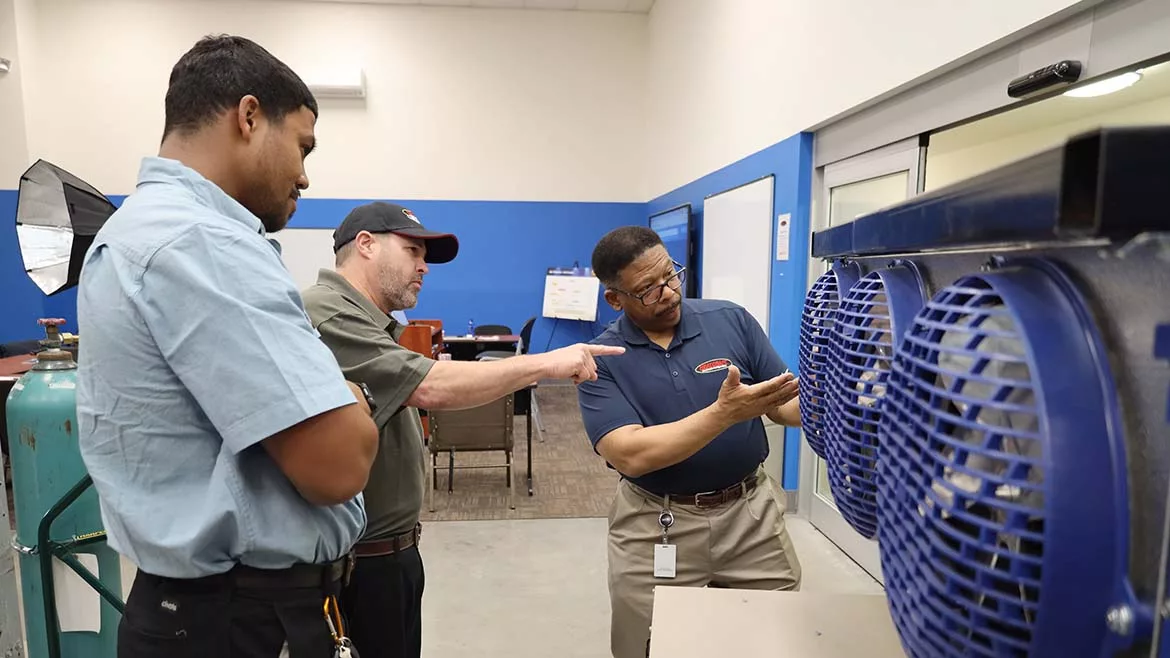
TECH TRAINING: Don Fort (far right) shows service technicians some of the finer points of commercial refrigeration equipment. (Courtesy of Heatcraft)
December 6, 2024
✕
Image in modal.

A big change is coming to the air conditioning and refrigeration industry. The commonly used synthetic refrigerants known as HFCs are being phased down by the Environmental Protection Agency (EPA) due to their heat-trapping effects, which contribute to global warming. Industry mandates vary, so check the EPA website to find out exactly when changes are coming for your particular refrigeration system. In addition, states may impose further regulations.

Beginning Jan. 1, 2025, the EPA will prohibit the use of refrigerants with GWP above 150 in new refrigeration stand-alone units used in the retail food industry. As a result, many commonly used synthetic blends, like R-449A, will be replaced with low-GWP alternatives such as carbon dioxide (CO2) and A2L refrigerants. We discussed CO2 in previous articles, so in this article, we will focus on A2Ls.


Working with A2Ls

Like CO2, A2Ls are non-toxic, but they are classified by ASHRAE as mildly flammable, due to a burn rate of 10 centimeters or less per second. A2Ls offer a significant advantage: their GWP is dramatically lower than today’s often-used refrigerants, such as R-404A with a GWP of 3,920. Contrast that with A2Ls: R-454C with a GWP of 148, R-455A with a GWP of 145, and R-454A with a GWP of 239.

Several procedures you are familiar with for HFC and HCFC refrigerants also apply to A2L refrigerants. For instance, because operating pressures are similar, the same type of copper piping used for HFCs and HCFCs can be used for A2Ls, and 15% silver brazing alloy still is acceptable for joining copper connections. In addition, the same brazing and piping practices apply as well: flux or flux-coated rod must be used for copper to brass, copper to steel, or dissimilar metals on any joint other than copper to copper, because flux removes oxygen from around the joint, allowing metals to bond securely. When repairing lines on any system, always use nitrogen when brazing to prevent oxidation inside the piping.

Existing line sets may need to be replaced. Due to the mild flammability of A2Ls, always mark line sets with red or other A2L-specific identification and verify that line sizing is correct.

In addition, A2L refrigerants use left-handed threads, meaning the thread pattern of the recovery cylinders will be the reverse of what you are accustomed to. Any vacuum pumps used must also be rated for A2L compatibility, ensuring they are compliant with a mildly flammable refrigerant.

The A2L tanks have a pressure relief valve instead of the rupture disc used with HFCs and HCFCs. Unlike a ruptured disc, which prevents cylinder reuse once the rupture occurs, the A2L tank valve simply releases pressure, preserving the cylinder’s usability.

Looking for quick answers on air conditioning, heating and refrigeration topics? Try Ask ACHR NEWS, our new smart AI search tool. Ask ACHR NEWS →


Charge and Recover

Ensuring that the system is clean, dry, and leak-free is essential. Any air in the system could contain moisture, so the system must be vacuumed to meet the recommended range of 500 microns. Triple evacuation is advised to ensure the system is dry. If charging a blended refrigerant through the low side, use liquid charging adapters to maintain blend integrity.

Also, beware of counterfeit recovery cylinders. Remember, all recovery cylinders must undergo hydrostatic testing for leaks every five years, and the designation — with test pressure and date — is stamped on the cylinder collar with a Department of Transportation label. Other important factors include:

  • Recovery equipment must be rated for A2L refrigerants;
  • Tanks are rated and identified for A2L refrigerants by a red band and have a pressure relief valve instead of a rupture disc;
  • Manifold sets and hoses must be rated for A2L refrigerants;
  • Hoses will use left-hand threads for A2L refrigerants;
  • Recordkeeping must be maintained, and different refrigerants should never be mixed;
  • Recovery cylinders must be rated for refrigerant type and pressure;
  • Blended refrigerants recovered from a leaking system may be out of blend proportions; and 
  • If refrigerant is to be reused, use a clean recovery cylinder.


Mitigating a Leak

A refrigerant detection system (RDS) is often required with mildly flammable refrigerants such as A2Ls. Because A2L refrigerant is heavier than air, it tends to pool. The RDS sensor is located underneath the coils where the refrigerant naturally settles, so it can alert the user to any refrigerant leaks.

ASHRAE requires that the sensor meets these eight points:

  1. Is self-diagnostic;
  2. Uses a factory setpoint that is nonadjustable in the field;
  3. Generates mitigation output within 30 seconds when 25% of the lower flammability limit (LFL) is achieved;
  4. Detects the presence of the specific refrigerant contained in the system;
  5. Energizes the equipment’s circulation fans upon failure of a self-diagnostic check;
  6. Alerts the ventilation system to begin working. The system must remove the leaked refrigerant from the space and provide an exhaust or transfer fan compliant with ASHRAE-Standard 15, Equation 7-10;
  7. Activates the safety shutoff valves, which must be outside the box that is being conditioned; and
  8. Ensures technician access for replacement of the RDS components.

Figure 1 illustrates the necessary actions for different-size systems. For instance, for leaks in systems using up to 33 pounds of refrigerant, valves must be closed to isolate the coil from the refrigerant lines connected to the outdoor condenser unit, thereby limiting the amount of mildly flammable vapors that might be present. In larger systems — those starting at 88 pounds with a greater volume of space — not only must the coil be isolated, but ventilation must be provided to rid the air permeated with the leaking A2L refrigerant.

R454C in Unit Coolers Chart.

Click figure to enlarge

FIGURE 1: When using R-454C in unit coolers, here are some of the actions required in the event of a refrigerant leak. (Courtesy of Heatcraft)

Safety is paramount when working with flammable substances, but fortunately, personal protective equipment (PPE) has come a long way in recent years. Basically, the same methods used for HFC and HCFC refrigerants are used for A2Ls, with technicians and support staff responsible for using proper protective gear. All staff working on this type of installation should use PPE including safety shoes, gloves, and glasses.


Going Forward

Although R-404A and other high-GWP refrigerants will no longer be manufactured after 2025, reclaimed high-GWP refrigerant will be available at supply houses for service of existing systems.

While refrigeration will remain essential, we also must be good stewards of the planet. Replacing the high-GWP refrigerants with those that are less damaging to the atmosphere — like A2Ls — is an excellent way to fulfill that goal. Make sure you are properly trained to use these mildly flammable refrigerants, however. Use the right equipment, follow all safety instructions, and understand the risks. Taking these steps can prevent injury to yourself and others.

KEYWORDS: A2L Refrigerants Commercial refrigeration flammable refrigerants FROSTlines refrigerant safety safety and HVAC training technicians

Share This Story

Looking for a reprint of this article?
From high-res PDFs to custom plaques, order your copy today!


Don fort
Don Fort, senior technical trainer for Heatcraft Refrigeration Products, has nearly 40 years of HVACR industry experience — with 25 of those years focused on technical training and education. To contact Don, email don.fort@heatcraftrpd.com.

Recommended Content

JOIN TODAY
To unlock your recommendations.

Already have an account? Sign In

  • HVAC-enrollment

    The Trades Are Back: HVACR Programs See Nearly 30% Enrollment Spike

    A new wave of future technicians is entering the pipeline.  
    Training and Education
    By: Matt Jachman
  • 2025 Top 40 Under 40

    2025 Top 40 Under 40 HVACR Professionals List

    The 11th annual Top 40 Under 40 list highlights those...
    HVAC Commercial Market
    By: Hannah Belloli-Oster
  • LG Ductless Mini-Split Systems

    The 9 Types of Heat Pumps

    As the U.S. moves toward electrification, heat pumps are...
    News
    By: Joanna R. Turpin
Subscription Center
  • Create an Account
  • Start a Subscription
  • Manage My Account
  • Sign Up for Newsletters
  • Visit Customer Service
  • Update Preferences

More Videos

Sponsored Content

Sponsored Content is a special paid section where industry companies provide high quality, objective, non-commercial content around topics of interest to The News audience. All Sponsored Content is supplied by the advertising company and any opinions expressed in this article are those of the author and not necessarily reflect the views of The News or its parent company, BNP Media. Interested in participating in our Sponsored Content section? Contact your local rep!

close
  • Piggy Bank
    Sponsored byWatercress Financial

    Energy Prices, Inflation, and HVAC: What Today’s Homeowners Care About

  • Refrigerated Food
    Sponsored bySolstice Advanced Materials

    R-455A Refrigeration: A Cold Storage Solution for the Future

  • Airex Rooftop Units
    Sponsored byAirex Manufacturing Inc

    Consolidating Roof Penetrations: A Growing Trend in Multifamily HVAC Design

Popular Stories

Refrigerants-and-gauge.jpg

HVAC Industry Warns of Counterfeit Refrigerants Entering U.S. Supply Chain

U.S. Supreme Court building

95% Furnace Efficiency Rule to Get New Hearing

Midea-training.jpg

HVAC Workforce Crisis Expands Beyond Technicians to Instructor Shortages

Data_Center_facility.jpg

HVAC Manufacturers Respond to Growing Data Center Backlash

HVAC Minute retail refrigeration system

EPA Final Rule’s Impact on R-410A Deadlines

View The ACHR NEWS
Centennial Anniversary Timeline

The ACHR News Timeline Chart
Submit a Letter
Submit a letter to our editors.

Events

November 6, 2025

Next-Gen Data Center Cooling: HVAC Innovation and Real-World Solutions

On Demand As AI workloads and high-density computing push traditional cooling methods to their limits, the data center industry is accelerating the adoption of next-generation HVAC technologies.

June 23, 2026

HVAC Duct Sealing Mastics: Why Selection Matters

In this webinar we will detail what HVAC material buyers and technicians need to know when selecting duct mastics, including matching mastic to substrate, alternatives to liquid mastic, and where UL 181 Listings fit into real world installations.

View All Submit An Event

Poll

Summer Staff

Are you fully staffed for the summer season?
View Results Poll Archive

Products

BNI Mechanical/Electrical Square Foot Costbook, 2026 Edition

BNI Mechanical/Electrical Square Foot Costbook, 2026 Edition

See More Products
HVAC Duct Sealing Mastics: Why Selection Matters - Free Webinar - 6/23/2026

Related Articles

  • Refrigerant Technicians

    Waiting For A2Ls In Commercial Refrigeration Equipment

    See More
  • Heatcraft-Evaporator-Unit.JPG

     CO₂ vs. A2Ls in Commercial Refrigeration

    See More
  • May 6, 2014: Commercial Refrigeration Equipment Demand in the US to Reach $10.7 Billion

    See More

Related Products

See More Products
  • Tech_CommRef_Guide_Small.jpg

    Technician’s Guide & Workbook for Quality Maintenance on Commercial Refrigeration Equipment

  • Semi-Hermetic Compressors: Testing, Servicing & Isolating DVD

  • Manual N.jpg

    Manual N® - Commercial Load Calculation

See More Products

Related Directories

  • Barr Refrigeration

    The world's largest inventory of new and used commercial refrigeration equipment, walk-in coolers and freezers with warranty are available at Barr Inc.
  • Heatcraft Refrigeration Products

    As a leader in innovative solutions, Heatcraft Refrigeration Products brings the most respected brand names in commercial refrigeration together: Bohn, Larkin, Climate Control and Chandler.
  • RefPlus Inc.

    Leading manufacturer of custom commercial and industrial refrigeration equipment.
×

Sign Up. Stay Informed.

The #1 trusted source for the HVACR industry since 1926

SUBSCRIBE
  • RESOURCES
    • Advertise
    • Contact Us
    • Advisory Board
    • Classifieds
    • Submit a Letter
    • Directories
    • Store
  • ACCOUNT CENTER
    • Create an Account
    • Start a Subscription
    • Manage My Account
    • Sign Up for Newsletters
    • Visit Customer Service
    • Update Preferences
  • SERVICES
    • Marketing Services
    • Reprints
    • Market Research
    • List Rental
    • Survey/Respondent Access
  • STAY CONNECTED
    • LinkedIn
    • Facebook
    • Instagram
    • YouTube
    • X (Twitter)
  • PRIVACY
    • PRIVACY POLICY
    • TERMS & CONDITIONS
    • DO NOT SELL MY PERSONAL INFORMATION
    • PRIVACY REQUEST
    • ACCESSIBILITY

Copyright ©2026. All Rights Reserved BNP Media, Inc. and BNP Media II, LLC.

Design, CMS, Hosting & Web Development :: ePublishing