An Update on the Transition to Low-GWP Refrigerants
AHRI hosted an educational session at the AHR Expo about the move to new refrigerants
The recent AHR Expo brought the HFC phasedown and the impending transition to lower-GWP refrigerants into sharp focus. At several educational sessions, HVACR industry leaders discussed the implications of the phasedown, which began in 2022 with a 10% reduction in HFC production and continued this year with a further 30% decrease. In one such session, hosted by AHRI, industry experts discussed the latest status of the AIM Act, including the Technology Transitions and Refrigerant Management rules, and also provided insights into which states have updated their building codes to allow the use of A2Ls.
Technology Transitions
Scott Stone, founder and president of Glencoe Strategies LLC, offered an overview of the AIM Act, which gave the Environmental Protection Agency (EPA) the authority to phase down the production and consumption of HFCs. Additionally, the AIM Act established limits on the GWP and specified transition dates for new equipment. It also regulates refrigerant management to help enhance the recovery and reclaiming of refrigerants and to reduce emissions from equipment.
“AIM Act implementation is well underway in 2024,” said Stone. “The production and consumption of HFCs steps down to 60% of the baseline this year. The baseline period is between 2011 and 2013, and we've been at 90% of that in terms of total HFCs on a CO2-equivalent basis that can be produced or imported in bulk into the United States. The stepdown to 60% is a lot less, and this is a significant jumping-off point as the phasedown progresses.”
As a result, 2024 will likely be a particularly challenging year, said Stone, due to the constriction in upstream refrigerant supplies, with downstream uses under the Technology Transition rule yet to take effect. Consequently, most equipment still relies on higher-GWP HFCs, leading to a strain on supplies.
“The Technology Transition rule divides up equipment into different categories, such as residential and light commercial air conditioning and heat pumps, refrigeration, comfort cooling chillers, etc., with different transition dates and GWP thresholds for the refrigerant that can be used in equipment that’s newly manufactured after that transition date,” said Stone. “This is meant to, sector by sector, product category by product category, organize the transition to lower GWP substitutes, so as to avoid some of the price surges and supply constraints we saw in Europe when they made a similar transition four or five years ago. On paper, this sounds very elegant and practical, but as it's been rolled out in EPA regulations, it's a little bit more complicated.”
The reason why it’s complicated is that the EPA's final rule distinguishes between products and systems, defining a product as fully manufactured and charged at the factory and a system as assembled and charged in the field, said Stone. Products manufactured before the transition date could be sold for up to three years afterward, but EPA initially provided no sell-through period for systems, which led to concerns about stranded inventory.
“We very effectively engaged EPA and got them to change in record time this part of the rule that would allow components manufactured before the compliance date to be used in the installation of new equipment for one year afterward,” said Stone. “This is meant to allow that inventory to clear out whatever's left and still be used for servicing. We only got one year, which is good but not great maybe, but that seemed to address the problem.”
Looking for quick answers on air conditioning, heating and refrigeration topics? Try Ask ACHR NEWS, our new smart AI search tool. Ask ACHR NEWS
Concerns also remain regarding the servicing exception for condensing units charged with R-410A, with some fearing that this would create a loophole that would allow for infinite replacement, said Stone. EPA will likely address this issue over the coming year, as well as fine tune other issues.
founder and president
Glencoe Strategies LLC
Refrigerant Management
As far as EPA’s proposed rule on Refrigerant Management, the Agency already had authority under Section 608 and 609 of Title VI of the Clean Air Act to regulate refrigerant management, including the prohibition on venting, said Stone. But the AIM Act's subsection (h) expands EPA's authority further to address leak detection and prevention, with requirements for commercial equipment monitoring and repair, as well as some phased-in retrofit and replacement obligations. And the more complex the system, the more stringent the requirement.
“And then what EPA proposed — which was a real barn burner — was by 2028, that initial charge and servicing for a large number of product categories would have to be 100% done with reclaimed refrigerant. This is not how things would typically work,” said Stone. “There were a number of questions about whether there would be enough reclaimed refrigerant by 2028 to satisfy that requirement. There was also concern that not enough in the rule addressed recovery initiatives and what types of programs could help increase recovery. There were also no new certification standards for technicians. This left us with a puzzle to solve, because it wasn't clear there was a coherent industry position on how to deal with refrigerant management. I think we're still very much at the ground level in figuring it out.”
Another concern is that there is no federal preemption of state authority in the AIM Act, so some states are creating their own HFC regulations, said Stone. For example, California, which has been a pioneer in this area, has been joined by Washington and New York in enacting their own rules. These regulations sometimes differ from federal standards in terms of timing and classification, which makes compliance more complex. It requires technical knowledge to navigate these differences, posing challenges for those seeking clarity on the regulations, said Stone.
Another challenge is that California and the EPA are using different 100-year GWP values — 750 and 700, respectively — that are based on the fourth Intergovernmental Panel on Climate Change (IPCC) assessment, said Stone. However, New York is breaking from this by adopting a 20-year GWP and relying on the IPCC's sixth assessment report, which could impact regulations, such as bulk import restrictions, especially for R-410A. New York also plans to implement stricter regulations, including a second stepdown to GWPs of 10 or lower, pushing for natural refrigerants over mid-range substitutes by the early 2030s, said Stone.
Building Code Update
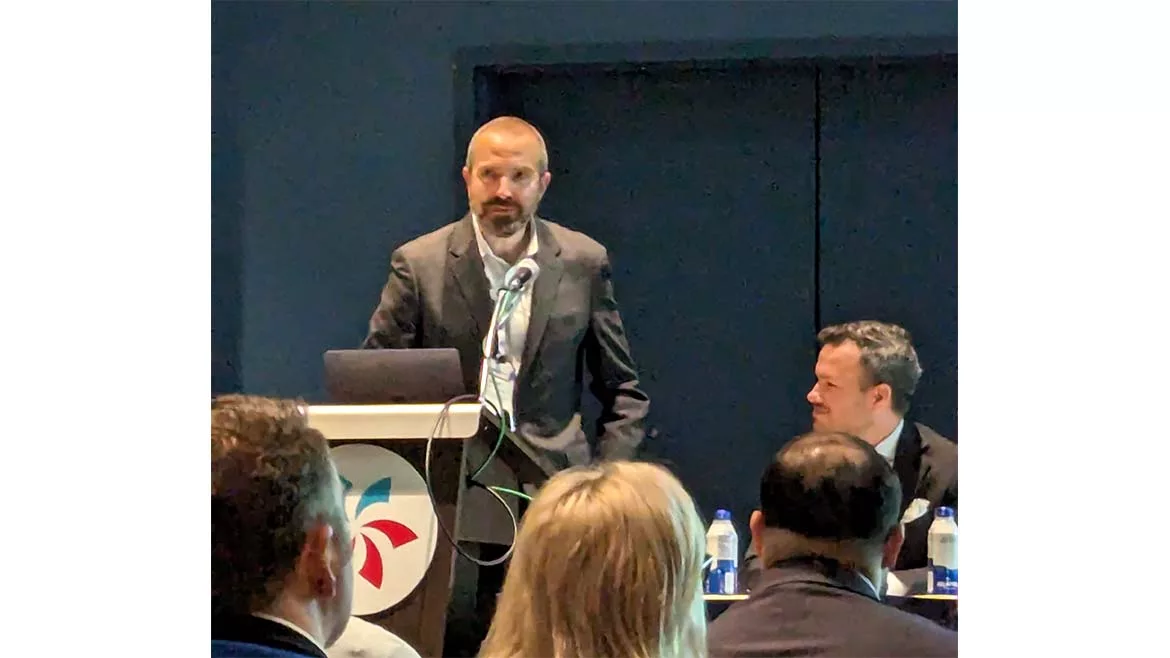
Tom Deary, director of codes at AHRI, then offered an update into which states have adopted building codes that allow the use of A2Ls. He noted that 45 states have approved the use of A2L refrigerants in some capacity.

CODE UPDATE: Tom Deary, director of codes at AHRI, offered an update on which states have adopted building codes that allow the use of A2Ls. (Staff photo)
“Those last three words there are doing a lot of work, because the code adoption process in every state varies considerably,” said Deary. “For example, there are some states that have approved the use of A2L refrigerants in residential air conditioning but perhaps not in commercial refrigeration. But in some capacity, 45 states have approved them. In a handful of states, we also sought letters of interpretation from the authority stating that A2L refrigerants and systems and equipment that use them did not violate their codes in any way. There are also a couple of states, Ohio and California in particular, where A2Ls — either through legislation or through code updates — have been approved, but they go into effect later this year.”
Of course, that means five states have not yet approved the use of A2L refrigerants, and those are Alaska, Hawaii, Massachusetts, Nevada, and Michigan. Deary said that in Alaska and Hawaii, AHRI is pushing for legislation to allow A2L refrigerants, and in Massachusetts, AHRI is ensuring that necessary amendments for A2L refrigerants are submitted as the building code undergoes public comment.
“Nevada's lack of a state building code requires active engagement with jurisdictions to update regulations by mid-2024,” he said. “And Michigan approved updated mechanical rules that include A2L allowances, but we seek further clarification through letters of approval. The review group meets soon, and I'll attend to advocate for A2L refrigerants.”
AHRI is also working to ensure A2L updates are made in the building codes of all six of the United States territories, said Deary. “In three of them, we have submitted needed amendments for A2L refrigerants, and in the other three, we are going back and forth with the departments and trying to schedule meetings with them,” he said. “But all six have identified that they understand this issue, and they understand that it needs to get done by the end of 2024. We've received no indication that we would not be able to help them accomplish that.”
It can be confusing to try and track all the building code updates across the U.S., which is why AHRI created a new interactive map that details state and local building codes and enacted legislation permitting the use of equipment employing A2L refrigerants, said Deary.
“As we learn more about U.S. states' and territories' plans regarding the transition to A2Ls, it is important to have a trusted source of accurate, up-to-date information on building codes and legislation available to stakeholders,” he said. “This is the benefit of the interactive map, which will be revised as codes and laws are updated.”
Looking for a reprint of this article?
From high-res PDFs to custom plaques, order your copy today!