Lessons from a CO Alarm Newbie
Somewhere right now an HVAC technician is dealing with their first carbon monoxide (CO) alarm call
Somewhere right now an HVAC technician is dealing with their first carbon monoxide (CO) alarm call. Their success will depend on the training they’ve received, and the test instruments they have. Some of these technicians will go into the call confidently and will be ready to troubleshoot problems. Others will be scared to death with no idea what to do. These technicians will do the best they can with the knowledge they have. But is that enough?
Almost 30 years ago, I fell into the second group. If not for a chance event, I may have never changed. Back then, I handled that first CO alarm call much differently than I would only a short time later. It took a rebuke from a gas company service technician to set me on the right path. Here’s what happened and what you can learn from my mistakes.
The Call That Changed Everything
In 1995, I was a service technician working for my family’s HVAC company. My first call on that fateful fall day was a CO alarm going off in the hallway of a customer’s home. I never handled a CO alarm call before, so I was nervous. A knot started forming in my stomach as I thought about how to handle the situation.
As I gathered the customer’s information, I learned they had also contacted the gas company. A utility service technician would be at the call when I arrived. Great! This call just keeps getting better. I arrived at the home and introduced myself to the customer. In their hallway, I found Raymond Sullivan, a grizzled gas company service technician, waiting for me.
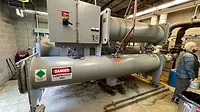
He was looking inside a hallway closet at a typical installation found throughout Central Kentucky. Inside the closet, there was an upflow 80% fan-assisted furnace common vented with a natural draft water heater. The supply ducts ran into the attic while the return ducts went through a crawlspace. The closet had a solid door and two four-inch pipes from the attic for combustion air. Directly behind the closet door was the CO alarm.
I knew the job met local codes because our company did the original installation 12 years earlier when the subdivision was new. Dad was a stickler for details and did his best to do things according to code.
Raymond gruffly mentioned he measured 10 ppm of CO around the furnace’s collector box with his test instrument. He told me the furnace likely needed work and might have a bad heat exchanger. Who was I to argue with the gas man?
Looking for quick answers on air conditioning, heating and refrigeration topics? Try Ask ACHR NEWS, our new smart AI search tool. Ask ACHR NEWS
Raymond told me he’d inspect for gas leaks while I check out the furnace. So, I pulled the blower and inspected the heat exchanger with a flashlight and mirror. I don’t see anything that resembles a crack in the heat exchanger. After reassembling the furnace, I turned it on and watched the flames.
The burners lit smoothly and the flames were a pretty blue color that looked like I had read they should. Next, I watched the flames as the blower kicked on to see if there was any disturbance. I may have missed a crack, but the flames remained steady as the blower kicked on.
Raymond came back in to check on my progress. Nervously, I told him I couldn’t find anything wrong with the furnace, so it must be a bad CO alarm. At this point in the call, it got interesting. Raymond insisted there was a problem with the furnace because he measured ambient CO inside the furnace cabinet and nowhere else in the home. I insisted that I couldn’t find anything wrong with the furnace. I probably sounded like a know-it-all 22-year-old newbie.
The exchange came to a head as the homeowner watched Raymond red-tag the furnace. He then recommended replacement to the homeowner from a knowledgeable HVAC contractor. That statement hurt, but what came next hurt even more. Raymond turned to me and shamed me in front of the homeowner for not being prepared, having the right test equipment, and only halfway doing my job.
This all happened in less than a minute, but it felt like an eternity. In shock, I sheepishly told the homeowner I would let my dad know what was going on and have him contact them. After I left, we never heard from that customer again. It wasn’t hard to figure out why.
The Change
The rest of that day was a blur. One thing I remember was how embarrassed and doubtful I felt. However, those feelings quickly changed. The more I thought about it, the angrier I got. My thoughts swirled as I asked myself, “Who was this guy to talk to me like that? What does he know about HVAC?”
Fortunately, I quickly realized these were just excuses to rationalize what I already knew. Raymond was right. I should have handled the call differently and done more. So instead of continuing the blame and excuse making, I took ownership of the situation and determined to learn more about this CO stuff.
I searched for resources and asked a lot of questions. The internet was in its infant stages then and social media didn’t exist. As I searched, I found nearly everyone I talked with didn’t know what to do either. Thankfully, I discovered an article series titled “Carbon Monoxide: What Do You Know?” by a fellow from Cincinnati named Jim Davis, who had hair from the 1970s.
Parts of the puzzle finally started connecting. I cut out Jim’s articles and studied them while looking for the visual clues Jim talked about. It was the only thing I could do. Eventually, I saved enough money to buy a Monoxor II CO analyzer from Bacharach to check ambient air and equipment for CO.
Two years later I took a Bacharach class with Rudy Leatherman. He is the man who introduced me to Jim Davis. The manual that came with the Bacharach class had answers to many of my questions. I soon found out that a lot of the material was based on Jim’s original CO and combustion books. Fortunately, I got into one of Jim’s classes a couple of years after this and the rest is history.
The change didn’t happen overnight. Instead, it took more than five years. During that time, I often considered giving up , but each time I thought back to how Raymond made me feel. Those memories were all it took to push through.
Hindsight Can Be Painful
It’s easy to dwell on past mistakes. If you aren’t careful, these thoughts can hold you back. How I handled my first CO alarm call looked much different than it would five years later. You may have noticed a pattern in my story above. I typically followed three steps back then.
- I performed a visual inspection and looked for cracks in the heat exchanger. If the furnace was older, I recommended a new one.
- I inspected the flame color and whether the blower influenced them.
- Finally, I looked at the CO alarm age and recommended a new one if nothing else stood out.
The reason I followed these steps is because I was unsure. I did the best I could with what I knew. However, the wrong process can cause you to look at the wrong things in the wrong places.
Since I had no combustion test instruments, I was guessing. You’ll notice that eyeballing the flame doesn’t count as a measurement. It is the combustion equivalent of beer can cold on a suction line. Looking back, I’m surprised at how much I overlooked and/or assumed. Some of these things were:
- Ambient CO readings
- Various CO sources that had nothing to do with HVAC
- Other fuel-fired equipment potentially malfunctioning
- Combustion analyzer readings
- Building airflow and pressure interactions.
As my knowledge improved, I figured out that Raymond measured in the wrong location using the wrong method. However, he did more than I did. I didn’t do anything except guess and make assumptions. He was also guessing but his testing gave him the illusion of credibility and the perception he knew what he was talking about.
A Better Way to Handle a CO Alarm Call
I handled a CO alarm call much differently once I knew what to do and had the right instruments to do it. No more guessing or assuming. Instead, I offered facts backed up with measurements and data. Here are the five steps I used during a CO alarm call. See if you notice a difference.
- Performed a visual inspection outside and inside the home
- Measured ambient CO with a low-level personal protection CO monitor and based my actions on NCI’s Combustion Safety Protocol
- Examined all fuel-fired equipment looking for specific clues I learned about in class
- Tested the flue gases of all fuel-fired equipment individually and compared my combustion readings to NCI’s Combustion Safety Protocol
- Checked for draft interference from other air-moving devices or building influences.
I replaced all my assumptions and guesses with measurements and guidelines. Following a proven diagnostic process made it easier to find the real problems. Was I perfect? No. But I was better at finding things I previously overlooked. And with experience, I got even better.
Discomfort Drives Action
If you’re a new technician and you find yourself in a tough spot during a call, it isn’t the end of the world. I wish someone had told me this long ago. You can learn from experience if you use it the right way. It took me getting embarrassed and angry about the situation before I did something about it. Discomfort drove me to action because I never wanted to be in that position again.
I learned that there is much more to handling a CO alarm call than a heat exchanger inspection, eyeballing the burner flames, and condemning the store-bought CO alarm. Unless you test, you’re just guessing.
In 2011, I ran into Raymond at my son’s middle school basketball game. I thanked him for the experience and told him how it changed me for the better. He appreciated my thanks but didn’t remember the event. That’s okay. I did.
Looking for a reprint of this article?
From high-res PDFs to custom plaques, order your copy today!