Cooling Chillers: A Primer
Experts discuss different chiller systems, their technologies, and applications
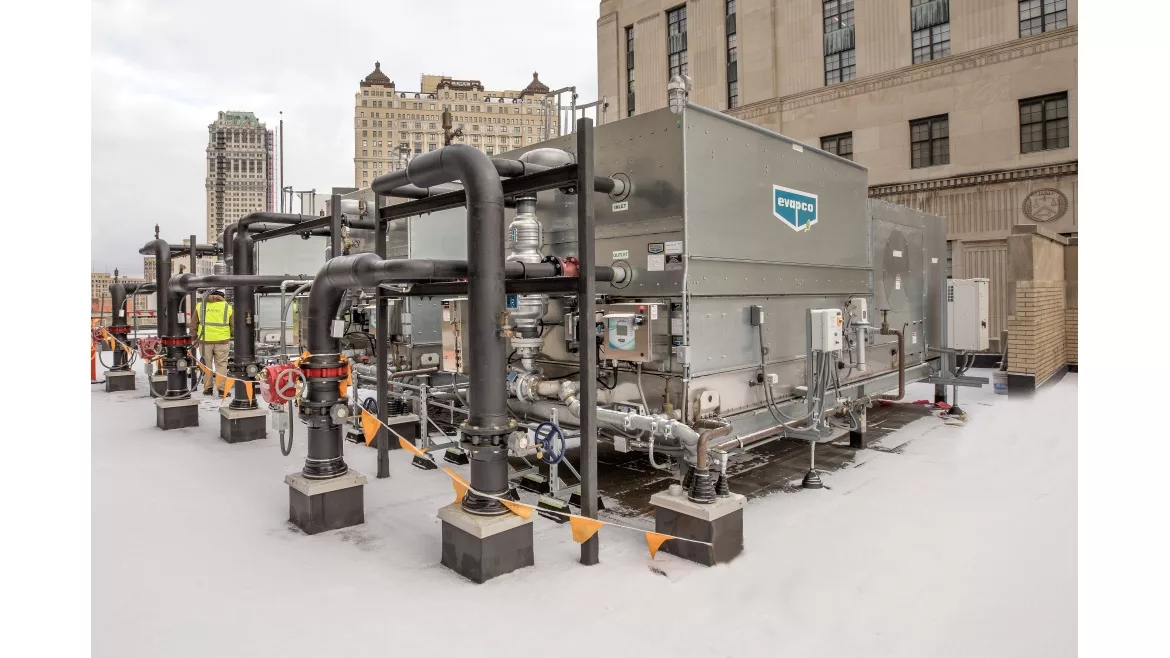
When we think of chillers, we generally think of the systems that are designed to do the heavy lifting when it comes to cooling large facilities — retail stores, office towers, shopping malls, airport terminals, college campuses and the like. Though primarily for cooling, chillers produce heat that can be put to use, too, such as for domestic hot water, or even space heating, often with assistance.
Simply put, a chiller uses a refrigerant and the principles of thermodynamics to remove heat from a conditioned space. But “chiller” is a broad term that encompasses different system configurations, refrigeration technologies, and methods of rejecting captured heat.
There are two main types of chillers. Compression chillers use a mechanical system to change the state of refrigerant and move it around. Absorption chillers use a heat source to drive the refrigeration cycle.
The NEWS recently asked experts from around the industry to explain various chiller systems and technologies and the advantages, limitations, and typical uses of different kinds of chillers. Here is what they had to say.
product marketing director
Johnson Controls Inc.
Compression Chiller
How it works: The major components of a compression chiller are an evaporator, a motorized compressor, a condenser, and an expansion valve, said Rob Tanner, product marketing director for applied equipment at Johnson Controls Inc.
A compression chiller mechanically squeezes a refrigerant gas and sends it through the compression refrigeration cycle. “Within this cycle, chilled water is produced within the evaporator and is sent through cooling coils in the air-handling units (AHUs) located throughout the building,” Tanner said.
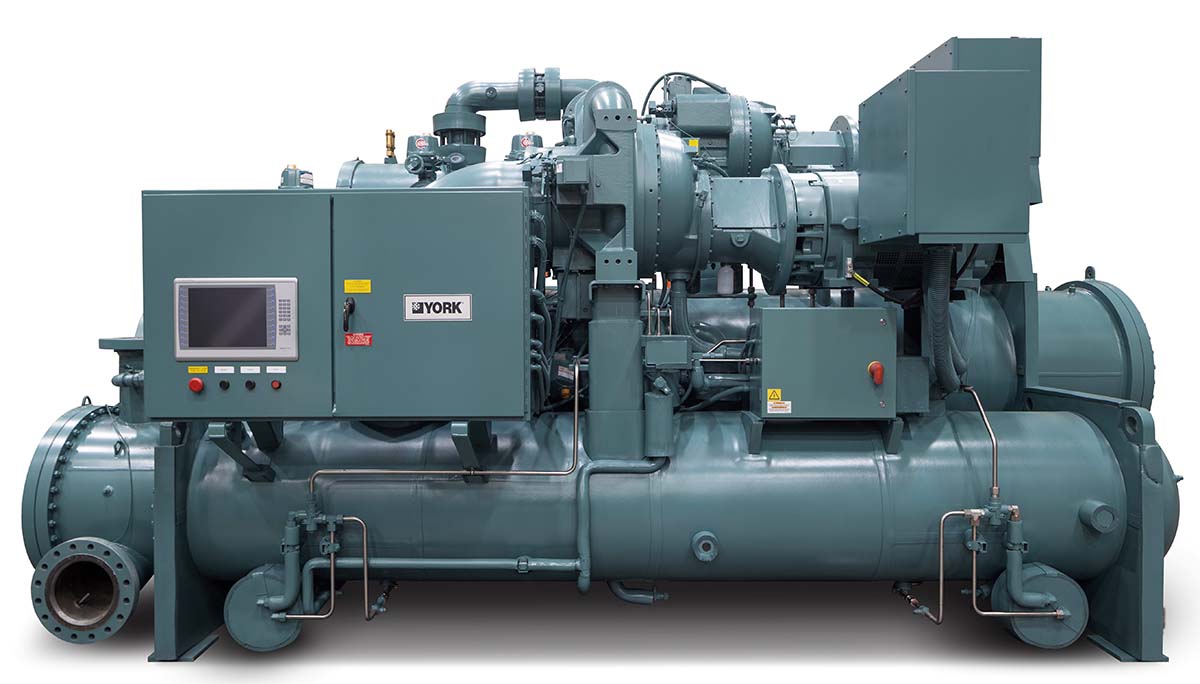
RUNNING HOT AND COLD: The YORK CYK heat pump is a chiller-heat pump combination that uses two centrifugal compressors to deliver higher water temperatures compared to a chiller with heat recovery, and can provide hot and chilled water simultaneously. The unit can save on water usage and operational costs compared to pairing a chiller and a boiler for cooling and heating. (Courtesy of Johnson Controls Inc.)
Air is blown over the cooling coils, and the AHUs move the cooled air through the building and transfer unwanted heat back into the chiller’s water circuit. Heat is absorbed into the refrigerant flowing through the heat exchanger and then returns to the compressor, according to Jeff Sturgeon, manager of the Southern California training center at the National Comfort Institute (NCI).
Looking for quick answers on air conditioning, heating and refrigeration topics? Try Ask ACHR NEWS, our new smart AI search tool. Ask ACHR NEWS
“After heat rejection occurs, the chilled water returns to the condenser to repeat the cycle,” Tanner said.
A compression chiller employs one of four mechanical compression technologies.
Centrifugal compressors use rotating impellers to add kinetic energy to the refrigerant, said Eddie Rodriguez, senior product manager at Danfoss. “The impeller then increases the velocity of the fluid, which adds energy and increases the pressure,” he said.
Screw, scroll, and reciprocating compressors all increase refrigerant pressure by decreasing its volume, said Rodriguez. A screw compressor uses a rotating helical screw, a scroll compressor pairs a stationary scroll with an orbiting scroll to create the pressure, and a reciprocating compressor uses a piston system; all three technologies are called “positive displacement,” Rodriguez said.
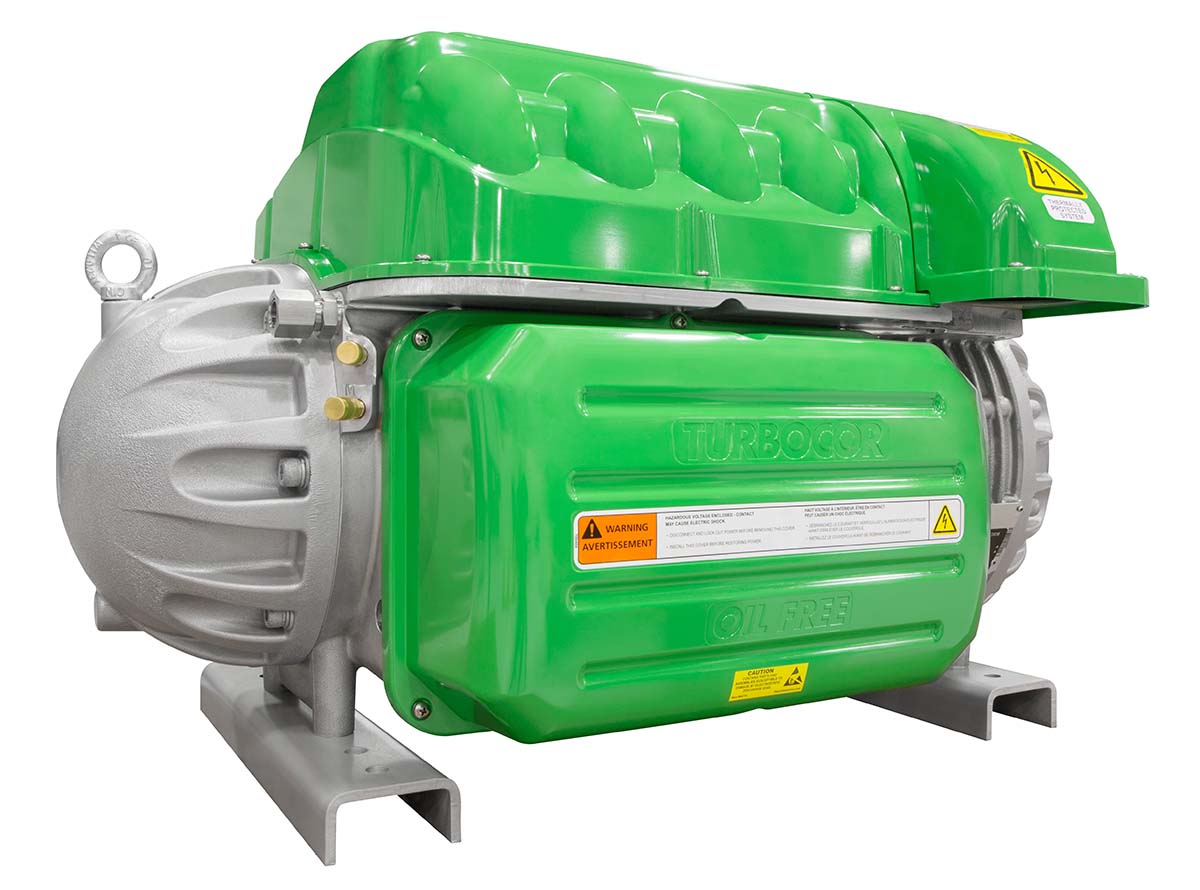
TURBOCOR: A Danfoss Turbocor TGS380 centrifugal compressor, used in vapor-compression chillers. Turbocor technology uses oil-free magnetic bearings, a variable-speed drive, two-stage compression, and a permanent-magnet synchronous motor. (Courtesy of Danfoss)
Applications: The cooling capacity of compression chillers varies widely according to the type of compression technology used. Scroll- and reciprocating-compression chillers are typically used for smaller applications, screw-compression chillers are for medium-sized applications, and centrifugal-compression chillers are for medium to large applications, said Rodriguez.
“Vapor compression chillers are dynamic systems that can be designed to meet a broad range of facility demands and decarbonization goals,” said Tanner.
Air-cooled chillers with scroll compressors can range in capacity from between 15 tons and 35 tons of refrigeration, Tanner said, while, for larger applications, some chiller models, outfitted with two centrifugal compressors each, can provide up to 6,000 tons.
“Staging multiple chillers may be necessary, depending on cooling loads,” said Tanner. “Additionally, multiple chiller types can be combined to achieve the desired load and performance. Redundancy in chiller system design can also be advantageous in critical facilities such as hospitals and data centers to minimize down time.”
Benefits: The benefits of compression chillers, Tanner said, include their wide capacity range and their ability to meet large cooling demands from big buildings.
Considerations: Disadvantages, experts said, include compressor noise, which can be higher in reciprocating chillers, and the need for space in a basement or mechanical room to accommodate the equipment (bigger cooling loads require bigger chiller footprints).
Absorbtion Chiller
How it works: An absorption chiller relies on a heating source, or waste heat, to begin the absorption refrigeration cycle. A refrigerant, usually water, is mixed with another solution that functions as an absorbent, usually lithium bromide but sometimes ammonia, Sturgeon said.
As the mixture is heated, the water turns into vapor, Tanner said. “Lithium bromide returns to the absorption chamber and the water vapor rises into the condenser,” he said. “The water vapor then travels to a cooling tower, where it condenses back into a liquid and flows into a low-pressure evaporator. Because of this sudden drop in pressure, the water is rapidly cooled to a sudden low temperature. The cooled water flows over a separate sealed water circuit that carries unwanted heat from within the building.”
Applications: The applications for absorption chillers have traditionally been limited because of their reliance on a heat source, Tanner said, but the use of recovered waste heat is broadening applications. “The U.S. Department of Energy has identified absorption chillers as one of the primary systems of combined heat and power (CHP) required to drive affordable, reliable, and low-emission energy,” he said.
Absorption chillers can range in size from gas-fired chillers for residential use that provide two tons of cooling up to large chillers with a capacity of as much as 5,000 tons, Sturgeon said. They’re typically used for medium- and large-sized buildings as well as building campuses, he said.
Benefits: Advantages, experts said, include reduced noise levels, compared to the use of compression chillers; efficiency, especially when waste heat is used as the heating source; and a lack of moving parts that typically means reduced maintenance costs.
Considerations: Limitations, according to Tanner, are that an absorption chiller that employs waste heat requires a high-quality heat source, and that the lithium bromide solution used as the absorbent risks becoming crystalized.
While chillers provide cooling to a space, they themselves need to be cooled; that is, the captured heat needs to be rejected from the system. This can be done by water, by air, and by evaporation.
Cool Tech: Water Cooling
How it works: With water cooling, captured heat is rejected from the building by cooling the condenser with water in an outdoor cooling tower, which is usually located on the roof or next to the building. Some of the water used to cool the condenser will evaporate into the atmosphere.
Applications: Water cooling can be used for either compression chillers or absorption chillers, though Tanner said that centrifugal-compression chillers are primarily water-cooled. Water-cooled chillers can be used in buildings of a wide range of sizes, but are more common in larger facilities.
Benefits: Water cooling can reject heat from chillers with the highest heat-removal capacity; is efficient, especially for large cooling loads; and lowers energy costs, compared to air cooling, by using water instead of electric fans, Tanner said.
Considerations: Water-cooled chillers require a constant supply of water, which could pose a problem in areas with water-conservation mandates, Tanner said. Because they have more components, water-cooled chillers have higher installation costs and higher maintenance costs, and they also require a larger system footprint, Rodriguez said.
Cool Tech: Air Cooling
How it works: “Air-cooled chillers disperse heat into the atmosphere through the operation of electric fans forced over an open condenser,” said Tanner.
“The heat from the application load is transferred from the evaporator-chilled water loop to the refrigerant in the condenser,” explained Rodriguez. “The heat in the condenser is then rejected to the atmosphere using fans.”
Applications: Air-cooled chillers can be used used in a variety of applications, and are more likely to be found in smaller buildings.
Benefits: An air-cooled chiller has a more compact footprint compared to a similar-capacity water-cooled chiller, and eliminates the need for a cooling tower. “Systems can often be installed on the rooftop or ground,” said Tanner. Air-cooled chillers also use less water and have lower maintenance and installation costs.
Considerations: Limitations, however, include lower cooling capacities than water-cooled chillers and decreased energy efficiency because of the use of electricity to power cooling fans. As outdoor air temperatures rise, said Sturgeon, the capacity and efficiency of an air-cooled chiller are reduced.
Cool Tech: Evaporative
How it works: Evaporative cooling can be described as a hybrid of water cooling and air cooling, said Sturgeon and Troy Reineck, who manages training at Evapco Inc., which designs and manufactures heat-transfer equipment.
While water cooling, or indirect evaporative cooling, involves some evaporation at the cooling tower, “Direct evaporative cooling uses evaporation at the entrance of the condenser coil on an air-cooled chiller to lower ambient air condition’s impacts on performance and efficiency,” Sturgeon said. “It takes a very hot environment and partially normalizes it to reduce losses in efficiency and capacity.”
“Warm water from a heat source is mixed with cool ambient air,” said Reineck. “A small percentage of the water is evaporated, removing heat from the remaining water, and warm air is discharged to the atmosphere.”
Applications: Evaporative cooling can be used for chillers that provide comfort cooling for a variety of facilities, including schools, condominium buildings, and offices, and is also used in industrial processes that require large amounts of heat, Reineck said.
Benefits: “Water is a very efficient means of heat transfer,” and evaporative cooling doesn’t require as much air movement as air cooling, said Reineck. “If I need to move less air, I don’t need as many fans.”
Considerations: Water in the cooling system will need to be maintained to regulate mineral content and prevent corrosivity. May pose issues in an area with water-use regulations or a limited water supply.
“Some areas won’t or can’t provide as much water as you need,” Reineck said.

ABSORPTION CYCLE: A simplified illustration of the absorption refrigeration cycle used in absorption chillers. (Courtesy of Trane)

COMPRESSION CYCLE: A simplified illustration of the vapor-compression refrigeration cycle in a chiller system. (Courtesy of Trane)
Looking for a reprint of this article?
From high-res PDFs to custom plaques, order your copy today!