A primer on industrial water treatment
Industrial process water can be used for washing, cutting, coating, plating, rinsing, spraying, boilers, and cooling towers
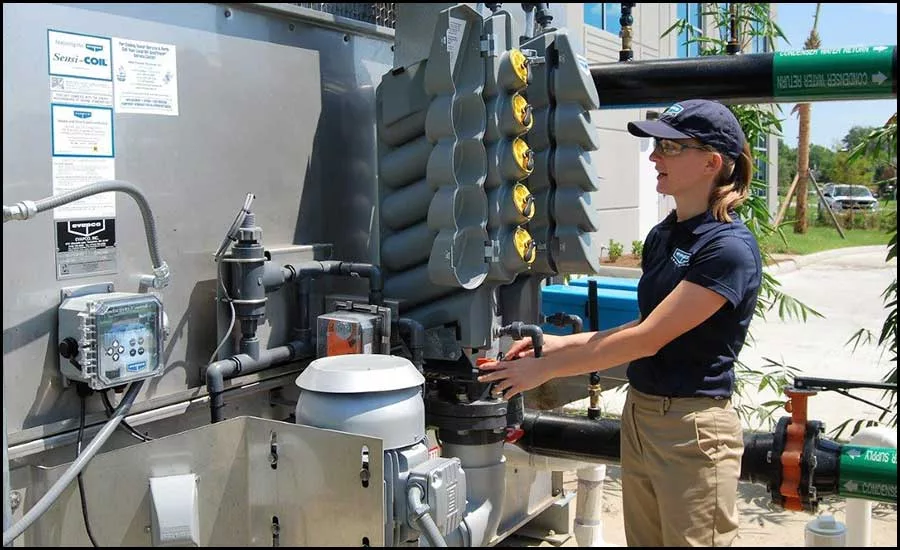
All images are courtesy of Watts and Evapco
With limited exception, many industrial facilities require the use of water as a coolant, either to transfer thermal energy or to support manufacturing processes. The extent of water consumption depends on the type of usage or processes involved.
The quality of the incoming, raw water often requires treatment or filtration — with higher levels of management and quality control to meet specific needs. Clearly, the needs for automotive manufacturing or data center cooling may differ from water quality requirements at a hospital, clean room facility, or hotel.
Industrial process water is used for a variety of manufacturing processes, including washing, cutting, coating, plating, rinsing, spraying, boilers, and cooling towers. There are often several steps involved in the treatment process, such as collecting, screening, straining, filtration, sedimentation and clarification, disinfection, storage, distribution, and evaporative release.
Photo Gallery
[image-gallery-embed ids="113196,113193,113198"]
Click on red "+" above to view gallery.
Maintaining proper industrial water quality may entail a variety of filtration, separation, or treatments to meet needs ranging from simple to complex. Treatment systems are used to introduce and maintain water of optimal quality for a wide range of applications. Some of the most common of these include raw/incoming water treatment, boiler feed water treatment (chiefly focused on combatting scale/mineralization of a heat exchanger surfaces), cooling tower water treatment systems to keep heat exchanger and chiller thermal energy transfer surfaces clean from scale and bio foulants, or wastewater treatment to meet government discharge requirements.
Industrial water conditioning typically involves the “adjustment” or preparation of water as a solution fit to a specific need. This involves removing or minimizing the natural or inherent undesirable characteristics in the water, such as softening to avoid scale or filtration to minimize particulates. Also, pH adjustment, removal of dissolved gases, addition of corrosion inhibitors, condensate treatment, and oxygen scavengers may also be required.
The tools and technologies employed, and the order they are implemented will vary greatly, based on the soluble and insoluble contaminants in the water.
Raw water
Raw water is water introduced into a manufacturing facility, typically sourced from groundwater, wells, lakes, and rivers. Raw water may be used for process cooling, rinsing, product formulations or dilution, or even as a consumable product if suitably purified.
Raw water used for industrial purposes might require treatment and filtration within a cooling tower loop — whether open (evaporative) or closed — as boiler feedwater, process or production water, or even for domestic water within a facility (used for washing, drinking, and safety showers).
Most often, industrial water treatment is tailored to meet specific needs to protect heating equipment from contaminants against scaling, fouling, or corrosion, which lead to energy loss and damage to the assets.
Raw water treatment systems typically remove materials like suspended solids, silica, iron, bacteria, and hardness. Water testing with a laboratory to determine undesirable materials in the water is often the first step in selecting construction sites for new facilities.
Photo Gallery
[image-gallery-embed ids="113195,113194,113199"]
Click on red "+" above to view gallery.
Boiler feedwater
Boiler feedwater is the water sent to boilers to generate steam or heated water otherwise used for manufacturing. Treatment of feedwater is used to protect boiler heat transfer surfaces, pipes, pumps, and other components from damage due to contaminants present in the makeup water, such as total dissolved solids (TDS); suspended solids; and organic materials like iron, copper, silica, calcium, magnesium, aluminum, hardness, or dissolved gases (with focus on oxygen and CO2).
Without proper treatment, boiler feedwater will damage equipment and piping from scaling (which can severely inhibit heat transfer or pump/valve operation), oxygen pitting, corrosion, and/or fouling of the boiler and other downstream equipment like heat exchangers and steam traps. When this happens, it results in costly plant downtime, expensive maintenance charges, loss of operational or energy efficiency, and potential equipment failure.
Unquestionably, it makes business sense to focus on maintaining consistent boiler feedwater quality. Types of treatment and filtration are designed to remove harmful impurities prior to entering a boiler, or to control water quality parameters. A boiler feedwater treatment system usually incorporates the following:
- Makeup water intake — Boilers lose water to steam consumption, loss of condensate return, and leakage. Replacement/makeup is drawn from treated city supply or raw water treatment systems.
- Filtration (Micro-Z) — Water is typically filtered to remove sediment, turbidity, and organic material. When used for pretreatment, it’s possible that membrane filtration units may be most cost-effective.
- Softening — This is used to remove calcium and magnesium hardness. This is accomplished by a softening resin, typically a strong acidic resin that allows it to effectively capture and remove hardness ions from the stream.
- Reverse osmosis (RO) — This can be very useful for removal of bacteria, salts, organics, phosphates, silica, and hardness. RO (and nanofiltration) both employ membrane filtration to capture contaminants. RO systems for industrial purposes typically provide a 65% to 75% recovery rate but can be pushed upwards of 90% as efforts to save water increase.
- Primary ion exchange (IX) — For large volumes of water or high-pressure boilers, deionizers may be used instead of membrane filtration. IX typically produces water of comparatively higher quality and resistivity, as well as better yields.
- Deaeration or degasification — Following all other treatment steps, the makeup water and condensate from the boiler system are combined and degasified of oxygen and, in some situations, carbon dioxide — ideal for corrosion prevention in the boiler and the condensate systems.
- Distribution — Following all treatment steps, boiler feedwater is piped to a boiler, where it’s heated to form steam. From this point, boiler condensate can be combined with treated makeup water, and the cycle begins again.

Cooling tower water
Cooling tower water is the water flowing to and through cooling towers as makeup water, water for circulation within a cooler, or blowdown water; it requires treatment and/or filtration. Equipment and piping must be protected against chlorides, hardness, iron, biological materials, silica, sulfates, and TDS, among other challenges.
With circulated water — the water flowing between the plant and a cooling tower — facility managers know to keep a watchful eye on TDS levels. At high levels, the challenge of TDS must be dealt with normally through blowdown. Much of the volume of water must be flushed and, as replacement/makeup water comes in, there are then new concerns to keep water in optimal condition. The better the condition of makeup water, the easier it is to maintain optimal water conditions. Typically, cooling tower conductivity and TDS is increased, or cycled up, to conserve water. This is done with proper mechanical and chemical treatment.
Treatment systems should remove harmful impurities in line with manufacturer recommendations for water quality. Typically, cooling tower water treatment systems will include the following:
- Makeup water intake — With most cooling towers, especially those designed to cool through evaporation, water needs to be replaced. Makeup water for a cooling tower may be drawn from a variety of sources. In some cases, source water must also be treated for hardness, silica, iron, and/or pH adjustment. The tower will use latent heat of vaporization to cool the water and can be impacted greatly by wet bulb temperatures and heat load at facilities.
- Filtration — Source water is typically filtered through one or more types of filtration to remove sediment, turbidity, or organic material, providing a cost-effective method of fouling prevention, and to avoid unnecessary maintenance of downstream equipment.
- Softening — If the water has high hardness, a softening resin can be used. Contaminants would otherwise cause scale deposits. Depending on feed water quality, softening can improve the operational efficiency of cooling towers.
- Chemicals — Very often, water for cooling towers may require some form of chemical treatment. This may include corrosion inhibitors, algaecides/biocides and/or scale inhibitors. More recently, the bacteria and, specifically, Legionella risks associated with cooling towers have gained greater visibility, as the droplets containing Legionnaires can travel great distances. A proper management plan will account for consistent dosing and remediation plans, should parameters shift out of specification.
- Side-stream filters — Many cooling towers recirculate water. Side-stream filtration can be helpful to remove contaminants that entered through atmospheric contamination, as is seen as a best practice need for open circulating systems. Removing material can help prevent debris from plugging spray nozzles or forming deposits on heat exchanger surfaces. Filtration can also protect equipment, like pumps, in the system.
- Post-treatment — If the volume of water usage is a concern, facility managers may opt to treat the blowdown water through RO filtration for reuse. Other post-treatment systems/methods may also be helpful prior to discharge. Oftentimes, this water can be reclaimed and used to save water in other parts of the facility.
Wastewater
Water used within an industrial plant is eventually lost due to evaporation, leakage, consumption (if it’s an ingredient within a product), or is discharged as an effluent. It can either be reused or safely discharged — whether back into the environment or into a treatment facility.
Commonly, the need to avoid environmental hazards is paramount. The relative complexity of a wastewater treatment will depend chiefly upon the compliance regulations impacting the plant. After compliance, there is often ability to improve optimization of equipment like barrel screens, belt filters, dissolved air flotation (DAF), and clarifiers. These optimizations can be accomplished mechanically, chemically, or even electrically in the case of a DAF air compressor being optimized to conserve electrical energy.
Conclusion
As you can see, there are a wide range of requirements for industrial water treatment. Each area has a unique set of challenges and often multiple pieces of equipment to meet the end goal.
By focusing on water quality, you can ensure the safety of water system users, increased life span of the equipment, and compliance.
Looking for a reprint of this article?
From high-res PDFs to custom plaques, order your copy today!