Basic Refrigeration: Thermodynamics of Heat Transfer
First in series describes how temperature and pressure changes affect refrigerant
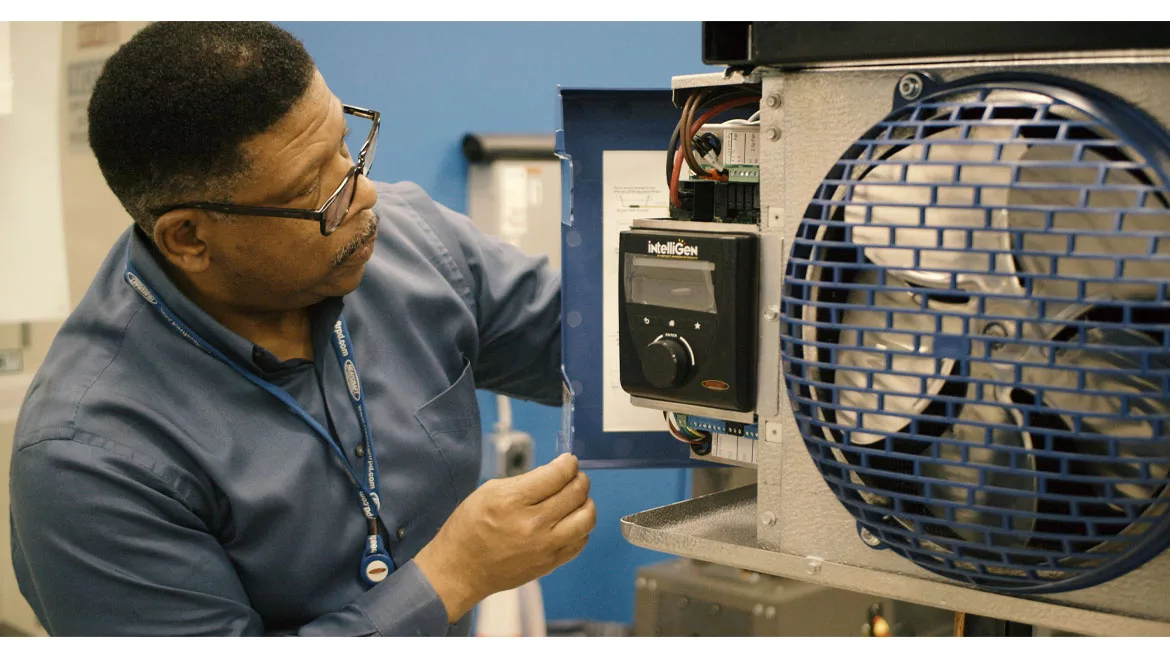
People not in the refrigeration business often think that refrigeration equipment produces cold air; in fact, the equipment is actually removing heat from air and leaving what’s left — the cold. When the sensor determines the target temperature has been reached, the equipment can take a pause, and when the temperature goes back up, the equipment goes on again.
It’s a fairly simple concept, but we all recognize that there is more to refrigeration equipment than that. In this article, you will learn about ways in which heat flows and factors that determine the speed of heat transfer. You will also learn about the four laws that describe how temperature and pressure changes affect the state of refrigerant in a sealed piping system. As a technician, you’ll need to know all of this as you troubleshoot equipment.
Heat Transfer
There are three different methods of heat transfer:
- Radiation. Radiant energy warms what it can touch; for example, radiant energy from the sun must touch a surface — Earth or our bodies — to transfer its heat. That’s why space is so cold (-455°F) — the radiant energy from the sun isn’t touching anything to warm it.
- Conduction. With conduction, direct physical contact is needed to transfer heat. When you touch an ice cube, it feels cold because the heat of your body moves from a warmer object — you — to a cooler object — the ice cube.
- Convection. Also called the chimney effect, convection is heat transfer by temperature differences; for example, in a fireplace, the products of combustion become lighter and start to rise. The chimney or flue pipe experiences a thermal draft, and the products of combustion will be drawn up the flue to the outdoor ambient.
Now that you understand the different methods of heat transfer, you need to know what affects the rate of heat transfer:
- Temperature difference. Sometimes in refrigeration, temperature difference is called the Delta T or ΔT. The greater the temperature difference between two objects, the faster heat flows from the warmer source to the cooler source.
- Surface area. The more surface area for the conductor, the more heat that can be transferred. Today’s modern HVACR larger coils enable the system to move a higher volume of heat, which is then rejected to the outdoor ambient.
- Type of material. For our purposes, there are two basic types of material — an insulator or a conductor. Although an insulator will conduct heat, it does not do that well, so it basically slows down the heat exchange process. On the other hand, copper and aluminum piping are very good heat conductors.
Refrigerants
Refrigerants are chosen for specific properties and how they behave is critical to the heat removal process. By manipulating temperature and pressure, it is possible to set up a condition that will allow refrigerant to either absorb or reject heat.
In a self-contained or sealed refrigeration system, the refrigerant piping is completely connected and not exposed to the outside air pressure, and components include the compressor, condenser, and evaporator (see Figure 1).
 Click graphic to enlarge
FIGURE 1: Refrigeration systems contain components that include the compressor, condenser, and evaporator. (Courtesy of Heatcraft)
In liquid state, refrigerant is primed to transfer heat from the walk-in cooler, for example, through the system to the outdoor heat exchanger. Liquids can’t be compressed, so refrigerant comes into the inlet of the condenser as hot vapor and moves through the passages of the condensing coil. Because there is a temperature difference between the outside air and the hot vapor, heat will transfer and refrigerant will change state from gas to liquid when it exits the condenser outlet.
The liquid receiver shown in Figure 1 simply receives subcooled liquid, then it flows to the thermal expansion valve (TXV) or electric expansion valve (EEV). When it leaves the TXV or EEV, refrigerant goes to a distributor, which divides the flow of liquid refrigerant into all the openings of the evaporator coil. Here, refrigerant pressure will drop, lowering the temperature. These two factors are directly proportional.
In the evaporator coil, there is a significant drop in temperature because of the drop in pressure. The warmer air being blown across the coil will give up some of the heat absorbed by the colder refrigerant being drawn through the suction line back to the compressor. The refrigerant vapor enters the compressor, which discharges refrigerant as a hot gas that then enters the inlet of the condensing coil, where it is rejected or gives up the heat collected from the evaporator to the outdoor ambient. As it does, it changes state from a hot gas to a subcooled liquid. Then the cycle starts all over again.
Four Laws
There is a set of laws that govern these changes of state from vapor to liquid. When refrigerant is inside a sealed system, several things will influence whether it is in a liquid state or a gas (vapor) state, and there are four laws that describe how the refrigerant behaves:
-
Boyle’s Law states that the pressure of an ideal gas (a gas with no contaminants in it) is inversely proportional to its volume at a constant temperature (see Figure 2). For instance, assuming temperature remains the same, if the pressure of a quantity of gas is doubled, the volume is reduced by half. Or, if the volume is doubled, the gas pressure is reduced by half.

Click graphic to enlarge
FIGURE 2: Boyle’s Law states that the pressure of an ideal gas (a gas with no contaminants in it) is inversely proportional to its volume at a constant temperature. (Courtesy of Heatcraft)
- Charles’s Law states that the volume of a given quantity of gas at a constant pressure varies according to temperature; therefore, refrigerant can take up more space just by heating it.
- Dalton’s Law of partial pressures states that every gas has weight. The total pressure of a mixture of gases is the sum of all the pressures of each of the gases in the mixture. Take our air, for example. At sea level, Earth’s total atmospheric pressure is 14.69 psi (pounds per square inch), which is the sum of all the pressures of the gases at sea level.
- Perfect Gas Law states that if gas in a container is heated, increasing the temperature, then the pressure of the gas will also rise in proportion to its pressure-temperature relationship. Essentially, if refrigerant is heated, its pressure will also increase, and if the refrigerant is cooled, its pressure will decrease. This law is most useful in understanding the principles of refrigeration. When refrigerant gauges are connected to a sealed system, just remember that temperature is directly proportional, so when temperature goes up, pressure follows. When temperature goes down, pressure goes down with it.

Click graphic to enlarge
FIGURE 3: The Perfect Gas Law states that if refrigerant is heated, its pressure will increase, and if the refrigerant is cooled, its pressure will decrease. (Courtesy of Heatcraft)
All this information can help technicians become more adept at troubleshooting. Knowing how the equipment is supposed to work provides a baseline for a means of comparison.
This is the first of a three part Basic Refrigeration series. Read the rest, which also cover:
To learn about troubleshooting refrigeration systems, technicians may want to attend in-person technical training at Heatcraft’s training facility in Stone Mountain, Georgia.
Looking for quick answers on air conditioning, heating and refrigeration topics? Try Ask ACHR NEWS, our new smart AI search tool. Ask ACHR NEWS
Looking for a reprint of this article?
From high-res PDFs to custom plaques, order your copy today!