ACHR News
search
Ask ACHR NEWS AI
cart
facebook twitter instagram linkedin youtube
  • Sign In
  • Subscribe
  • Sign Out
  • My Account
ACHR News
  • NEWS
    • Breaking News
    • New HVAC Products
    • Featured Products
    • Manufacturer Reports
    • HVAC Data
    • Legislation
    • ACHR NEWS Centennial
  • RESIDENTIAL
    • Air Conditioners
    • Furnaces
    • Residential Heat Pumps
    • Ductless
    • Residential IAQ
    • Testing, Monitoring, Tools
    • Components & Accessories
  • COMMERCIAL
    • Air Handlers
    • Rooftop Units
    • Chillers and Cooling Towers
    • Commercial Heat Pumps
    • Boilers and Hydronics
    • VRF/Ductless
    • Commercial IAQ
  • REFRIGERATION
    • Refrigerants
    • Refrigerant Regulations
    • Leak Management
  • CONTRACTOR PRO
    • Geothermal
    • Homeowner Study
    • VRF and VRV Ductless
    • Unitary Trends
  • EDUCATION
    • Training and Education
    • Business Management
    • Service and Maintenance
    • Continuing Education
    • Market Research >
      • HVAC Brand Awareness Report
      • VRV, VRF, VRVZ Report
      • Unitary Trends Report
      • Water Heat Professionals Report
    • Webinars
    • Sponsor Insights
    • eProducts Info
    • White Papers
  • EVENTS
    • HVAC Contractor Forum
    • Industry Events and Webinars
  • MEDIA
    • Videos
    • AHR Expo 2025 Videos
    • Podcasts >
      • ACHR News Podcast
      • HARDI Podcasts
      • AHR Expo Podcasts
      • ACCA Podcasts
    • Interactive Spotlights
    • Quizzes
    • eBooks
    • HVAC Talkback
  • HVAC GROUP
    • ACHR NEWS >
      • Current Issue
      • Digital Edition
      • Subscribe
    • Distribution Trends
    • SNIPS NEWS >
      • Join SNIPS NEWS
    • Engineered Systems News >
      • Join ES News
    • HVACR Directory
    • Contests
    • Newsletters
    • Contact
    • Advertise
    • My Account
HVAC ContractingNewsService and MaintenanceHVAC Residential MarketVentilationResidential Indoor Air Quality

Benefits of a Residential Air Balance Report

These reports help the contractor to stand out to customers
By David Richardson
Air Balance Report.
March 31, 2021

Since the 1960s, engineers have required air balance reports to assure their designs work in the field. These reports gather multiple HVAC system measurements and put them in a single form that shows a complete picture of true performance. Could you benefit from using a similar report?

READ MORE ABOUT

• Residential Indoor Air Quality

• Ventilaition

• Troubleshooting


From Commercial to Residential

Air balancing has its roots in commercial and industrial HVAC. In this world, individual testing, adjusting, and balancing (TAB) professionals “fine-tune” the installing contractor’s work and document the quality of the final product.

The balancer records all measurements and test results on an air balance report. Once testing is complete, they compare their readings to manufacturer specifications or engineered drawings. If everything is within specifications, they submit the balanced system. If balancing is unattainable, they make a list of deficiencies and repairs for the installing contractor to correct.

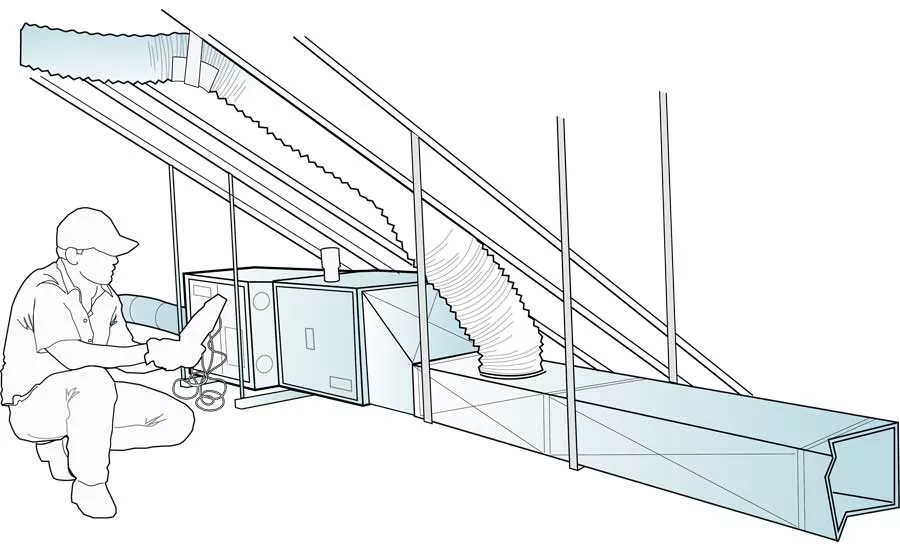
Residential HVAC professionals across the country now use many of these same principles in various and creative ways. They are the balancers. They use proven air balancing tests to diagnose airflow issues, verify the quality of their work, and prove their systems perform as designed.


A Residential Air Balance Report Is an Assurance Policy

Air is an invisible part of the systems you design, test, and repair. Low airflow equals low comfort and high operating costs. Unfortunately, these problems show up as a disappointed customer. You can avoid that by fixing many issues that lead to their concerns before they ever know about it. It just takes a bit of testing.

A residential air balance report is a single page that is part of a larger report package. It provides a place to record the information that identifies various system problems.

If conditions exist that prevent the system from operating as designed, the contractor can discover the issue and fix it before it results in a callback or equipment failure. Without the information on an air balance report, many of these issues remain hidden.

Looking for quick answers on air conditioning, heating and refrigeration topics? Try Ask ACHR NEWS, our new smart AI search tool. Ask ACHR NEWS →

The report assures your system works as designed and your customer gets what they paid for.


A Residential Air Balance Report Puts Information in One Place

Good air balance reports gather all the right information in a single location. In its basic format, a residential air balance report includes:

  • Project information (customer name, address, test date, and balancer’s name)
  • Equipment information (manufacturer, model, and serial numbers, technical specifications)
  • System information (location, room names, grille information, and design airflows)
  • Test results (static pressure, fan airflow, temperature, voltage, amperage, outside air, supply register airflows, and return grille airflows).

Experienced balancers fill out all the known system information at the office. The only thing they need to do once they arrive at the job site is gather missing information. Then it’s time to measure with the appropriate test instruments.


A Residential Air Balance Report Guides Adjustments and Repairs

Once a balancer has all the measurements and information they need to complete the report, they see a clear picture of how the system operates. They compare their measured test results against manufacturer specifications. These include required airflow, rated external static pressure, and design calculations, such as room airflow from a load calculation.

Balancers examine test results to see where the system is and then figure out where to adjust. The measurements help take them towards their next steps. Such measurements are like a GPS. They guide you to necessary adjustments and issues. However, if you don’t listen to the directions or look at the display, you’ll end up lost.

Let’s say a balancer tests and determines that fan airflow is too high. From this information, they know to adjust the fan speed to get within 10% of the required airflow. Measuring individual room airflow works the same way. The results from a balancing hood may show that some rooms have too much airflow, while others don’t have enough. The measurements guide the balancer to necessary damper adjustments to get register and grille airflow within 10% of the design.

Once the balancer makes final adjustments, he or she tightens all balancing damper handles and marks them with a felt-pen marker or a shot of spray paint. This step may sound excessive, but it kept me from rebalancing an entire system years ago.


Don’t Fake the Numbers

There are times your readings won’t come out perfect. Welcome to the world of field measurements! Your readings probably won’t add up, either. It’s rare that they do. There are lots of reasons readings don’t come out perfect. Some common culprits are duct leakage, test instrument accuracy, and measurement techniques. That’s the reality of measuring in an imperfect environment.

If the readings are off substantially, you’re in luck. The best lessons you learn are when your readings don’t look right. You must dig deeper and find out why. If this happens to you, whatever you do, don’t fudge the test results. Reckon with the numbers and look deeper to understand what they reveal. This challenge will rapidly improve your testing skills.

It’s hard to fake the numbers. Any skilled HVAC professional can pick apart a bogus balance report in less than five minutes. Those who measure can see airside relationships that you can’t fake on paper. To the trained eye, they stand out like a zit on a teenager’s forehead.


Continued Report Benefits

Repeating issues that appear in the test results show improvement opportunities for your installation crews. The report makes the results of their work visible. Your top duct guys get validation for their work. The sloppy duct guys can’t hide from the report results. Minor details have an enormous impact. Issues like excess flex duct core and kinked ducts show up in the numbers.

There are also times when the system has been in operation for a while and someone comes along and damages the ducts. The report provides a paper trail documenting any future change in the system and what led to the cause.

The same accountability also protects your installation in case comfort issues arise that are beyond the HVAC system. It eliminates the HVAC system as a potential suspect and points toward other problems that can affect comfort such as building and insulation defects. The documentation takes the monkey off your back and guides you to a solution for the homeowner.


Next Steps

So how do you promote an air balance report as part of your work?

  • First, you need to know how to air balance a duct system, and you need to have the proper test instruments.
  • Second, test your work to identify areas of improvement and then make necessary corrections.
  • Third, make air balancing a premium package option for your customers who want an exceptional duct system and proven results. You provide the option. They decide if they want it or not.

An air balance report helps you stand out and says volumes about your company, design methods, installations, and results. It shows confidence and proves you take responsibility for your work. Remember, if you don’t measure, you don’t know. However, your customers will. They will feel it, and your balancing report will prove it.

KEYWORDS: airflow management Duct Dynasty HVAC service troubleshooting and HVACR ventilation control

Share This Story

Looking for a reprint of this article?
From high-res PDFs to custom plaques, order your copy today!


David richardson
David Richardson serves the HVAC industry as Vice President of Training for National Comfort Institute, Inc. (NCI). NCI specializes in training focused on improving, measuring, and verifying HVAC and Building Performance. If you’re an HVAC contractor or technician interested in learning more about building science applied to HVAC, contact David at ncilink.com/ContactMe.

Recommended Content

JOIN TODAY
To unlock your recommendations.

Already have an account? Sign In

  • HVAC-enrollment

    The Trades Are Back: HVACR Programs See Nearly 30% Enrollment Spike

    A new wave of future technicians is entering the pipeline.  
    News
    By: Matt Jachman
  • 2025 Top 40 Under 40

    2025 Top 40 Under 40 HVACR Professionals List

    The 11th annual Top 40 Under 40 list highlights those...
    HVAC Residential Market
    By: Hannah Belloli-Oster
  • LG Ductless Mini-Split Systems

    The 9 Types of Heat Pumps

    As the U.S. moves toward electrification, heat pumps are...
    HVAC Residential Market
    By: Joanna R. Turpin
Subscription Center
  • Create an Account
  • Start a Subscription
  • Manage My Account
  • Sign Up for Newsletters
  • Visit Customer Service
  • Update Preferences

More Videos

Sponsored Content

Sponsored Content is a special paid section where industry companies provide high quality, objective, non-commercial content around topics of interest to The News audience. All Sponsored Content is supplied by the advertising company and any opinions expressed in this article are those of the author and not necessarily reflect the views of The News or its parent company, BNP Media. Interested in participating in our Sponsored Content section? Contact your local rep!

close
  • Piggy Bank
    Sponsored byWatercress Financial

    Energy Prices, Inflation, and HVAC: What Today’s Homeowners Care About

  • Refrigerated Food
    Sponsored bySolstice Advanced Materials

    R-455A Refrigeration: A Cold Storage Solution for the Future

  • Airex Rooftop Units
    Sponsored byAirex Manufacturing Inc

    Consolidating Roof Penetrations: A Growing Trend in Multifamily HVAC Design

Popular Stories

HVAC-Price-Increase-graphic

HVAC Price Increase List: July 2026

Trade groups challenge EPA refrigerant rule

HVACR Trade Groups Challenge EPA Refrigerant Rule in Federal Court

heat-pump-tech-customer.jpg

DOE Updates $8.8B Home Energy Rebate Program Guidance

Lovato-refrigerant-rooftop_AC_Units_.jpg

When Refrigerants Change, So Do the Contactors

Martin Hoover

ACCA Leadership Shakeup: Barton James Out, Hoover Named Interim CEO

View The ACHR NEWS
Centennial Anniversary Timeline

The ACHR News Timeline Chart
Submit a Letter
Submit a letter to our editors.

Events

November 6, 2025

Next-Gen Data Center Cooling: HVAC Innovation and Real-World Solutions

On Demand As AI workloads and high-density computing push traditional cooling methods to their limits, the data center industry is accelerating the adoption of next-generation HVAC technologies.

July 22, 2026

Designing VRF Systems Using A2L Refrigerant

In this session, we will cover how to design VRF systems for the U.S. market using new A2L refrigerants. These systems provide an advanced zoning solution by using inverter technology to deliver precise heating and cooling control across multiple zones and spaces.

View All Submit An Event

Poll

Summer Staff

Are you fully staffed for the summer season?
View Results Poll Archive

Products

BNI Mechanical/Electrical Square Foot Costbook, 2026 Edition

BNI Mechanical/Electrical Square Foot Costbook, 2026 Edition

See More Products
Designing Systems Using A2L Refrigerant - Free Webinar - 7/22/2026

Related Articles

  • Profit-ACHR-NEWS

    The Irreplaceable Benefits of a Well-Constructed Budget

    See More
  • Credit Card at Gas Station

    Reaping the Benefits of a Properly Managed HVAC Fleet

    See More
  • Benefits of a Group Partnership

    See More

Related Products

See More Products
  • Installing Residential Forced Air Furnaces

  • A-Heat-Pump-Thats-Not-Delivering-Any-Air-DVD-Cover-218x300.jpg

    A Heat Pump That’s Not Delivering Any Air

See More Products

Related Directories

  • Associated Air Balance Council

    Associated Air Balance Council (AABC) sets standards for Total System Balance, certifies independent agencies, and ensures unbiased, high-quality services with a National Performance Guaranty and rigorous Quality Assurance Program.
×

Sign Up. Stay Informed.

The #1 trusted source for the HVACR industry since 1926

SUBSCRIBE
  • RESOURCES
    • Advertise
    • Contact Us
    • Advisory Board
    • Classifieds
    • Submit a Letter
    • Directories
    • Store
  • ACCOUNT CENTER
    • Create an Account
    • Start a Subscription
    • Manage My Account
    • Sign Up for Newsletters
    • Visit Customer Service
    • Update Preferences
  • SERVICES
    • Marketing Services
    • Reprints
    • Market Research
    • List Rental
    • Survey/Respondent Access
  • STAY CONNECTED
    • LinkedIn
    • Facebook
    • Instagram
    • YouTube
    • X (Twitter)
  • PRIVACY
    • PRIVACY POLICY
    • TERMS & CONDITIONS
    • DO NOT SELL MY PERSONAL INFORMATION
    • PRIVACY REQUEST
    • ACCESSIBILITY

Copyright ©2026. All Rights Reserved BNP Media, Inc. and BNP Media II, LLC.

Design, CMS, Hosting & Web Development :: ePublishing