How to Prevent the Compressor From Overheating
Discharge temperatures, superheat can offer insights
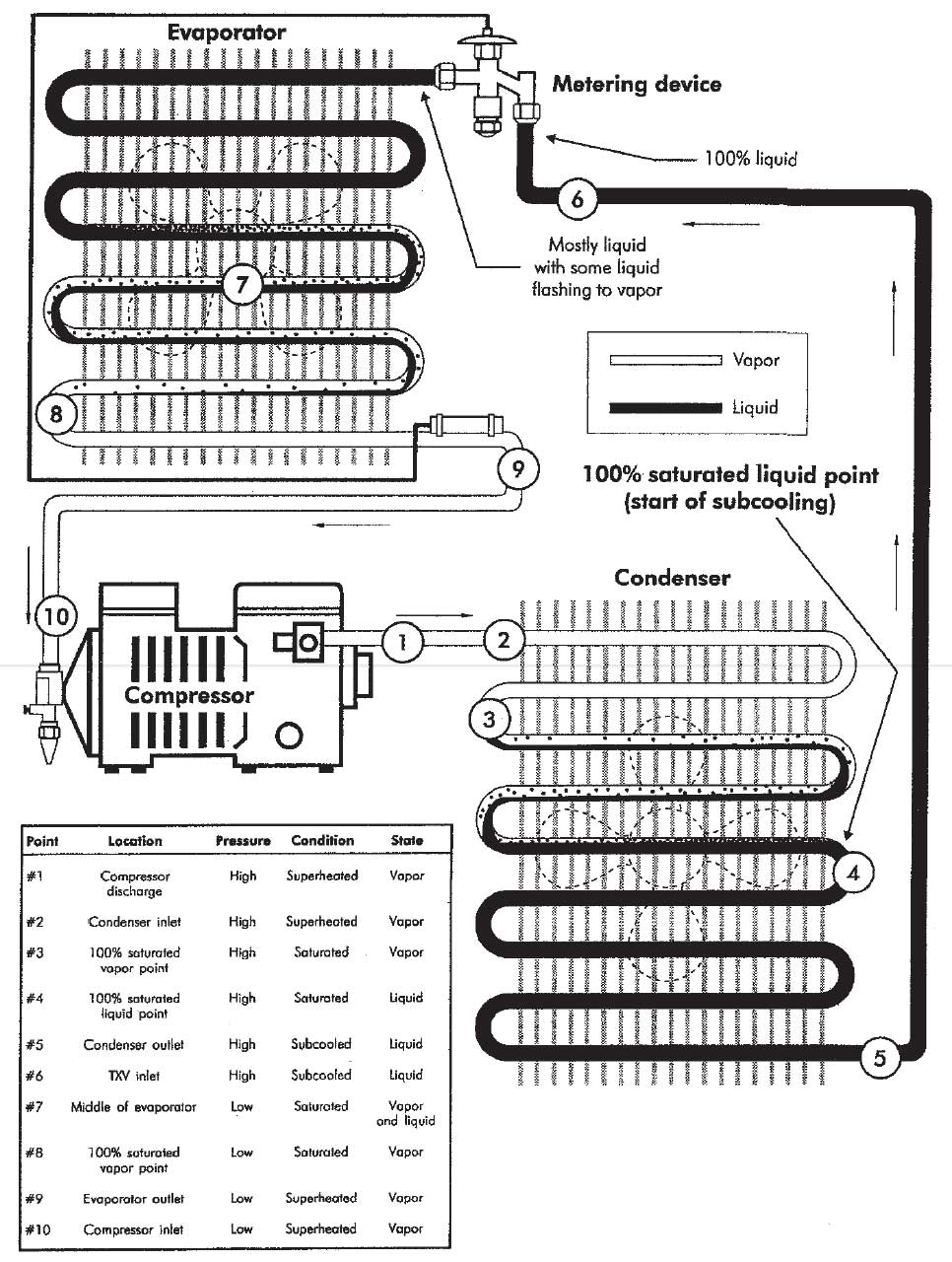
The hottest temperature point in a refrigeration or air conditioning system is on the back of the compressor’s discharge valve, as shown in Figure 1. However, since this point cannot be measured by a field service technician, the discharge line temperature has to be measured instead. The discharge line is shown at Point 1 in Figure 2.
The compressor’s discharge temperature can be measured by placing an insulated thermistor or thermocouple on the discharge line about 3 to 4 inches from the compressor (Point 1). The discharge temperature is a measure of the superheated refrigerant’s vapor temperature; it measures the compressor’s discharge line heat intensity, not heat content. To obtain the heat content (enthalpy), it would be necessary to know both the pressure and temperature at this point and then use a thermal dynamic superheat table for this specific refrigerant.
Remember, superheated refrigerant refers to a refrigerant vapor that is at a higher temperature than its saturation temperature for a certain pressure, which, in this case, would be the condensing pressure for the high side of the system. For example, this system’s refrigerant is R-134a, and the condensing pressure is 124 psig. Using a pressure/temperature (P/T) chart, the corresponding temperature for the 124 psig condensing pressure is 100°F. This means that the condensing temperature is 100° at the condenser’s phase change from vapor to liquid inside the condenser (between Points 3 and 4 on Figure 2). If the compressor’s discharge temperature at Point 1 reads 225°, the superheated gas coming out of the compressor would have to be desuperheated by 125°
(225° - 100° = 125°) before it reaches the condensing temperature of 100° and starts to phase change from vapor to liquid. This process is called desuperheating because it is sensibly cooling or desuperheating the hot refrigerant gas as it travels from the compressor outlet to the condenser, where the beginning of the phase change happens.
COMPRESSOR DISCHARGE TEMP
The compressor’s discharge temperature can tell the service technician what is going on inside a refrigeration or air conditioning system. Since this is a superheated vapor temperature measurement, a P/T relationship does not exist, and a pressure gauge cannot be used for its measurement. Pressure gauges can only be used for a P/T relationship when a saturation temperature (evaporating and/or condensing) is wanted.
The compressor discharge temperatures reflect all of the latent heat absorbed in the evaporator, the evaporator superheat, the suction line superheat, the heat of compression, and mechanical and fluid friction heat along with heat that the compressor motor generates. All these heat sources can be divided into heat absorbed and heat generated as follows.
Heat absorbed:
- Latent heat in the evaporator;
- Evaporator superheat; and
- Suction line superheat.
Heat generated:
- Heat of compression;
- Mechanical and fluid friction; and
- Compressor motor heat.
It is at the discharge temperature where all of this absorbed and generated heat is accumulated and now must start to be rejected in the discharge line and part of the condenser. Also, the compressor’s discharge temperature is a reflection of the hottest part of a refrigeration system, and there are limits as to how hot a discharge temperature should be.
Looking for quick answers on air conditioning, heating and refrigeration topics? Try Ask ACHR NEWS, our new smart AI search tool. Ask ACHR NEWS
TEMPERATURE LIMITS
The limit to any compressor discharge line temperature is 225°. If the discharge temperature is higher than that, the system may start to fail from worn rings, acid formations, and oil breakdown. Remember, if the discharge temperature is 225°, the actual discharge valve will be about 75° hotter, which brings the actual compressor’s discharge valve to 300°. Most oil will start to break down and vaporize at 350°, and if this occurs, serious overheating problems will happen. Since the overheating of compressors is one of the most serious field problems, service technicians must always monitor compressor discharge temperatures and keep them under 225°.
Some of the main reasons for high compressor discharge temperatures are listed below.
1. High condensing pressures, which are caused by high condensing temperature. When this happens, the compressor must work harder, so it generates more heat when compressing the suction pressure to the higher condensing pressures. Reasons for this can include:
- Dirty condenser coils;
- Burned out condenser fans;
- Broken fan belts;
- Undersized condenser coils;
- Overcharge of refrigerant
- Noncondensables in the system;
- High ambient temperature; and/or
- Recirculated air over the condenser.
2. Low suction pressures, which result in more heat being generated when compressing a lower suction pressure to the condensing pressure. Reasons for this can include:
- Undercharged systems;
- Thermostatic expansion valve (TXV) or capillary tubes underfeeding;
- Low evaporator heat loads
- End of the cycle;
- Frosted evaporator coils;
- Evaporator fan out;
- Kinked suction lines;
- Plugged suction line;
- Liquid line filters;
- Kinked liquid lines; and/or
- Plugged compressor inlet screens.
3. High compression ratios may occur because more heat of compression will be generated when compressing the gases through a greater pressure range. Reasons for this can include:
- Low suction pressures;
- High head pressures; or
- Combination of both low suction and high head pressure.
4. High compressor superheats, which can be caused from the evaporator being starved of refrigerant. Reasons for this can include:
- Restricted liquid line;
- Undercharge;
- Plugged filter drier;
- Kinked liquid line; or
- TXV or capillary tube underfeeding.
COMPRESSOR SUPERHEAT (TOTAL SUPERHEAT)
Superheat is measured as the difference between the actual temperature of refrigerant vapor at a certain point and the saturation temperature of the refrigerant. Total superheat is all the superheat in the low side of the refrigeration system. It starts at the 100 percent saturated vapor point in the evaporator (Point 8) and ends at the compressor inlet (Point 10). It is sometimes referred to as compressor superheat. Total superheat consists of evaporator superheat plus suction line superheat. A technician can measure total superheat by placing a thermistor or thermocouple at the compressors inlet and taking the temperature. A pressure reading will also be needed at this same location.
Example:
R-134a system
Low side pressure at compressor of 20 psig or 22°
Compressor inlet temperature = 50°
Total superheat calculation:
50° (compressor in temperature)
- 22° (saturation temperature)
28° total superheat (compressor superheat)
In this example, the total superheat is calculated to be 28°. It is possible to have a TXV that is adjusted to control superheat at the coil (evaporator superheat) and still return liquid refrigerant to the compressor at certain low-load conditions. If so, the conditions causing the floodback should be found and corrected. It is recommended that all TXV-controlled refrigeration systems have some compressor superheat to ensure that the compressor will not see liquid refrigerant (flood or slug) at low evaporator loads. The TXV, however, should be set to maintain proper superheat for the evaporator, not for compressor.
Compressor superheat is assurance that there is no liquid refrigerant present at the compressor. A buffer of compressor superheat will also make sure that the refrigerant vapor entering the compressor is not too dense. Overly high density vapors entering the compressor will cause the compressor to have a higher than normal amp draw. This will overload the compressor in many instances and open thermal overloads.
On the other hand, excess suction gas superheat and/or long periods of low mass flow rate (e.g., an unloaded compressor or variable capacity compressor at lower capacities) can result in insufficient cooling of the rotor, motor, and stator and open the internal protectors. Always consult the compressor manufacturer for the maximum return gas temperature the compressor can handle to prevent compressor overheating.
Many appliance and refrigerated case manufactures are working with compressor manufacturers to determine the optimum amount of compressor superheat so as not to overheat compressors. The proper amount of compressor superheat will ensure a cool running compressor and proper density suction gases for good capacities.
COMPRESSOR DIFFERENCES
It is important for service technicians to understand the difference between suction-gas cooled and air-cooled compressors. In an air-cooled compressor, the suction return gas does not pass over the windings of the compressor; the return gas simply enters the compressor through the suction service valve on the side of the compressor. This gas enters the suction valve and cylinders right away without seeing any other heat source. If there is any liquid (refrigerant or oil) entrained in this suction gas, the valves and/or pistons/rods themselves can be seriously damaged. Most suction gas-cooled compressors are often referred to as semi-hermetic compressors.
This is not the case for refrigerant gas-cooled compressors. Liquid refrigerant coming back to the compressor must first pass around or through the motor windings. There is a good chance that the windings will be producing enough heat to vaporize any liquid refrigerant before it is sucked up through the suction cavities to the valve structures. Refrigerant gas-cooled compressors are often referred to as fully-hermetic compressors.
Publication date: 12/3/2018
Want more HVAC industry news and information? Join The NEWS on Facebook, Twitter, and LinkedIn today!
FIGURE 2: Pressures, conditions, and states of refrigerant in a refrigeration system. PHOTO COURTESY OF ESCO PRESS
Looking for a reprint of this article?
From high-res PDFs to custom plaques, order your copy today!