ACHR News
search
Ask ACHR NEWS AI
cart
facebook twitter instagram linkedin youtube
  • Sign In
  • Subscribe
  • Sign Out
  • My Account
ACHR News
  • NEWS
    • Breaking News
    • New HVAC Products
    • Featured Products
    • Manufacturer Reports
    • HVAC Data
    • Legislation
    • ACHR NEWS Centennial
  • RESIDENTIAL
    • Air Conditioners
    • Furnaces
    • Residential Heat Pumps
    • Ductless
    • Residential IAQ
    • Testing, Monitoring, Tools
    • Components & Accessories
  • COMMERCIAL
    • Air Handlers
    • Rooftop Units
    • Chillers and Cooling Towers
    • Commercial Heat Pumps
    • Boilers and Hydronics
    • VRF/Ductless
    • Commercial IAQ
  • REFRIGERATION
    • Refrigerants
    • Refrigerant Regulations
    • Leak Management
  • CONTRACTOR PRO
    • Geothermal
    • Homeowner Study
    • VRF and VRV Ductless
    • Unitary Trends
  • EDUCATION
    • Training and Education
    • Business Management
    • Service and Maintenance
    • Continuing Education
    • Market Research >
      • HVAC Brand Awareness Report
      • VRV, VRF, VRVZ Report
      • Unitary Trends Report
      • Water Heat Professionals Report
    • Webinars
    • Sponsor Insights
    • eProducts Info
    • White Papers
  • EVENTS
    • HVAC Contractor Forum
    • Industry Events and Webinars
  • MEDIA
    • Videos
    • AHR Expo 2025 Videos
    • Podcasts >
      • ACHR News Podcast
      • HARDI Podcasts
      • AHR Expo Podcasts
      • ACCA Podcasts
    • Interactive Spotlights
    • Quizzes
    • eBooks
    • HVAC Talkback
  • HVAC GROUP
    • ACHR NEWS >
      • Current Issue
      • Digital Edition
      • Subscribe
    • Distribution Trends
    • SNIPS NEWS >
      • Join SNIPS NEWS
    • Engineered Systems News >
      • Join ES News
    • HVACR Directory
    • Contests
    • Newsletters
    • Contact
    • Advertise
    • My Account
HVAC ContractingTechnical

Controlling Temperature and Curbing Energy Costs with HVLS Fans, Fabric Curtain Walls
By Andy Olson
EE_HVLS Fans
September 3, 2018

Providing a stable temperature is important to almost any type of building, including food, pharmaceutical, retail, and more. Unfortunately, maintaining this temperature control can be expensive.

Beyond conventional HVAC systems, more and more facilities are considering alternative ways to control temperature, while also controlling costs. Two increasingly popular ways of doing this are implementing networked systems of high-volume, low-speed (HVLS) ceiling fans, and segmenting heated or cooled spaces with fabric curtain walls.

SUMMER ENERGY SAVINGS AND COMFORT

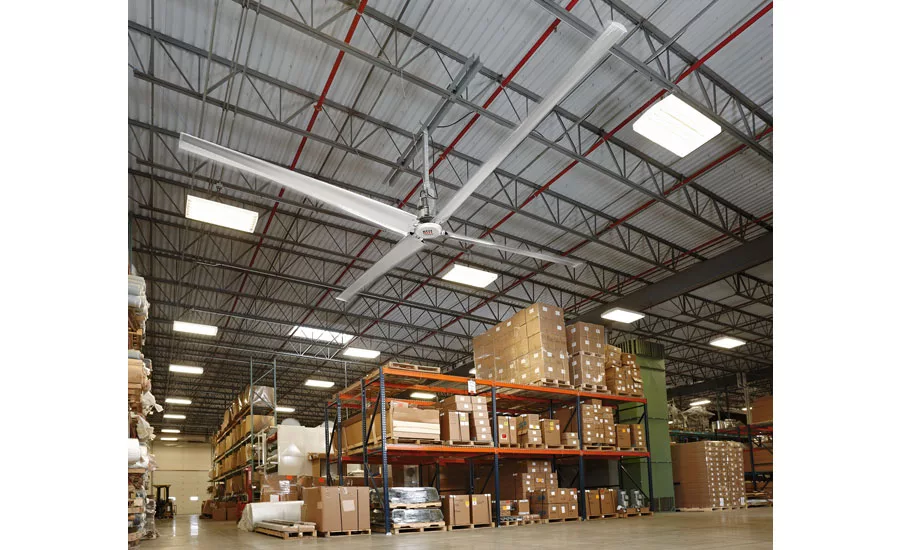
Large, cavernous facilities from storage plants and warehouses to restaurants and gymnasiums can use HVLS fans to cool down visitors, employees, and inhabitants of any type.

HVLS fans create a light 2-3 mph breeze that produces an evaporative cooling effect and reduces the effective temperature by 7 to 11°F. By moving large volumes of air in an area up to 22,000 square feet, a single HVLS fan can replace as many as 10 to 20 traditional high-speed floor fans. In air conditioned facilities, the breeze from an HVLS fan typically allows up to a 5°F increase in thermostat setting with no change in comfort. With an electric bill savings of 4 percent for each degree, an annual savings of 20 percent can be achieved in warm weather climates.

BETTER USE OF HEATED AIR IN WINTER

During the heating season, there is often more than a 20°F difference between floor and ceiling in warehouses, large retailers and virtually any tall building due to warm air rising and cold air settling. Heating systems must work hard for extended periods of time to achieve the proper temperature at the ground level, because the air temperature is roughly one-half to 1°F warmer for each additional foot of conditioned space.

HVLS ceiling fans mitigate the rising heat effect by gently moving the warm air near the ceiling back down toward the floor where it is needed. This mixing effect, known as destratification, creates a much more uniform air temperature with perhaps a single degree difference from floor to ceiling. With the use of an HVLS fan, there is less of a burden on the heating system, saving energy and dollars.

BMS/HVLS INTEGRATION

For even more environmental and energy control, as many as 18 HVLS fans can be linked into one network that can be easily managed with one device. This controller allows independent speed adjustments and scheduled run times at the touch of a button, greatly reducing maintenance challenges associated in facilities that have ambient sunlight or temperature-effecting operations in one part of the building, but not another.

Looking for quick answers on air conditioning, heating and refrigeration topics? Try Ask ACHR NEWS, our new smart AI search tool. Ask ACHR NEWS →

An optional Ethernet port allows the system to be accessed via a remote device, such as smartphone or other mobile unit. Additionally, they can be programmed into a building management system (BMS) and connected to other infrastructure equipment such as exhaust fans. A “fire stop” option is also available, in which the BMS will automatically turn off the HVLS fans and activate sprinklers in the event of a fire.

THE ROI OF HVLS 

Because HVLS fans are efficient, their return on initial investment often ranges from six months to two years, depending on a number of application variables. Winter energy savings are substantial, as users can reduce their heating bills by 20 to 30 percent.

SEGMENTING SPACE WITH FABRIC CURTAIN WALLS

Another energy saving product that is becoming increasingly popular are non-permanent fabric curtain walls. By separating environments within and around the perimeter of industrial buildings, fabric curtain walls can allow HVAC systems to work more efficiently — while keeping workers comfortable and productive.

Many facilities attempt to heat and/or cool large areas of their buildings, and in some cases, condition the whole footprint. The reasons for this vary from employee comfort and safety to raw material or ingredient protection to requirements for specific processes in production areas. With fabric curtain walls, you can effectively compartmentalize treated air spaces so that air and energy dollars aren’t flowing freely throughout the entire building.

The smaller the space can be made, the smaller and less powerful the HVAC system required. By reducing the volume of the space to be heated or cooled, less energy needs to be used to power HVAC systems to achieve a desired temperature. Facilities can cordon off areas in a warehouse that demand a cooler temperature, while leaving other areas at a warmer temperature. Additionally, lower air flow through the filter reduces the frequency required for change out or cleaning.

If a space needs to be enlarged or reduced, or the shape of the space footprint needs to change, curtain walls can simply be reconfigured. No “de-construction” is required.

Industrial curtain walls are available with several levels of insulation and can provide up to 40 degrees of temperature separation. They are easily installed, can be trimmed to fit around conduit, piping, ductwork, etc., and can be anchored to the floor to withstand pressure differential across them. Depending on the application, a curtain wall can be suspended from the room ceiling, or they can be supplied with a stand-alone framework to hang from. They are available as stationary as well as sliding (suspended from roller track), and can be fitted with strip curtains, personnel doors, or high-speed industrial doors for full range of access to the space.

By creating temperature-controlled zones, you can be more strategic with HVAC expenditures on an annual basis. Fabric curtain walls can significantly improve the effectiveness of these systems, as well as offer the opportunity for cost savings, both in the initial cost of the equipment, as well as in direct operating cost.

CAPITALIZING ON THE ADVANTAGES

Designers and engineers are increasingly turning to HVLS fans and fabric curtain walls to maximize energy efficiency and improve comfort. Although no two facilities or applications are exactly the same, and careful analysis of product specs and placement is necessary, HVLS fans and fabric curtain walls continue to gain recognition as practical and affordable ways to enhance environmental control.

Publications date: 9/03/2018

Want more HVAC industry news and information? Join The NEWS on Facebook, Twitter, and LinkedIn today!

KEYWORDS: high volume, low speed (HVLS) fans

Share This Story

Looking for a reprint of this article?
From high-res PDFs to custom plaques, order your copy today!


Untitled 1

Andy Olson is a marketing manager for Rite-Hite, Milwaukee, Wisconsin, a manufacturer of loading dock equipment, industrial doors, safety barriers, HVLS fans, industrial curtain walls, and more, all designed to improve safety, security, productivity, energy consumption, and environmental control. For more information, visit www.ritehite.com.

Recommended Content

JOIN TODAY
To unlock your recommendations.

Already have an account? Sign In

  • HVAC-enrollment

    The Trades Are Back: HVACR Programs See Nearly 30% Enrollment Spike

    A new wave of future technicians is entering the pipeline.  
    Training and Education
    By: Matt Jachman
  • 2025 Top 40 Under 40

    2025 Top 40 Under 40 HVACR Professionals List

    The 11th annual Top 40 Under 40 list highlights those...
    HVAC Light Commercial Market
    By: Hannah Belloli-Oster
  • LG Ductless Mini-Split Systems

    The 9 Types of Heat Pumps

    As the U.S. moves toward electrification, heat pumps are...
    News
    By: Joanna R. Turpin
Subscription Center
  • Create an Account
  • Start a Subscription
  • Manage My Account
  • Sign Up for Newsletters
  • Visit Customer Service
  • Update Preferences

More Videos

Sponsored Content

Sponsored Content is a special paid section where industry companies provide high quality, objective, non-commercial content around topics of interest to The News audience. All Sponsored Content is supplied by the advertising company and any opinions expressed in this article are those of the author and not necessarily reflect the views of The News or its parent company, BNP Media. Interested in participating in our Sponsored Content section? Contact your local rep!

close
  • An illustration shows a house with a geothermal heating system. Pipes are depicted running underground.
    Sponsored byClimateMaster

    Residential Tax Credits Are Ending, But Demand Continues

  • Piggy Bank
    Sponsored byWatercress Financial

    Energy Prices, Inflation, and HVAC: What Today’s Homeowners Care About

  • Refrigerated Food
    Sponsored bySolstice Advanced Materials

    R-455A Refrigeration: A Cold Storage Solution for the Future

Popular Stories

price-raising-practices.jpg

Rising Costs Force Contractors to Take a Harder Look at Pricing

DOE-sign.jpg

HVAC Groups Support DOE’s Rulemaking to Cut Energy Efficiency Mandates

HARDI lolgo navy

HARDI Distributors' Sales Down Nearly 5% in May

Data-Center-Inspection.jpg

Can HVAC Train Enough Technicians for the Data Center Boom?

New-HVAC-Equipment.jpg

Amended Complaint Filed in HVAC Price-Fixing Lawsuit

View The ACHR NEWS
Centennial Anniversary Timeline

The ACHR News Timeline Chart
Submit a Letter
Submit a letter to our editors.

Events

November 6, 2025

Next-Gen Data Center Cooling: HVAC Innovation and Real-World Solutions

On Demand As AI workloads and high-density computing push traditional cooling methods to their limits, the data center industry is accelerating the adoption of next-generation HVAC technologies.

July 22, 2026

Designing VRF Systems Using A2L Refrigerant

In this session, we will cover how to design VRF systems for the U.S. market using new A2L refrigerants. These systems provide an advanced zoning solution by using inverter technology to deliver precise heating and cooling control across multiple zones and spaces.

View All Submit An Event

Poll

Summer Staff

Are you fully staffed for the summer season?
View Results Poll Archive

Products

BNI Mechanical/Electrical Square Foot Costbook, 2026 Edition

BNI Mechanical/Electrical Square Foot Costbook, 2026 Edition

See More Products
Designing Systems Using A2L Refrigerant - Free Webinar - 7/22/2026

Related Articles

  • Warehouse

    Optimize HVAC Systems With HVLS Fans

    See More
  • Case In Point

    Retail company reduces energy costs with HTHV technology

    See More
  • Mushroom Farm Cuts HVAC Coil Cleaning and Energy Costs with UV

    See More

Related Products

See More Products
  • 0-88069-026-7-228x228.jpg

    Fans and V-belt Drives

  • Building Information Modeling: Planning and Managing Construction Projects with 4D CAD and Simulations

  • The ACHR News - April 20, 2026

    ACHR NEWS April 20, 2026, Issue

See More Products

Related Directories

  • ZOO Fans

    Destratification fans for open ceilings and drop ceilings, HVLS fans, Garage transfer fans. ZOO Fans save energy and increase comfort for efficiency and performance.
  • Energy Saving Products Inc.

    Distributors of Infrared Heaters and HVLS Fans.
×

Sign Up. Stay Informed.

The #1 trusted source for the HVACR industry since 1926

SUBSCRIBE
  • RESOURCES
    • Advertise
    • Contact Us
    • Advisory Board
    • Classifieds
    • Submit a Letter
    • Directories
    • Store
  • ACCOUNT CENTER
    • Create an Account
    • Start a Subscription
    • Manage My Account
    • Sign Up for Newsletters
    • Visit Customer Service
    • Update Preferences
  • SERVICES
    • Marketing Services
    • Reprints
    • Market Research
    • List Rental
    • Survey/Respondent Access
  • STAY CONNECTED
    • LinkedIn
    • Facebook
    • Instagram
    • YouTube
    • X (Twitter)
  • PRIVACY
    • PRIVACY POLICY
    • TERMS & CONDITIONS
    • DO NOT SELL MY PERSONAL INFORMATION
    • PRIVACY REQUEST
    • ACCESSIBILITY

Copyright ©2026. All Rights Reserved BNP Media, Inc. and BNP Media II, LLC.

Design, CMS, Hosting & Web Development :: ePublishing