Defining, Understanding, and Applying Proper Subcooling
Beginning technicians often have difficulty understanding and calculating subcooling
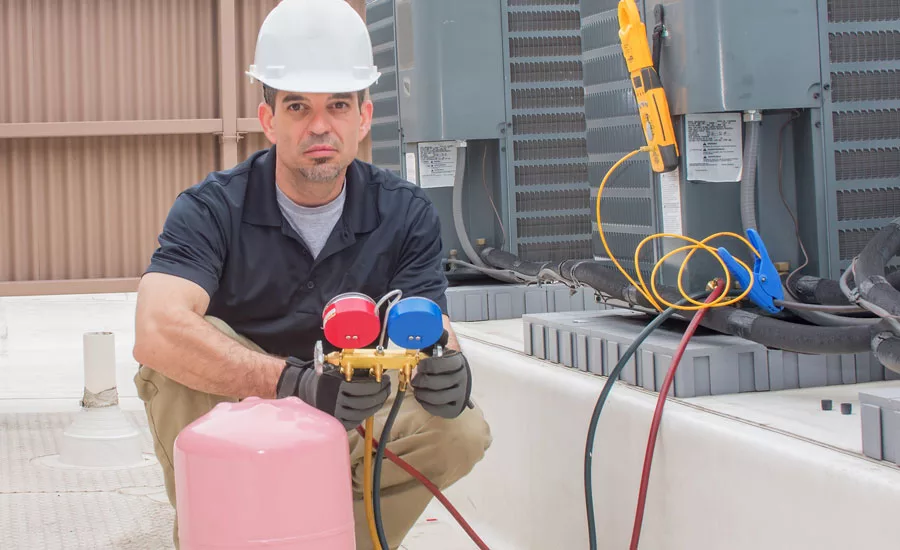
SUBCOOLING 101: John Tomczyk, author and professor emeritus, Ferris State University, Big Rapids, Michigan, describes subcooling as the difference between the measured liquid temperature and the liquid saturation temperature at a given pressure. So, any sensible heat taken away from the 100 percent saturated liquid point in the condenser can be defined as liquid subcooling.
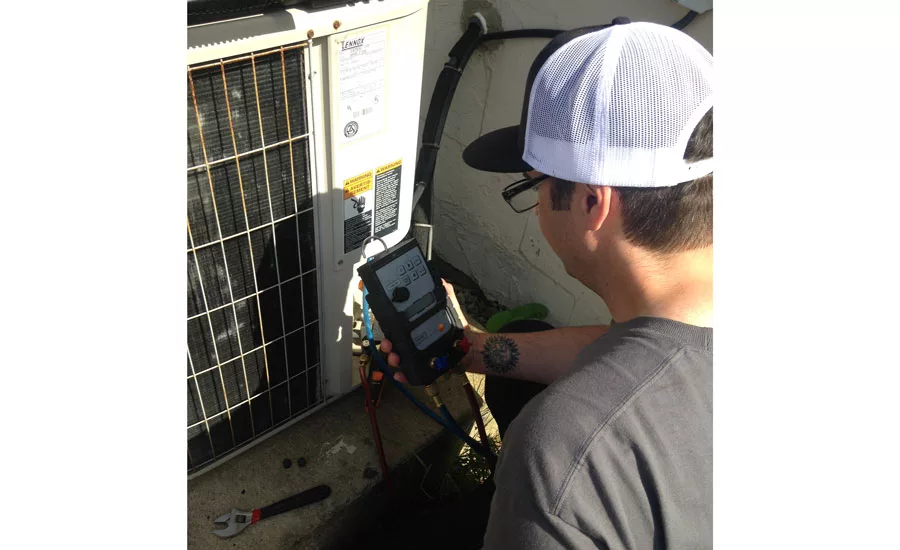
Troubleshooting tech: Justin Carmen, a technician with Koldcraft Refrigeration Service LLC in Pittsburgh, carefully troubleshoots an outdoor condensing unit.
Subcooling can be a somewhat difficult topic for new technicians starting out in the industry. In fact, few topics garner as many questions from green techs than subcooling does.
“A lot of technicians often ask, ‘What should my subcooling be?’ as opposed to fully understanding what it even is,” said Bryan Orr, cofounder and vice president of service, Kalos Services Inc., Clermont, Florida, and founder of HVACRSchool.com. “The actual range of required subcooling is not that great, so it’s not a super difficult question to answer in a simplistic form, but the actual understanding of what it is and how it functions is more in-depth.”
Orr has written several articles on HVACRSchool.com discussing the whole range of subcooling and specifically defining exactly what it means.
“There are a few things beginning techs should know, and the first is what it is,” he explained. “Subcooling tells you that you have a full line of liquid refrigerant in the liquid line. A lot of new techs, especially if they haven’t been exposed to refrigeration or a refrigerant sight glass, don’t really understand. A refrigerant sight glass is essentially doing the same thing we’re doing when we’re measuring subcooling, which is first and foremost proving the liquid line is 100 percent full of liquid. Additionally, a lot of technicians have this belief that subcooling is only useful when you’re working with electronic expansion valves (EEVs) or thermostatic expansion valves (TXVs), and that’s just not true. Subcooling is an important measurement to take on any type of metering device in a comfort cooling system.
“A lot of techs also misunderstand that you are adding to the system efficiency with additional degrees of subcooling because the refrigerant is actually further cooled below its condensing temperature, which means it requires less energy to then flash boil it and evaporate it in the evaporator,” Orr continued. “A lot of technicians miss that even small changes in subcooling can have a significant impact on system capacity and efficiency. And, finally, new technicians also miss the relationship between outdoor air conditions and subcooling. A lot of newer techs don’t understand the relationship between outdoor temperature and condenser load. They think that as the air gets hotter or as the condenser coils become blocked, that that’s going to decrease the subcooling, when, in fact, it doesn’t. In some cases, it even increases it.”
John Tomczyk, author and professor emeritus, Ferris State University, Big Rapids, Michigan, explained subcooling as the difference between the measured liquid temperature and the liquid saturation temperature at a given pressure. So, any sensible heat taken away from the 100 percent saturated liquid point in the condenser can be defined as liquid subcooling.
“You subcool liquid because you don’t want it to get to the metering device without being subcooled; otherwise you’ll have premature flash gas,” Tomczyk said. “If you start flashing in the liquid line, you’re losing refrigeration effect, which takes away from the efficiency of the system.”
Looking for quick answers on air conditioning, heating and refrigeration topics? Try Ask ACHR NEWS, our new smart AI search tool. Ask ACHR NEWS
Tomczyk called subcooling a tricky topic for beginning technicians.
“A lot of people think it’s an amount, but it’s a measured amount,” he said. “You have to measure two different temperatures. Take the condensing temperature and the condenser outlet temperature, and the difference between the two is the amount of subcooling.
“Let’s say the condensing temperature is 100°F. Put a thermistor on the condenser outlet, and let’s say that’s 90°,” continued Tomczyk. “So, you have 10° of subcooling. Technicians get confused thinking that just because there is 10° of subcooling, it means there is a certain amount of liquid in there. That is not true. It just means the liquid is cooled 10°.
“For instance, if you put that condenser in a really cold ambient outside, you can have 1 inch of liquid to give you 10° of subcooling, because it’s cooling really fast,” Tomczyk continued. “But sometimes, you can have a foot backed up in the condenser with only 10° of subcooling. It’s not an amount of liquid; it’s how fast the liquid is cooling.”
Additionally, Tomczyk said subcooling and superheat are two things you always have to check if you think there is a refrigeration system problem.
According to Joe Marchese, author, instructor, and former HVACR contractor, the three things beginning techs should know about subcooling are how to measure it, why you measure it, and the acceptable values.
“All of these will allow a technician to properly diagnose a system problem and/or may be required to properly charge a system with refrigerant,” he said. “Techs should be measuring subcooling when they are adding refrigerant to a system with a TXV-style metering device and anytime they are diagnosing an issue with the mechanical refrigeration system.”
COMMON MISTAKES IN THE FIELD
There are a number of things that can cause high or low subcooling, Orr noted.
“Techs see a system with the correct subcooling, but they don’t realize it is correct only because someone corrected for subcooling without consideration of the other factors of the system, which can be confusing,” he explained. “An example would be if you have a TXV slamming down or a piston that is too small or restricted. Somebody sees a high subcooling, so they start to remove some refrigerant to get to a proper subcooling. But, now you have two problems: a metering device that’s restricted and a system that is low on charge because somebody compensated for it.”
Another common mistake made in the field is assuming subcooling is always one number.
“You shouldn’t always assume it’s always 10° subcooling,” Orr said. “What’s tricky about that is that I’ve said things like that. In a previous article, I wrote, generally speaking, 10°-12° of subcooling at the outlet of the condenser coil is most common. It’s something we say all the time because, generally speaking, that is the truth. But you only go back to rules of thumb when you have no access to manufacturer literature, which does happen from time to time. You really want to make sure you’re following what the manufacturers have to say.”
Bill Johnson, author and former HVACR instructor and contractor, said a few common mistakes techs make in the field include charging the system at other than design conditions and using poor instrumentation.
“When in doubt, consult a well-illustrated textbook or technical bulletin,” Johnson said.
“Other common mistakes include not measuring the refrigerant pressure at the location when the subcooling calculation is required, simple math errors, using the wrong column of a PT chart, and trying to calculate the subcooling when the liquid line pressure rapidly changes,” Marchese added.
SUBCOOLING BEST PRACTICES
The best thing a tech can do while out in the field is always know what the manufacturer says about a particular piece of equipment,” Orr noted.
“There can be some pretty decent variance on systems,” he said. “You’ll see some systems that require 8° of subcooling while others go up to 16° or more in some cases. And that’s just generally what I’m used to seeing. It does make a significant difference, so if a system is designed to have a 12° subcooling, then set a 12° subcooling — don’t set it at 6°. The first best practice would be not to make this stuff up. Look at what the manufacturers have to say about subcooling.
“The second thing would be to measure subcooling on every system, not just selectively,” he continued. “A caveat worth adding is in certain types of large refrigeration where headmaster controls are being used, measuring subcooling becomes a little more difficult. You have to measure subcooling on every system, whenever possible, knowing there are some exceptions where it is not practical. And lastly, never use only one reading to charge a system. A lot of technicians have the sense, and I’m using air quotes here, that you can charge by subcooling. You use subcooling as one of your primary metrics for charging on an expansion valve system, but you have to take it in conjunction with system airflow, superheat, design, suction pressure, head pressure, and all of those other things that have to be taken into account when you’re factoring in subcooling, because you could set a subcool on a system with massive problems. Just because you hit that subcooling target doesn’t mean you have a properly functioning system.”
Johnson advised that subcooling should typically be between 10°-20°.
“One best practice includes letting the unit run long enough for it to stabilize, maybe 30 minutes,” he said. “A measure of the subcooling can give you an indication of the correct condenser charge. The correct subcooling in the condenser can improve unit performance by 10-15 percent. Charging a unit to the correct subcooling level takes time; and the larger the unit, the more savings the customer receives. Ensure the charge is accomplished at design operating conditions, which is usually 95°F condenser air for an air-cooled unit. This may be accomplished in mild weather by blocking the condenser until the design head pressure is accomplished. Different conditions pertain to water-cooled equipment.”
According to Marchese, one best practice is to measure the liquid line pressure, convert that pressure to its equivalent saturation temperature, and measure the liquid line temperature. The difference between the two is the subcooling value.
“It is best to measure the pressure and temperature at the location where the subcooling measurement is required,” he said. “Measuring the pressure at a different location can lead to an inaccurate subcooling calculation. If there is a pressure difference between the measure location and where the subcooling is to be measured, your subcooling calculation will be off.”
The first rule, though, is to always follow manufacturers’ guidelines, Marchese said.
Publication date: 7/10/2017
Want more HVAC industry news and information? Join The NEWS on Facebook, Twitter, and LinkedIn today!
Looking for a reprint of this article?
From high-res PDFs to custom plaques, order your copy today!