Ducts in a Conditioned Space: To Insulate or Not?
Have HVAC contractors been ignoring a problem for decades?

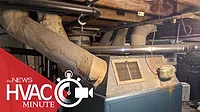
A common idea promoted across the industry is that any heat lost from an uninsulated duct system to a conditioned space isn’t truly lost and has no effect on energy consumption. Most contractors would never consider installing uninsulated ducts in a vented attic or crawlspace but regularly do in basements and foamed attics.
Is it possible there are negative effects caused by uninsulated ducts in conditioned spaces we may have overlooked for decades? Let’s look at some problems you might encounter due to this practice and how you can determine the impact on the performance of your systems.
ELUSIVE PROBLEMS
There are some elusive problems tied to uninsulated duct systems in a conditioned space. They can be tricky to pinpoint since they don’t show up all the time. Some of the most troublesome problems include:
- Duct condensation;
- Hot and cold rooms;
- Uneven temperatures;
- Excessive run time of multi-stage and variable capacity equipment; and
Unexpected Btu loss through the ducts.
As our industry pushes for the elimination of oversized equipment, these problems are showing up more. Oversizing allows a cushion for duct temperature loss that simply isn’t there with properly sized equipment. If you’re a proponent of properly sized equipment, you will probably have to deal with this at some point, if you haven’t already.
HEAT TRANSFER FUNDAMENTALS
The answers to the most complicated problems we encounter are usually found in the fundamentals. When looking to solve these elusive problems, consider the following truth — hot always goes to cold.
If the space surrounding an uninsulated duct system is cooler than the air in the ducts, heat will flow from the ducts to that cooler space. The opposite is true, as well. If the space surrounding an uninsulated duct system is warmer than air in the duct system, heat will flow from the surrounding air to the ducts.
For example, in heating mode, the air temperature in the duct is 125ºF and the basement temperature is 70º. The temperature difference between the duct and the basement is 55º. Imagine the amount of heat that would escape from the uninsulated duct into the basement and not make it to the upstairs rooms.
Looking for quick answers on air conditioning, heating and refrigeration topics? Try Ask ACHR NEWS, our new smart AI search tool. Ask ACHR NEWS
One of the primary functions of an HVAC system is to keep customers comfortable by adding or removing heat. Our industry measures the flow of heat in British thermal units (Btu) at an hourly rate, commonly referred to as Btuh.
Room comfort needs are based on sensible heat. This is the type of heat you can feel through a change in temperature and is commonly expressed through the formula: cfm x ▲T x 1.08 = sensible Btu. So, what does this have to do with uninsulated ducts?
SATISFYING ROOM HEATING AND COOLING NEEDS
Airflow and temperature change are both necessary ingredients for successful Btu delivery. If one of them is missing, you’ll likely have an uncomfortable and unhappy customer. This is important to remember.
Equipment isn’t the only factor determining Btu delivery. The duct system must also be factored in since its part of the HVAC system. You can have perfectly operating equipment yet fail to adequately heat and cool the space it’s designed to serve when attached to a poorly designed or installed duct system.
Airflow and temperature change are needed as much in the conditioned space as at the equipment. A simple rule to remember is the closer a duct is to the equipment, the lower the heat loss. The farther away a duct is from the equipment, the greater the heat loss. If your ducts leak, it’s even worse.
Think about this for a minute, when rooms in a home are uncomfortable, the natural response is to adjust the thermostat to make it more comfortable. This adjustment directly impacts the energy consumption of a system since it now runs longer to condition uncomfortable rooms.
TEST FOR YOURSELF
If you suspect your installations are suffering from duct temperature loss, there is a quick and simple diagnostic test you can perform to gauge the impact. You’ll need a digital dry bulb thermometer and four temperature measurements. You can use this test in cooling or heating mode.
Begin by turning on the system. Allow it to reach a stable operating point. This varies depending on equipment type and could take up to 15 minutes. Once operation has steadied, measure and record the temperature change at the equipment. This temperature reading is typically taken in the return plenum and supply plenum. Once you have both measurements, subtract them to determine the equipment’s temperature change. Record this value for later reference.
The next step is to measure the temperature change across the duct system. A fast and easy way to do this is to measure and record air temperatures from the farthest supply register and return grille.
This works best if you have a quick-responding thermometer. If you take too long between readings, your numbers could be off substantially. Just as with equipment temperature change, once you have these values recorded, subtract them to determine the system’s temperature change.
If your system is awesome, the temperature change of the equipment and duct system should be very close. Chances are high there will be some differences. If they’re close, you’re probably all right; if they’re pretty far off, you’re likely experiencing too much duct loss.
A safe rule to compare your readings against is there shouldn’t be any more than 10 percent temperature change across the duct system.
FOR EXAMPLE
Let’s look at an example of how to figure this out.
Say you are measuring a furnace operating in heating mode. You measure temperatures at the equipment and find your supply air temperature is 130º and return air temperature is 70º. This equals an equipment temperature change of 60°.
Next, measure temperatures at the farthest supply register and return grille.
Your supply register temperature is 110º and return air temperature is still 70º. This equals a system temperature change of 40°.
To determine percentage of duct system temperature loss, divide the system temperature change of 40° by the equipment temperature change of 60°. You have a duct system temperature loss of 33 percent.
Ouch. How would you address this if you measured similar readings on one of your systems? This would change a 95 AFUE furnace into a 62 AFUE system (95 percent – 33 percent = 62 percent) just through duct temperature losses.
CREATE SOLUTIONS FOR YOUR CUSTOMERS
The most applicable repair for duct temperature loss is adding insulation. Be careful as you choose from the various insulation options. Some insulation types offer high promises but fail to consistently perform in the field.
As you consider adding insulation, first be sure the duct system is delivering proper airflow. Insulating a leaky or undersized duct system is a waste of money. Additional repairs are needed for it to work as intended.
If you’re looking to only seal ducts, you might be missing an equally important aspect of system performance by neglecting the temperature side. There are additional rewards available to you and your customers by expanding beyond duct tightness alone.
Overall, the purpose of an HVAC system is to condition air, not just move it around. It’s all about the Btu. Look at any heat loss/gain calculation to see this principle.
The rubber truly meets the road when you test for yourself. See what you discover as you perform the simple test described above and reap the rewards from the hidden opportunities it reveals.
Publication date: 6/26/2017
Want more HVAC industry news and information? Join The NEWS on Facebook, Twitter, and LinkedIn today!
Looking for a reprint of this article?
From high-res PDFs to custom plaques, order your copy today!