Btu Buddy 160: Dangerous Leak Repair
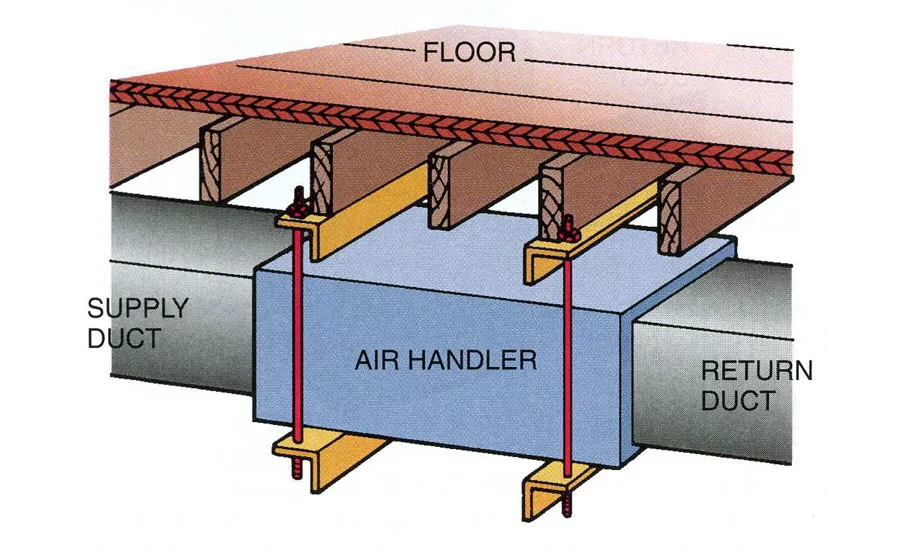
FIGURE 1: This is an example of an air handler suspended under a floor. In an older house there would be cobwebs hanging everywhere. (From Refrigeration & Air Conditioning Technology, 7th Edition, by William Whitman, William Johnson, John Tomczyk and Eugene Silberstein published by Delmar Cengage Learning.) (©Delmar Cengage Learning.)
Bob is a service technician who is well trained and nationally certified. However, he has sometimes suffered from the same confusion that all technicians occasionally do — the facts that he gathers may or may not point to the obvious cause of the problem or the best solution. But Bob has had something that no one else has. He recalled his long-time HVACR mentor and imagines him accompanying him as “Btu Buddy,” someone who reminded him to take time to stop and think before rushing to judgment, helping keep him on the right track, even with facts that are confusing.
Now, Bob’s company has promoted him to help train a new employee, right out of a school specializing in HVAC, just like Bob was. Bob is now Tim’s Btu Buddy. Tim is anxious to travel with Bob. Tim realizes that he is right out of school, with the theory and lab work that he accomplished in school, but still needs help. He knows that he worked with many of the components of the systems in the school, under ideal conditions with good light and air conditioning. Now it is into the field, sometimes under the house with poor lighting, or out on the rooftop in the sun, where the real action is. He is naturally and normally reluctant, but he has Bob to help guide him.
Bob and Tim had just arrived at a service call, the first one for the day. The complaint was that the homeowner’s air conditioning had stopped sometime in the night and the residence was hot.
They talked to the homeowner to try to get any information from her as to what might be going on, but she didn’t really know anything. She just told them that the system quit cooling sometime during the night. They went to the thermostat and it was reading 77°F but the setpoint of the thermostat was 72°. The indoor fan was running, so the thermostat was definitely calling for cooling and they knew from the fact that the fan was running that the low-voltage circuits all seemed to be working as the fan worked off of the 24 V low-voltage circuit. They went around to the back of the house where the condensing unit was located and they found that it was not running.
They checked the voltage to the low-voltage terminal block and it was 24 V. Then they checked the low-voltage terminals on the contactor and it read zero voltage. They looked at the wiring diagram and discovered that there was a low-pressure low-charge cut out in the circuit, otherwise the unit should have been running. They suspected a low charge.
Bob told Tim, “Go to the truck and get the gauges and tools and let’s see if we can figure out what’s going on.”
Tim came back with the tools and they installed gauges on the system and there was absolutely no pressure in the system. Now they had to go and search for some kind of leak.
Looking for quick answers on air conditioning, heating and refrigeration topics? Try Ask ACHR NEWS, our new smart AI search tool. Ask ACHR NEWS
Tim got the nitrogen cylinder out of the truck and they started allowing nitrogen into the system. Bob said, “I hear nitrogen coming out from somewhere. Let’s go find out where the big leak is.”
They looked over the condensing unit and could hear no leak there, so they opened the access door to underneath the house and Tim said, “I hear nitrogen blowing out in here.”
Bob said, “Get the flashlight and let’s crawl under the house and see what’s going on.”
Tim went under the house and did some looking around and called out to Bob, “Here is the problem. The liquid line is broken in two. It looks like the dog chain got tangled in the liquid line and the dog broke the liquid line. All we need to do is make a clean cut out of the liquid line and put a coupling in it and it will be good to go.”
Tim went to the truck and came back with a coupling that was the right size and a torch to braze it into the line. He went under the house and cut the liquid line in such a way that it could be spliced together with the coupling. He cleaned up the pipe ends and stuck them together and was about to light the torch when Bob looked under the house and said, “Stop right there. Don’t light that torch.”
Tim said, “This looks simple enough. Why not go ahead with the fix?”
Bob took a flashlight and said, “Look around above you. When the line broke, it spewed oil and refrigerant in every direction for about 10 feet. This house is fairly old and there are a lot of cobwebs under here. Look closely at the cobwebs.”
Tim said, “The cobwebs have oil hanging in them. They acted like a blotter and absorbed a lot of the oil. Is that what you’re talking about?”
Bob said, “Yes, that’s what I’m talking about. I have a friend that was in a similar situation and when he fired his torch up and swung it around towards the pipe, he touched one of the cobwebs that was soaked with oil and it caught fire. The fire instantly spread to all the cobwebs that had oil in them. He had a fire about 10 or 12 feet in diameter everywhere up next to the floor joists. He and his partner barely got the fire out without setting the house on fire. There is very little oil in the cobwebs and the fire would almost be a flash fire and happen very quickly. But if there is anything that is combustible close by, it may also set that on fire. Notice the lawnmower and gas can sitting under the house here where the homeowner pushes it after mowing the yard. That’s a potential for a real problem if the cobwebs are ignited.”
Tim then asked, “What should we do?”
Bob said, “Let’s each get a broom and wipe these cobwebs away from the timbers under here. By getting all of the exposed oil in the cobwebs down, we reduce the potential for fire greatly.”
They each got a broom and wiped the oil-soaked cobwebs away from the floor joists. Then they proceeded to repair the leak with a fire extinguisher close by, with no incident of fire.
Bob then said, “We need to pull a good vacuum on this system because we don’t know how long it was open. What would happen is the refrigerant would begin to blow out of the system and eventually get down to a very low temperature until it blew all the refrigerant out of the system; then the system would be very cold where the last amount of liquid boiled out. When the system began to warm up and all of the refrigerant was blown out of the piping, it would probably then pull in outside air. We don’t know if there is any outside air in the system, but we must treat it as though there is air in the system and evacuate it carefully.”
They pressurized the system and checked their repair for leaks using soap and found no problems. So they connected the vacuum pump and pulled a deep vacuum to about 500 µm. They let the system stand under vacuum for about 30 minutes to verify that no atmosphere was being pulled into the system and then they proceeded to charge the system using the recommended amounts of refrigerant for the evaporator condenser and line set. After charging the system with the correct amount of refrigerant, they started it up and all was operating correctly.
As they were wrapping up their work, Tim commented, “It was a good thing that you knew not to light the torch in the presence of the oil-soaked cobwebs. I never would have thought of that and it could have been a real problem.”
Bob said, “I never would have thought of it either, except that my friend told me about his incident and that it nearly scared him to death because he thought he had burned a house. I have never forgotten that story and I never thought I would have to apply the knowledge, but we did today and avoided a big problem. Now it is time to go and talk to the homeowner about why that dog was on a leash under the house.”
They went up and talked to the homeowner and she said, “We don’t have a fenced yard and that dog must be contained with a chain. So we tie the dog chain to a stake in the yard and let it run as far as it can. We placed the stake close enough to the house so that the dog can run and get under the house in cold weather or hot weather.”
Bob explained to the homeowner, “We fastened all of the lines up tight to the floor joists so the dog couldn’t get over the line and entangle the chain again. This should work. A fence would really be a better investment but I understand that you may not want a fence in your backyard and that the dog has to have some way to move about.”
As they were riding off, Bob said, “It is sad to see a dog on a chain; the dog doesn’t really have a good life, but she is doing all she can for the dog under the conditions.”
Publication date: 7/18/2016
Want more HVAC industry news and information? Join The NEWS on Facebook, Twitter, and LinkedIn today!
Looking for a reprint of this article?
From high-res PDFs to custom plaques, order your copy today!