The Professor: Recognizing, Solving Refrigerant Migration
Eliminating Refrigerant from the Compressor’s Suction Line or Crankcase
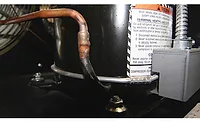
 Refrigerant migration is defined as refrigerant, either liquid or vapor, traveling to the compressor’s suction line or crankcase during the off cycle. During the off cycle, or especially during a long shutdown, refrigerant will want to travel, or migrate, to a place where the pressure is the lowest. In nature, most fluids travel from a place of higher pressure to a place of lower pressure. The crankcase usually has a lower pressure than the evaporator because of the oil it contains. Oil has a very low vapor pressure and refrigerant will flow to it whether the refrigerant is in the vapor or liquid form. In fact, refrigerant oil has such a very low vapor pressure it will not vaporize even when a 100-micron vacuum is pulled on the refrigeration system. Some refrigeration oils have a vapor pressure of as low as 10 microns. If the oil did not have a very low vapor pressure, it would vaporize every time a low pressure exists in the crankcase, or a vacuum was pulled on it.
If refrigerant migration does occur, and the crankcase is lucky enough to have a crankcase heater, the vapor will be forced away from the crankcase and end up in the suction line. This refrigerant may condense in the suction line and cause slugging in the compressor’s cylinders on start-up. Slugging is liquid refrigerant or liquid oil actually trying to be compressed in the cylinders of the compressor. Slugging happens during the compressor’s on cycle. As we know, liquids cannot be compressed and tremendous reversal forces are generated often resulting in broken parts. Slugging can especially happen if the compressor is located outdoors in a cold ambient. The cold ambient will amplify the lower vapor pressure area and help condense the refrigerant vapor to liquid. The crankcase heater does help keep the oil in the crankcase free of refrigerant from refrigerant migration.
Uphill or Downhill
Because refrigeration migration can occur with refrigerant vapor, the migration can occur uphill or downhill. Once the refrigerant vapor reaches the crankcase, it will be absorbed and condense in the oil. Refrigerant and oil have a strong attraction for one another and mix very well. Since liquid refrigerant is heavier than oil, the liquid refrigerant will be on the bottom of the oil in the crankcase. On short off cycles, the migrated refrigerant does not have a chance to settle under the oil, but does still mix with the oil in the crankcase. When the compressor does turn on, the sudden pressure drop on the crankcase containing liquid refrigerant and oil will cause the refrigerant in the oil to flash to a vapor. This causes violent foaming in the crankcase. The oil level in the crankcase will now drop and mechanical parts will be scored from inadequate lubrication. The crankcase pressure will now rise and the mixture of refrigerant and oil foam can now be forced through compressor passages, around piston rings, and be pumped by the compressor. Not only does this situation cause loss of oil from the crankcase to the system, but it can also cause a mild form of slugging in the compressor’s cylinders. High compressor current draw, which will lead to motor overheating, usually follows. Also, broken or warped valves can occur as a result of overheating and/or slugging.
Solution
The only sure solution in avoiding migration is to get rid of all of the refrigerant in the evaporator, suction line, and crankcase before the off cycle. This can be accomplished through an automatic pump-down system. A thermostat controlling box temperature is wired in series with a liquid-line solenoid. When the box temperature is satisfied, the thermostat contacts will open. This will de-energize the liquid-line solenoid and a pump-down cycle will be initiated. Soon, all the liquid and vapor refrigerant from the solenoid forward through the compressor will be pumped into the high side (condenser and receiver) of the system. Once the low-side pressure reaches about 10 psig, a low-pressure controller will interrupt the compressor circuit initiating an off cycle. The system is now pumped down and migration cannot occur because of a lack of refrigerant vapor and liquid in the evaporator, suction line, and crankcase.
When the box thermostat then calls for cooling, the liquid-line solenoid is energized and refrigerant pressure will now travel through the metering device to the low side of the system. This pressure will cause the cut-in pressure of the low-pressure control to close its contacts and bring the compressor to another on cycle. The cut-in pressure for the low-pressure control is system and refrigerant dependent. It has to be high enough to prevent any short cycling of the compressor during an on cycle, but low enough to allow the low-side pressure to reach it when an on cycle is initiated by the box thermostat. Actual trial and error will allow a service technician to determine the low-pressure control’s settings.
It is important not to let the low-side pressure get too low before shutting off the compressor. If the low-side pressure was allowed to drop to 0 psig before the low-pressure control terminated the cycle every off cycle, damage could occur to the compressor from lack of refrigerant mass flow rate and high compression ratios. This severely unloads the compressor and may cause overheating from loss of the cooling effect on the compressor’s windings. A cut-out pressure of 10 psig is low enough to ensure most of the liquid and vapor refrigerant has been cleared from the evaporator, suction line, and crankcase to prevent refrigerant migration during the off cycle.
Publication Date: 7/1/2013
Want more HVAC industry news and information? Join The NEWS on Facebook, Twitter, and LinkedIn today!
Looking for quick answers on air conditioning, heating and refrigeration topics? Try Ask ACHR NEWS, our new smart AI search tool. Ask ACHR NEWS
Looking for a reprint of this article?
From high-res PDFs to custom plaques, order your copy today!