FTC Reveals Altered Energy Guide Labels
 As of now, the sole mode of enforcement for the pending regional energy efficiency standards will come in the form of a new-look Energy Guide sticker.
Labeling Requirements
Through the Appliance Labeling Rule, HVACR manufacturers are required to attach yellow Energy Guide stickers to each newly created unit. When initially published in 1979, the rule applied to eight appliance categories: refrigerators, refrigerator-freezers, freezers, dishwashers, water heaters, clothes washers, room air conditioners, and furnaces. Subsequently, the Federal Trade Commission (FTC) expanded the rule’s coverage to include central air conditioners, heat pumps, fluorescent lamp ballasts, plumbing products, lighting products, and certain types of water heaters.
Proposed Enforcement
To promote compliance with pending regional energy-efficiency standards, the Energy Independence and Security Act (EISA) of 2007 directed the DOE to develop an enforcement plan to specify the responsibilities of installers, distributors, and manufacturers. DOE was required to complete an enforcement plan within 15 months following the issuance of the final efficiency standard rulemaking.
DOE released three enforcement proposals earlier this year. The first would simply require contractors to install the proper HVACR equipment in the appropriate region. The second proposal would again require appropriate installations, with a rule that contractors must maintain records and paperwork detailing each installation. The third approach would require appropriate installation; record keeping that would include installation dates, locations, serial numbers; and more. These notes would then have to be shared with distributors, who in turn would be mandated to retain similar information, which would ultimately be shared with the DOE upon request.
While DOE has indicated that they may ultimately opt to move forward with one or more of these suggestions, the only form of enforcement being put into motion at this time is an alteration to the FTC’s Energy Guide labels.
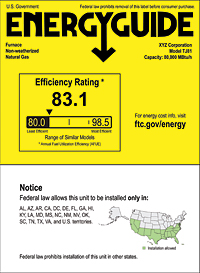
The proposed Energy Guide sticker will include two parts: a revised upper portion designed primarily for consumers and a lower portion organized to help installers comply with the new regional standards.
The upper portion will continue to resemble the current Energy Guide design. The label will disclose a product’s efficiency rating (EER or SEER, based upon the product), a range of efficiency ratings for similar products, and a link to an online energy cost calculator.
The upper portion will also display a range of ratings for similar models to help consumers compare competing products. The FTC proposes to update existing comparability ranges for all heating and cooling equipment, to comply with the regional standards requirements. The ranges will be added prior to the May 1, 2013 deadline, for applicable equipment. Ranges for products subject to the Jan. 1, 2015 implementation date will not be applied until just prior to that date.
Looking for quick answers on air conditioning, heating and refrigeration topics? Try Ask ACHR NEWS, our new smart AI search tool. Ask ACHR NEWS
The lower portion of the proposed sticker contains text which provides general information to installers about regional efficiency standards, including a list of applicable states. A colored U.S. map illustrates which portion of the country the product may legally be installed. Finally, the proposed label contains a link to the DOE’s database of certified equipment, http://bit.ly/Ls9lH1.
The FTC is proposing the label be affixed directly on the product, the product’s packaging, and be displayed on the retailer’s website. Manufacturers will also be required to provide consumers, distributors, and installers access to their product labels online.
The FTC accepted comments on the proposed changes through Aug. 6. Received comments will be available for viewing on the Energy Guide website following a review period.
Bryan Rocky, director, Residential Product Management, Johnson Controls, said the new labels will serve more as an informational piece, rather than a method of enforcement.
“The homeowner has likely already purchased the system before they actually see the sticker or label because the labels are attached to the final finished goods,” he said. “The labels will provide some degree of validation as a homeowner compares the actual label on the product they purchased to the item they were told they purchased.”
AHRI
The FTC received written comments on its Advance Notice of Proposed Rulemaking (NOPR) on the Energy Guide labels, issued Nov. 28, 2011. Comments were filed by the Air Conditioning Contractors of America (ACCA), the Air-Conditioning, Heating, and Refrigeration Institute (AHRI), and the Natural Resources Defense Council (NRDC). Joint comments were also submitted by efficiency advocates, including the Alliance to Save Energy, the American Council for an Energy Efficient Economy (ACEEE), and others.
In its comments, AHRI recommended that all labels contain a reference to the AHRI directory (www.ahridirectory.org), which lists AHRI-certified models.
In its June 6, 2012 NOPR, the FTC disagreed with AHRI, stating that it prefers to link consumers to a DOE website because “DOE’s site provides a government source for information from both AHRI and non-AHRI members.”
AHRI stands firm that its directory would offer the most comprehensive list of information available nationwide.
“The AHRI directory of certified equipment currently plays an important role in helping consumers make informed decisions when purchasing residential furnaces and central air conditioners and heat pumps,” wrote Aniruddh Roy, regulatory engineer, AHRI, in the institute’s submitted response. “We believe that the AHRI directory can even play a bigger role with the implementation of regional standards to ensure that contractors select the right products and that consumers get equipment that can meet the regional standards. We recommend the FTC allow the AHRI directory of certified products to be one of the approved methods for disclosing information associated with the new regional standards for residential furnaces and central air conditioners and heat pumps.”
AHRI representatives said the proposed rule serves as a good starting point, but they do intend to file additional comments on the topic.
“We have been working with the FTC on this issue since the agency began the rulemaking process,” said Karim Amrane, vice president, Regulatory and Research, AHRI. “We will continue to work with the FTC to ensure that the Energy Guide label is as accurate and informative as possible for our members’ customers.”
ACCA and HARDI
ACCA supports a modified Energy Guide label that is easy to read and comprehend.
“It’s critical that the new Energy Guide labels present the energy use and regional standard compliance information in a manner that is legible for distributors, contractors, and consumers,” said Charlie McCrudden, vice president of government relations, ACCA. “ACCA believes that the new and improved Energy Guide labels will help minimize any confusion about where a product can legally be installed, especially as the new regional standards go into effect for non-weatherized furnaces and mobile home furnaces in less than 10 months.”
In addition to changes to the label content, the FTC is proposing to require manufacturers to place the new Energy Guide labels on each product, its packaging, and the manufacturer’s website. The proposed rule would also require contractors to make the Energy Guide labels themselves (and not just information about the product’s energy use) available to the consumer prior to purchase.
“This requirement for contractors could be satisfied by showing the consumer the Energy Guide labels or providing them instructions to view the labels online prior to purchase,” said McCrudden.
ACCA believes the DOE and FTC should market the new region-based efficiency standards and Energy Guide alterations through a public awareness campaign.
“FTC, in coordination with DOE, should create print and broadcast public service announcements, promotional leave behind materials, and other information to better inform consumers and contractors of the pending changes,” said McCrudden.
While enforcement was previously handled at the loading dock, it will now be regulated by region, which transfers a large portion of the responsibility to the contractor. ACCA representatives believe this will be a major issue for its members.
“Take the borders between Virginia, West Virginia, Kentucky, Maryland and Pennsylvania — portions of these states are in both the northern and southern regions,” said McCrudden, “In the panhandle of Maryland, you may see 80 percent AFUE furnaces, which are legal to hold and sell, but, just to the south in West Virginia, only 90 percent units are allowed. How does the DOE intend to control this equipment from being shipped across borders? This is a large concern for us.”
Jon Melchi, director of government affairs, Heating, Air-conditioning & Refrigeration Distributors International (HARDI), is supportive of the concept of the altered stickers.
“We believe the enforcement structure, as presented through the FTC labels, will be sufficient to enforce the DOE’s regional standards,” he said. “We don’t feel there will be any sufficient gain if the DOE adds additional enforcement hurdles, thus we are supportive of the updated stickers and the message they convey.”
Much like AHRI, HARDI expressed a concern with the DOE’s insistence on utilizing its own database.
“The DOE’s desire to operate a database creates a duplicative function, as AHRI provides a directory and has offered it up for use. In these tough economic times, it seems unnecessary that the DOE operate such a listing. Their efforts to create a database that already exists is redundant and frankly is a waste of taxpayer time and money.”
Melchi said all industry associations have a vested interest in making the consumer aware of what products may legally be installed, and the efficiency of such products.
“We’re in favor of a consumer friendly label,” said Melchi. “The manufacturers suffer because they will be the ones affixing the right stickers on the right equipment, and the contractors will be affected because they will be the ones required to inform the consumer and make sure the equipment is installed in the proper location. We are just planning to ship the equipment in the right direction, and continue to be a cooperative industry partner. We remain supportive of anything that makes things easier for the consumer.”
Sidebar: Regional Standards
On Oct. 25, 2011, the Department of Energy (DOE) announced new efficiency standards for residential furnaces, central air conditioners, and heat pumps as directed by the Energy Independence and Security Act of 2007 (EISA). Unlike existing DOE standards, which impose uniform, national efficiency levels, the new standards vary by region for certain products. The DOE rules impose regional efficiency standards for four product categories: split-system air conditioners, single-package air conditioners, non-weatherized gas furnaces, and mobile home gas furnaces.
The new DOE requirements will become effective on two dates: May 1, 2013, for non-weatherized gas furnaces, mobile home gas furnaces, and non-weatherized oil furnaces; and January 1, 2015, for weatherized gas furnaces and all central air conditioners and heat pumps.
The DOE standards apply to three regions: the North, Southeast, and Southwest. For furnaces, the standards are the same for the Southeastern and Southwestern regions.
The Northern region encompasses Alaska, Colorado, Connecticut, Idaho, Illinois, Indiana, Iowa, Kansas, Maine, Massachusetts, Michigan, Minnesota, Missouri, Montana, Nebraska, New Hampshire, New Jersey, New York, North Dakota, Ohio, Oregon, Pennsylvania, Rhode Island, South Dakota, Utah, Vermont, Washington, West Virginia, Wisconsin, and Wyoming.
The Southeastern region encompasses Alabama, Arkansas, Delaware, Florida, Georgia, Hawaii, Kentucky, Louisiana, Maryland, Mississippi, North Carolina, Oklahoma, South Carolina, Tennessee, Texas, Virginia, the District of Columbia, and U.S. territories. The Southwest includes Arizona, California, New Mexico, and Nevada.
Publication date: 9/3/2012
Looking for a reprint of this article?
From high-res PDFs to custom plaques, order your copy today!