Compressor Applications in Light Commercial Refrigeration
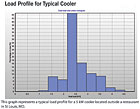
Figure 1.
Of those factors, the compressor is one of the critical components in determining the performance of commercial refrigeration equipment. Today there are many compressor technologies to choose from - reciprocating, rotary, and scroll compressors among them - each with its own benefits and challenges.
KINDS OF COMPRESSORS
Reciprocating compressors use a well-known, mature technology. They are available in two configurations: hermetic designs and semi-hermetic designs.Hermetic designs are typically less expensive, moderately robust, and reasonably efficient, generating moderate noise. They have a wide operating envelope range and some difficulty handling liquid refrigerant, but are fairly robust in multi-compressor applications. Semi-hermetic compressors are typically more expensive, available in larger capacities (1.5 hp and above), are heavier, and again are moderately efficient and noisy with a wide operating range. They’re most used in multi-compressor applications.
Rotary compressors, which grew up in the air conditioning industry, are primarily smaller and typically applied in higher evaporator temperatures. They have a limited capacity range, are fairly lightweight, and relatively inexpensive. On the downside, they are extremely sensitive to liquid slugging, and their sensitive internal sealing limits their application envelope range.
Scroll compressors are the latest, quietest technology. They feature efficiency in their target applications and have excellent liquid-handling capabilities using compliant designs. They are typically less expensive than semi-hermetic compressors, but are more expensive than hermetic-reciprocating and rotary compressors at the smaller sizes.
Scroll compressors are available in sizes above 1.5 hp. They work well in multi-compressor applications, but care must be taken with regard to oil management. Typically the compressor is designed to function in low condensing temperatures, allowing it to be used in floating condensing temperature designs.
For new installations, the keys to optimal performance are selecting the right compressor technology for the right application, and identifying how the equipment will be used and where it will be applied.
Three applications for refrigeration compressors include walk-in coolers, milk-cooling tanks, and ice cube machines. Several factors affect each compressor application.

Figure 2.
WALK-IN COOLERS
Walk-in coolers are designed to receive and store fresh or prepared food. They’re also used for beverage storage/display and flower storage.Walk-in coolers are an important link in the food distribution channel. They connect the cold storage houses of wholesalers with retailers (convenience stores, small discount stores, floral shops) and restaurants. Walk-in coolers are also an important link in the food safety chain. Food safety will continue to shape future equipment as well as refrigeration circuit designs, taking into account such factors as temperature consistency, food quality (humidity, structure, etc.), how equipment is monitored and controlled, and how the equipment alerts the operator when there’s a problem.
When it comes to walk-in coolers, refrigeration system designs include one-to-one, multi-split, and rack systems.
A one-to-one design features one condensing or package unit dedicated to a single walk-in box with a single evaporator. This design is typically found in a restaurant or a floral shop. For small walk-ins (below 2 hp), a hermetic reciprocating compressor currently is used. Above 2 hp, a mixture of hermetic and semi-hermetic reciprocating compressors is used. Scroll compressors are being used more often as noise, efficiency, and liquid-handling requirements become more important.
A multi-split design features one condensing or package unit feeding more than one evaporator in one or more walk-ins or display cases. This design is common in convenience stores and small discount supermarkets. Today, a mixture of hermetic and semi-hermetic reciprocating compressors is commonly used - again with scroll compressor use increasing due to improvements in noise, efficiency, and reliability.
A rack system design features an assembly of two to eight compressors feeding more than one evaporator in one or more walk-ins or display cases. This design is typically found in large convenience stores, discount stores, and supermarkets. In general, hermetic reciprocating compressors are used on smaller, two-compressor systems. In larger systems, semi-hermetic reciprocating compressors make up most of the installed base, with scroll compressors used with increasing frequency on new systems.
Load profile (a critical piece of information) determines a walk-in’s performance. The load profile shows how much heat load (from warm product inside the cold room, warm outside air coming into the walk-in due to leaks, or from door openings, etc.) the refrigeration system needs to overcome over the year to keep the walk-in at the desired temperature.
Figure 1 shows a load profile for a typical walk-in cooler. The graph represents a typical load profile for a 1.5-ton cooler located inside a St. Louis restaurant. This load profile includes daily stocking of vegetables, meat, fruits, some prepared foods, etc., and removal of those items several times per day. The load profile describes the percentage of time (y axis) that the compressor delivers a specific amount of cooling (x axis). Note that the compressor is sized for much more than the capacity it needs most of the time.
Compressors in walk-in applications are typically outdoors, and as a result, they are required to operate in very low condensing temperatures. During off periods, the compressor can become the coldest part of the refrigeration circuit, attracting liquid refrigerant. The ability to handle liquid or to function well with pump-down circuits is essential, and noise can be a key consideration. Depending on the configuration, the multi-compressor approach may be important.
MILK-COOLING TANKS
Milk tank cooling is another application for refrigeration compressors. The most common method to refrigerate milk is using direct-expansion bulk milk-cooling tanks placed at milk production centers.Figure 2 illustrates an evaporator/milk temperature profile for a typical milk tank. Normally, there will be one or two milkings per day. The compressor must pull down the milk to its storage temperature within a certain period of time, then hold that temperature until the tank is unloaded. The cycle occurs over again. The compressor is subject to very high evaporator temperatures (suction pressure) and is often limited by a thermal expansion valve with maximum operating pressure set point.
In some applications, the compressor is installed on a farm where the voltage supply is not very stiff, causing difficult starting conditions. In addition, the compressor can experience slugging of liquid refrigerant upon starting, typically following a tank cleaning. This high evaporator temperature, and the presence of liquid, requires a very robust compressor.
Today, milk tanks up to 1,000 gallons use a single compressor, typically a hermetic reciprocating compressor, with scroll compressors used more frequently as efficiency, starting simplicity, and liquid handling (due to tank washings) are becoming more important. Above 1,000 gallons, the market is split between single compressors (with hermetic and semi-hermetic recips) and twin compressors using hermetic reciprocating solutions.
ICE CUBE MACHINES
A third application for refrigeration compressors is in ice cube machines, which create cube ice by running conditioned water over cold plates, forming the cubes, then removing them through either mechanical means or by running hot gas through the plates (and the compressor). This creates a break with the plate, and the cubes fall into a harvest bin.The compressor is subject to a wide evaporator temperature range - starting at high temperatures after harvest cycle, down to freezing temperatures - and is sometimes mounted outdoors, subject to varying (and low) ambient conditions. In the winter, the compressor is often the coldest part of the system; as a result, pump-down circuits are applied when the compressor stops.
Today, in the smaller ice cube machine sizes (up to 1,000 pounds of ice per day), fractional-hp size hermetic reciprocating compressors are standard. In larger machines (above 1,200 pounds of ice per day), integral hp size hermetic reciprocating compressors are typically used. However, scroll compressors are gaining popularity as efficiency regulations become more stringent, and scroll compressor liquid-handling capabilities and low noise are recognized.
An evaporator temperature profile for a typical ice cube machine varies from 28°F down to approximately 5°, and there can be rapid changes during harvest and the pumped-down circuit impact.
CONSIDER GEOGRAPHY
In addition to understanding the conditions in which the compressor will operate, it’s also critical to consider the ambient conditions in which the compressor - and the refrigeration equipment - will be used.
Some compressor manufacturers (such as Danfoss) can compare the performance of different compressors in different applications in specific regions or climate zones. These comparisons, or simulations, take into account a customer’s specific application requirements and projected energy consumption, combining the application cooling requirements and the additional load contributed by the ambient conditions. In the end, the simulations calculate payback or comparative savings.
Let’s look at one application, a walk-in, with the same internal load and usage (door openings). Note the performance comparison in different yearly ambient conditions in three U.S. cities: Phoenix; Bangor, Maine; and St. Louis.
The walk-in has an outdoor condensing unit, maintains a constant internal air temperature of 35° (25° evaporator temperature), and daily usage as described. In a system simulation, a refrigeration system modeling technique calculates the heat load of the application based on the internal load introduction. In addition, the load is introduced by ambient infiltration due to door openings.
Such a simulation shows that the compressor’s energy performance is very different depending on the ambient infiltration. The scroll compressor uses significantly less energy over the year in the Bangor climate, less energy than the piston compressor in the St. Louis climate, and more energy than the piston compressor in Phoenix.
Each compressor application has its own unique requirements that influence reliability, ease of operation, and operating costs. And while the requirements may appear similar, refrigeration compressors are applied differently in different regions. That’s why it’s important to address the specific needs of each customer, and devise a solution that best meets those needs.
Publication date: 03/30/2009
Some compressor manufacturers (such as Danfoss) can compare the performance of different compressors in different applications in specific regions or climate zones. These comparisons, or simulations, take into account a customer’s specific application requirements and projected energy consumption, combining the application cooling requirements and the additional load contributed by the ambient conditions. In the end, the simulations calculate payback or comparative savings.
Let’s look at one application, a walk-in, with the same internal load and usage (door openings). Note the performance comparison in different yearly ambient conditions in three U.S. cities: Phoenix; Bangor, Maine; and St. Louis.
The walk-in has an outdoor condensing unit, maintains a constant internal air temperature of 35° (25° evaporator temperature), and daily usage as described. In a system simulation, a refrigeration system modeling technique calculates the heat load of the application based on the internal load introduction. In addition, the load is introduced by ambient infiltration due to door openings.
Such a simulation shows that the compressor’s energy performance is very different depending on the ambient infiltration. The scroll compressor uses significantly less energy over the year in the Bangor climate, less energy than the piston compressor in the St. Louis climate, and more energy than the piston compressor in Phoenix.
Each compressor application has its own unique requirements that influence reliability, ease of operation, and operating costs. And while the requirements may appear similar, refrigeration compressors are applied differently in different regions. That’s why it’s important to address the specific needs of each customer, and devise a solution that best meets those needs.
Publication date: 03/30/2009
Looking for a reprint of this article?
From high-res PDFs to custom plaques, order your copy today!