Those in the HVACR industry can try to keep abreast of the issues through reading industry-related materials, attending conferences and workshops, and seeking out online training options.
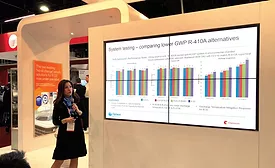
This year, the company was particularly excited to talk about one of its more recent and significant product milestones, R-454B, which will be sold commercially by Chemours as Opteon™ XL41. The new replacement for R-410A was recently selected by Carrier for its residential and light commercial ducted a/c equipment.
If fully supported by governments, the private sector, and citizens, the Kigali Amendment will avoid up to 0.4°C of global warming this century while continuing to protect the ozone layer. The amendment will substantively contribute to the goals of the Paris Agreement.
In October, the Supreme Court decided not to review the case, leaving in place the 2017 ruling, which means for now, the use of high-GWP refrigerants, such as R-404A and R-410A, remains legal.
To recap, earlier this year, refrigerant manufacturers, Honeywell and Chemours, asked the Supreme Court to review an August 2017 decision by the U.S. Court of Appeals for the D.C. Circuit, which stated the EPA could not ban HFCs through its Significant New Alternatives Policy (SNAP) program, because that program was designed only to address ozone-depleting substances. While HFCs are among the greenhouse gases suspected of contributing to climate change, they do not deplete the ozone layer.
Earlier this year, refrigerant manufacturers, Honeywell and Chemours, asked the Supreme Court to review an August 2017 decision by the U.S. Court of Appeals for the D.C. Circuit, which stated the EPA could not ban HFCs through its Significant New Alternatives Policy (SNAP) program, because that program was designed only to address ozone-depleting substances.
Following the passage of California's SB 1013, several other states announced that they, too, were going to implement laws that would reduce the use of HFCs.
Several industry members recently announced their support for certain proposed measures — negotiated by a few manufacturers without input from the HVACR industry at large — for meeting the state's HFC emissions reduction target; however, HARDI has abstained from signing on until consensus can be reached on a more realistic sell-through period.
he phase out, which would be implemented from 2020-2024, is expected to reduce HFC emissions by more than 20 percent of projected levels by 2030. DEC will be seeking input on this proposal prior to proceeding with a formal rulemaking, with the intent of finalizing a rule in 2019.