ACHR News
search
Ask ACHR NEWS AI
cart
facebook twitter instagram linkedin youtube
  • Sign In
  • Subscribe
  • Sign Out
  • My Account
ACHR News
  • NEWS
    • Breaking News
    • New HVAC Products
    • Featured Products
    • Manufacturer Reports
    • HVAC Data
    • Legislation
    • ACHR NEWS Centennial
  • RESIDENTIAL
    • Air Conditioners
    • Furnaces
    • Residential Heat Pumps
    • Ductless
    • Residential IAQ
    • Testing, Monitoring, Tools
    • Components & Accessories
  • COMMERCIAL
    • Air Handlers
    • Rooftop Units
    • Chillers and Cooling Towers
    • Commercial Heat Pumps
    • Boilers and Hydronics
    • VRF/Ductless
    • Commercial IAQ
  • REFRIGERATION
    • Refrigerants
    • Refrigerant Regulations
    • Leak Management
  • CONTRACTOR PRO
    • Geothermal
    • Homeowner Study
    • VRF and VRV Ductless
    • Unitary Trends
  • EDUCATION
    • Training and Education
    • Business Management
    • Service and Maintenance
    • Continuing Education
    • Market Research >
      • HVAC Brand Awareness Report
      • VRV, VRF, VRVZ Report
      • Unitary Trends Report
      • Water Heat Professionals Report
    • Webinars
    • Sponsor Insights
    • eProducts Info
    • White Papers
  • EVENTS
    • HVAC Contractor Forum
    • Industry Events and Webinars
  • MEDIA
    • Videos
    • AHR Expo 2025 Videos
    • Podcasts >
      • ACHR News Podcast
      • HARDI Podcasts
      • AHR Expo Podcasts
      • ACCA Podcasts
    • Interactive Spotlights
    • Quizzes
    • eBooks
    • HVAC Talkback
  • HVAC GROUP
    • ACHR NEWS >
      • Current Issue
      • Digital Edition
      • Subscribe
    • Distribution Trends
    • SNIPS NEWS >
      • Join SNIPS NEWS
    • Engineered Systems News >
      • Join ES News
    • HVACR Directory
    • Contests
    • Newsletters
    • Contact
    • Advertise
    • My Account

Keep Chillers Operating At Peak Efficiency

July 2, 2002
Mark Hanson, a McQuayService technician, finishes a maintenance job on a centrifugal chiller by verifying that actual conditions match performance specifications.
Since their inception over 60 years ago, centrifugal chillers have been the most economical answer for cooling large buildings; over 80,000 centrifugal chillers are in use today. Responding to market demand, HVAC manufacturers continue to improve the energy efficiency of their systems.

Advances in chiller design significantly improve efficiency. However, keeping chillers operating efficiently is still very much in the hands of contractors and service representatives. “High-tech” chillers are built with narrower tolerances; service and upkeep are more crucial than ever to keep efficient chillers operating at peak conditions.

Your first step toward maintaining an efficiently run high-tech system is the daily log. Old-fashioned as it may seem, this log allows you to build a history of operating conditions including temperatures, pressures, fluid levels, and flow rates. True, microprocessor controls are increasingly given the responsibility for recording these statistics. But there is still no substitute for a daily read of controls in the chiller room.

Several variables affect efficiency. The functions described here highlight the main service procedures applicable to all centrifugal chillers to maintain high efficiency, low upkeep, and long life.

HEAT TRANSFER

Heat transfer has the single greatest effect on chiller efficiency. Large chillers can have over five miles of tubing in their condenser and evaporator tubes, so clean heat transfer is fundamental to maintaining high efficiency.

Chiller efficiency declines rapidly with fouled or contaminated tubes. Minerals, scale, mud, algae, and other impurities increase thermal resistance and degrade overall performance. These contaminants accumulate on the water side of heat transfer surfaces in closed- or open-loop systems. (For more information, see the accompanying sidebar, “Tube Cleaning Checklist,” below.)

Approach temperatures (the difference between a heat exchanger’s leaving fluid temperature and the saturated temperature of the refrigerant being cooled or heated) are a good indicator of heat transfer efficiency. Higher approach temperatures are prime indicators that heat transfer efficiency is decreasing.

By keeping log sheets, the servicer can easily detect when temperatures start to change from their efficient levels.

A hypothetical example of a 600-ton chiller operating year- round in a hospital shows how operating costs can increase by $20,000. As the evaporator and condenser fouling factors increase, operating conditions move to 42.4 degrees F evaporator temperature and 97.4 degrees condensing temperature, resulting in 0.593-kW/ton operation — an 8% operating cost increase. Keep those tubes clean!

Looking for quick answers on air conditioning, heating and refrigeration topics? Try Ask ACHR NEWS, our new smart AI search tool. Ask ACHR NEWS →

CONDENSER WATER TREATMENT

All condenser water loops using open cooling sources (such as atmospheric cooling towers) require water treatment of some sort. Scale, corrosion, and biological growth lead to fouling in the condensers. This impedes heat transfer.

Erosive conditions (sand flowing through the tubes at high velocity) may pit tubes, decreasing tube effectiveness. Serious water conditions can damage tubes, piping, and other materials in contact with the water. Inspect chilled water loops once a year for general water quality and evidence of corrosion.

The entering condenser water temperature (from the cooling tower) also affects chiller efficiency. Lowering this temperature improves the chiller’s efficiency. On some building systems, the operator will lower the chilled water setpoint to overcome air handler deficiencies, such as dirty coils. This cures the symptom, not the problem, and makes the chiller work harder for the same net cooling effect.

REFRIGERANT

The actual amount of cooling a chiller performs depends on how much refrigerant (cfm) it moves through the compressor. It is important to maintain the proper level of refrigerant for the conditions desired. Refrigerant leaks, as well as air and moisture introduced into the system, decrease system efficiency and reliability.

Refrigerant charge: A low refrigerant charge, usually due to leaks, causes the compressor to work harder for less cooling effect. Positive-pressure chillers can store their entire refrigerant charge in the condenser, so leak repair is usually a simple task. Low-pressure chillers do not have inherent storage capability, and the charge must be removed for leak checks and repair. For large-capacity machines, some type of pumpout storage needs to be provided.

Low-pressure chiller: Although they will be phased out by 2020, low-pressure chillers are still commonly used. Their evaporators operate in a vacuum and use either CFC-11 (now phased out) or the alternative, HCFC-123. It is difficult to create a perfectly sealed unit, so noncondensables (air and moisture) leak into the chiller. Noncondensables create two problems:

1. They offer no refrigeration effect, even though the compressor uses energy to move them. At the same time, they can blanket tubes with air, preventing them from doing any heat exchange work.

2. Noncondensables contain moisture, which causes acids to form within the chiller. These acids can damage motor windings and bearings.

Noncondensables lower the real efficiency of the chiller from the rated performance by as much as 8% at 60% load and 14% at 100% load.

Purge units on low-pressure chillers minimize the effect of noncondensables. Purge units must be serviced and maintained according to the manufacturer’s recommendation. While modern, high-efficiency purge units minimize air in the chiller and refrigerant loss, older purge systems can lose as much as 25% of the chiller’s refrigerant charge per year.

Positive-pressure refrigerants: Eventually, positive-pressure chillers using HFC-134a, HFC-410A, and HCFC-22 will replace low-pressure chillers. They do not require purge units because noncondensables cannot enter the chiller.

CONTROLS, STARTERS, MOTORS

The chiller motor is typically the largest single electrical load in a building. Constant-speed compressors match capacity to load through inlet vanes, throttling the gas allowed into the compressor impellers. Closing the inlet vanes reduces flow, affecting efficiency at part-load conditions. This is not the most effective method of chiller capacity modulation.

With the right operating conditions, variable-speed drives (VSDs) can offer significant energy savings. Varying motor speed is a much more efficient method of capacity control, as it matches motor efficiency to load and wastes less energy. VSDs also act as soft starters to lower the inrush current for the motor to almost that of the full-load-running amps. This is an important factor for chillers operating on emergency power generators. VSDs also reduce the mechanical shock of starting large-horsepower motors, increasing reliability and life.

However, VSDs introduce another efficiency concern. Proper VSD calibration is essential for optimum part-load operation. Operation and controls must be checked to ensure that speed is matched to load.

Here is a brief checklist for efficient operation of starters and motors:

  • Check safety and sensor calibrations on microprocessor controls (consult manufacturer’s guidelines).

  • Check electrical connections, wiring, and switchgear related to the chiller for hot spots and worn contacts.

  • To prevent insulation faults, test electrical motor windings for insulation resistance to ground and winding to winding.

  • Check the cooling line filter of hermetic refrigerant-cooled motors.

  • Check the shaft seal of open-drive motors for possible refrigerant leaks.

  • Clean motor-cooling air vents to ensure maximum cooling effect.

    COMPRESSOR LUBRICATION

    Once a year, take a sample of lubrication oil in the compressor and send it to a laboratory for a “Spectrometric” chemical analysis and report. This gives the levels of any moisture content, wear metals, acids, and other contaminants that affect performance.

    Like any hermetically sealed refrigeration system, the oil should only be replaced if indicated by analysis.

    High moisture content can indicate a problem with the purge unit. Sample low-pressure chillers more frequently based on purge run-hours. Check oil filters for pressure drop; replace them if the oil charge is replaced.

    FUTURE OF CHILLER OPERATION

    Daily, weekly, monthly, and annual operational reviews give you optimum chiller efficiency. The press for improved efficiency will continue; manufacturers are developing systems that respond to this demand.

    The emphasis is already changing from scheduled maintenance to predictive and reactive maintenance, based on operating information gathered via microprocessors. This will help prevent major failures, reduce downtime for maintenance functions, and minimize emergencies. With improved technologies, service representatives will have more information to keep chillers operating at the levels customers expect.

    Sidebar: Tube Cleaning Checklist

    Condenser water tubes:

  • Drain water from condenser.

  • Remove nonconnection head.

  • Visually inspect tube sheets and water boxes for obstructions, fouling, and scale.

  • Using a mechanical rotating tube brushing machine with nylon brushes, brush clean the length of each tube, removing soft debris and mud.

  • Clean visible scale (hard mineral deposits) chemically (consult a chemical water treatment firm). Never use cutting devices or hard metal tools to clean tubes.

  • Flush clean the tubes with water.

  • Replace head gaskets if they are worn.

  • Check pressure drop to confirm proper design water flows.

  • Perform eddy current scan (nondestructive tube analysis) every three years; perform during the first year of operation to establish a baseline.

    Evaporator tubes:

  • Brushing is not typically required due to the closed chilled-water loop (if required, see checklist for condenser water tubes).

  • Monitor approach temperatures to determine evaporator fouling.

  • Check pressure drop to confirm proper design water flows.

  • Perform eddy current scan (nondestructive tube analysis) every five years; perform during the first year of operation to establish a baseline.

    Grenz is with McQuayService. McQuay International products and services are provided through a worldwide network of sales and service offices. For more information, call 800-432-1342 or visit www.mcquay.com (website). For training on servicing centrifugal chillers, contractors can attend McQuay training classes in Staunton, VA. To enroll, go to www.mcquay.com/training.

    Publication date: 07/08/2002
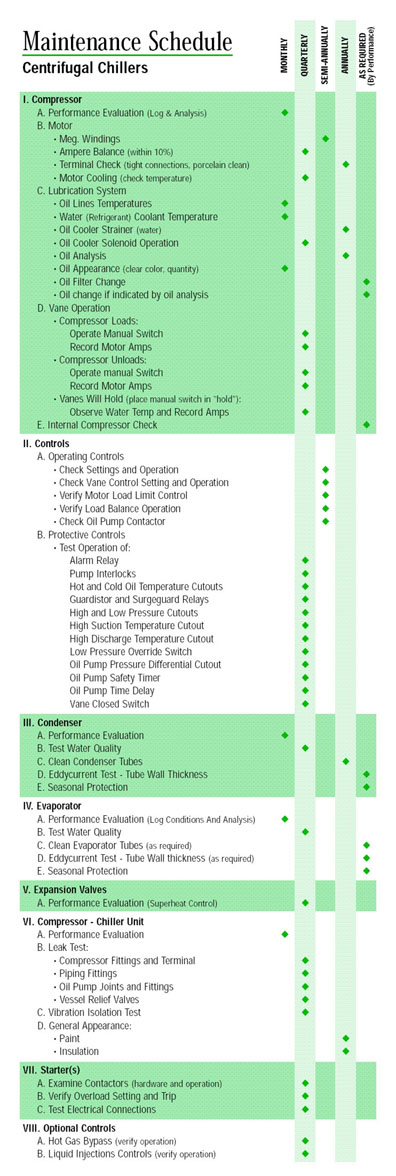
    Table 1. Maintenance schedule for centrifugal chillers. (Courtesy of McQuay International.)
  • Share This Story

    Looking for a reprint of this article?
    From high-res PDFs to custom plaques, order your copy today!


    Recommended Content

    JOIN TODAY
    To unlock your recommendations.

    Already have an account? Sign In

    • HVAC-enrollment

      The Trades Are Back: HVACR Programs See Nearly 30% Enrollment Spike

      A new wave of future technicians is entering the pipeline.  
      News
      By: Matt Jachman
    • 2025 Top 40 Under 40

      2025 Top 40 Under 40 HVACR Professionals List

      The 11th annual Top 40 Under 40 list highlights those...
      HVAC Residential Market
      By: Hannah Belloli-Oster
    • LG Ductless Mini-Split Systems

      The 9 Types of Heat Pumps

      As the U.S. moves toward electrification, heat pumps are...
      News
      By: Joanna R. Turpin
    Subscription Center
    • Create an Account
    • Start a Subscription
    • Manage My Account
    • Sign Up for Newsletters
    • Visit Customer Service
    • Update Preferences

    More Videos

    Sponsored Content

    Sponsored Content is a special paid section where industry companies provide high quality, objective, non-commercial content around topics of interest to The News audience. All Sponsored Content is supplied by the advertising company and any opinions expressed in this article are those of the author and not necessarily reflect the views of The News or its parent company, BNP Media. Interested in participating in our Sponsored Content section? Contact your local rep!

    close
    • Piggy Bank
      Sponsored byWatercress Financial

      Energy Prices, Inflation, and HVAC: What Today’s Homeowners Care About

    • Refrigerated Food
      Sponsored bySolstice Advanced Materials

      R-455A Refrigeration: A Cold Storage Solution for the Future

    • Airex Rooftop Units
      Sponsored byAirex Manufacturing Inc

      Consolidating Roof Penetrations: A Growing Trend in Multifamily HVAC Design

    Popular Stories

    Outdoor-condensing-units.jpg

    EPA Removes R-410A Installation Deadline

    HVAC-Price-Increase-graphic

    HVAC Price Increase List: June 2026

    Trump-Section-232.jpg

    Trump Reduces Section 232 Tariffs on HVAC Equipment to 15%

    cooling-habits.jpg

    50 Percent of Americans Have Skipped HVAC Maintenance

    ACHR NEWS Editor Chris Gray Presenting HVAC Minute 5-18-2026

    HVAC Manufacturers Fight Pricing Lawsuits

    View The ACHR NEWS
    Centennial Anniversary Timeline

    The ACHR News Timeline Chart
    Submit a Letter
    Submit a letter to our editors.

    Events

    November 6, 2025

    Next-Gen Data Center Cooling: HVAC Innovation and Real-World Solutions

    On Demand As AI workloads and high-density computing push traditional cooling methods to their limits, the data center industry is accelerating the adoption of next-generation HVAC technologies.

    June 9, 2026

    Before You Go All In on AI: Set Up Your Business to Actually Win

    In this webinar, we'll walk you through exactly what to get in place before you add AI to your business. You'll leave with a clear picture of where you stand today and a practical action plan to set yourself up for real results.

    View All Submit An Event

    Poll

    Summer Staff

    Are you fully staffed for the summer season?
    View Results Poll Archive

    Products

    BNI Mechanical/Electrical Square Foot Costbook, 2026 Edition

    BNI Mechanical/Electrical Square Foot Costbook, 2026 Edition

    See More Products
    A2L Refrigerants - Free Webinar - May 21, 2026

    Related Articles

    • McGough Construction Dylan Shaw

      Free Cooling Isn’t Free: Lessons From Operating at the Edge of Climate Extremes

      See More
    • Housing Market Is Still Robust, But Is It At Its Peak?

      See More
    • Unitary is at a peak and staying near

      See More

    Related Products

    See More Products
    • peak performance training.png

      Instructor/Facilitator Package: PEAK Performance for the Technical Professional

    • ttabppftpfront.png

      PEAK Performance for the Technical Professional

    • PEAK Audio Discs.jpg

      PEAK Performance Audio Book On CD

    See More Products

    Events

    View AllSubmit An Event
    • May 12, 2026

      Peak Season Prep: Capture Every Dollar Coming Your Way

      On Demand In this session, we’ll break down how to prepare your business to capture every opportunity during peak demand. You’ll learn how to improve response times, convert more inbound inquiries, and use tools like AI to handle calls and texts, book jobs faster, and maximize revenue—without overloading your team.
    • August 19, 2025

      AI Playbook for Peak Season Profit

      ON DEMAND: Join this training to see playbooks for how an AI CSR can turn every call, text, and web lead into a booked job, while giving your staff hours back, even during the summer.
    View AllSubmit An Event

    Related Directories

    • Cold Shot Chillers

      Cold Shot Chillers manufactures reliable, efficient industrial process chillers, offering air-cooled and water-cooled solutions for diverse industries, ensuring precise temperature control and durability.
    • KeepRite Refrigeration

      Leading North American manufacturer of commercial refrigeration products, including specialized applications in food storage and processing, industrial process cooling, including evaporator coils, condensing units, condensers, and heat transfer/recovery.
    ×

    Sign Up. Stay Informed.

    The #1 trusted source for the HVACR industry since 1926

    SUBSCRIBE
    • RESOURCES
      • Advertise
      • Contact Us
      • Advisory Board
      • Classifieds
      • Submit a Letter
      • Directories
      • Store
    • ACCOUNT CENTER
      • Create an Account
      • Start a Subscription
      • Manage My Account
      • Sign Up for Newsletters
      • Visit Customer Service
      • Update Preferences
    • SERVICES
      • Marketing Services
      • Reprints
      • Market Research
      • List Rental
      • Survey/Respondent Access
    • STAY CONNECTED
      • LinkedIn
      • Facebook
      • Instagram
      • YouTube
      • X (Twitter)
    • PRIVACY
      • PRIVACY POLICY
      • TERMS & CONDITIONS
      • DO NOT SELL MY PERSONAL INFORMATION
      • PRIVACY REQUEST
      • ACCESSIBILITY

    Copyright ©2026. All Rights Reserved BNP Media, Inc. and BNP Media II, LLC.

    Design, CMS, Hosting & Web Development :: ePublishing