Free Cooling Isn’t Free: Lessons From Operating at the Edge of Climate Extremes
Exploring the overlooked complexities and real-world challenges of implementing free cooling in extreme climates
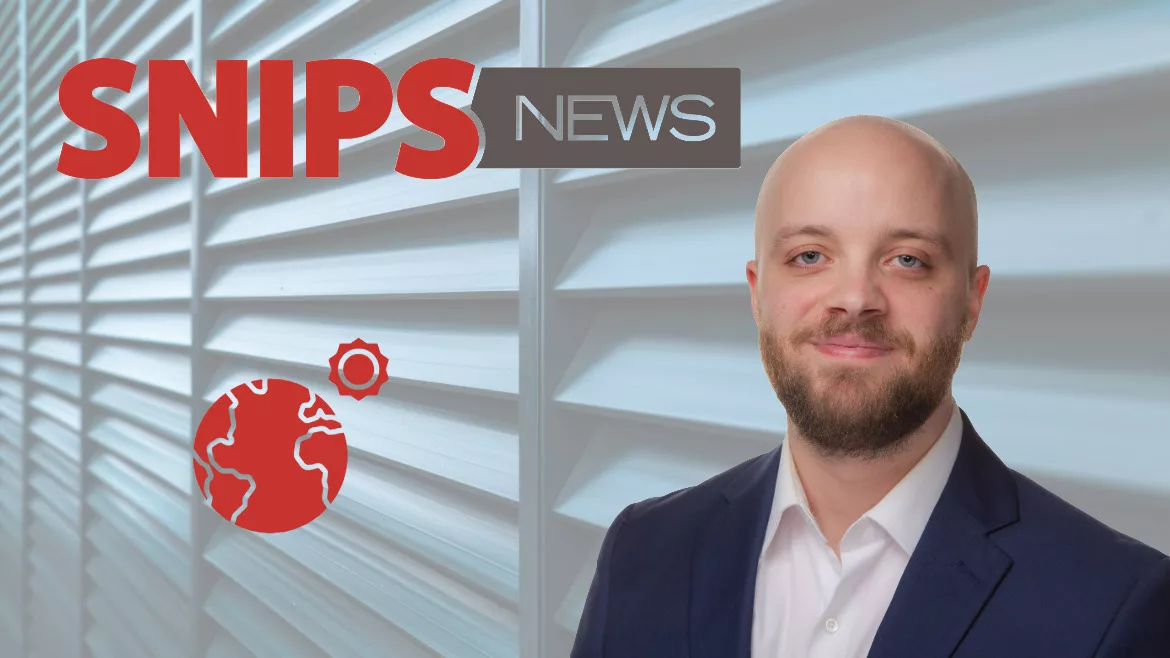
MEP: Dylan Shaw, MEP senior project manager at McGough Construction, stands in front of facility louvers – a gateway for fresh air in advanced free cooling systems.
Free cooling is often viewed as a clear advantage for cold-climate data centers, but real-world delivery can be far more complex. In this Q&A with Dylan Shaw, Mechanical, Electrical, and Plumbing (MEP) senior project manager at McGough Construction, we explore the challenges contractors encounter when building facilities designed to operate across wide temperature ranges. We also cover how those conditions affect systems performance, coordination, and long-term reliability. He offers a contractor’s perspective on what owners should consider when pursuing free cooling strategies.
When owners say “free cooling” in cold climates, what’s the biggest misconception you encounter?
The biggest misconception is that free cooling applies to the entire facility load. In reality, that term only refers to the reduction in compressor loads; you still have a significant amount of fan and pump energy required to facilitate that cooling. Furthermore, even in cold markets like North Dakota, you still have to size your equipment for the worst design day – the 105-degree day you might only encounter for eight hours a year. Because of this, upfront capital costs remain relatively similar to traditional systems despite the availability of free cooling.
What are the hardest technical or operational challenges you’ve faced when building free cooling systems for data centers at the edge of climate extremes?
The biggest challenge we faced recently was with a water-cooled chiller plant where the condenser water fluctuated anywhere from 40°F in January to 118°F in July. This created a massive amount of thermal expansion in the fluid. During construction and commissioning, we found the plant was often too low on pressure in the winter, which can cause pumps to cavitate and erode seals and impellers.
On the opposite side, we saw an overproduction of pressure in the summer. In these cases, if expansion tanks are undersized or the design lacks relief valves to handle those swings automatically, it requires constant manual intervention to fill and bleed the system.
Can you walk us through how you evaluate a site’s suitability for free cooling? What factors are most likely to derail an owner’s assumptions?
Owners are often attracted to cold regions like the upper Midwest assuming it will be inexpensive to operate, but it’s still absolutely necessary to design for those 100-plus-degree peaks. Beyond the climate, infrastructure is a major factor. If you are building in a rural location, the effort required to get water to and from the site is a logistical challenge. In areas that have not hosted these projects before, there may not be enough water tankers to move fresh water in and contaminated cleaning water out quickly enough.
How do you design mechanical and control systems to handle rapid swings in temperature or humidity outside?
In my experience, humidity doesn’t change rapidly enough to be a primary driver of control system design. Yet temperature swings require a much more robust control strategy. To maintain stability in these facilities, the design must prioritize right-sized buffer tanks and thermal energy storage.
A critical, and often overlooked, design element is the strategic placement of sensors. If you place a temperature sensor only on the leaving side of a massive storage tank, the system won't register a temperature spike until the entire volume of that tank has passed the sensor. For example, we had to relocate sensors on a project post-commissioning because there was a several-minute delay between a real-time plant event and the system’s reaction. To handle rapid swings, transducers must be located where they can provide a real-time data loop.
What are some examples of hidden costs or integration issues that owners should be prepared for?
A major surprise can be the startup heat requirement. Even though data centers are about cooling, cold climates require heat for offices and loading docks. Under normal operations, we extract waste heat from the customer’s server load to warm offices, loading docks, and peripheral spaces. Yet if you are commissioning or starting a plant during a winter cycle, there is no server load to extract from.
We have seen smart project teams caught off guard by the necessity of renting a fleet of load banks at the eleventh hour. These load banks are required to place a false load on the system, providing the thermal energy needed to jumpstart the plant and maintain it until the actual customer servers are online. It’s a significant logistical cost that must be factored into the commissioning budget of any facility in an extreme climate.
How do you coordinate with other disciplines – architectural, structural, electrical – to ensure free cooling doesn’t create new headaches for reliability or maintenance?
Coordination across disciplines requires a transparent, math-driven conversation about redundancy vs. reality. When we calculate the peak load for the absolute worst-case design day, we often find that standard electrical feeders or mechanical components are mathematically undersized to provide 100% redundancy during that specific peak.
This is where inter-discipline coordination is vital: We must help the owner decide between two paths. They can either right-size expensive equipment for a weather scenario that might only occur once in a millennium, or they can consciously accept a system that is, for example, 99.9% redundant. Our role is to ensure that the architectural and electrical footprints are designed around that choice, rather than discovering a capacity gap during an extreme weather event.
In your experience, how do free cooling systems impact long-term reliability or the maintenance profile of a facility compared to traditional approaches?
From a maintenance perspective, free cooling offers a significant advantage by creating a built-in service window. Depending on the specific system design, your chillers may remain completely offline for several months of the year. This provides a fantastic opportunity to perform comprehensive servicing without the typical risks associated with maintaining equipment while it is supporting a live load.
These systems are also inherently resilient to long-term climate shifts. In our region, we don't require extreme temperatures like -40 degrees to achieve full free cooling; we generally only need to be in the 20 – to 30 – degree range. Because the threshold for full capacity is so much higher than our seasonal lows, the free cooling benefit remains baked in even if average ambient temperatures rise over the 20-year lifespan of the facility.
What sorts of issues have cropped up after commissioning, once a facility is operating through its first full climate cycle?
The most prevalent post-commissioning challenge is managing the dramatic pressure changes caused by thermal expansion. On massive chilled water plants, it is incredibly difficult to fully load equipment and mimic a true "design day" during the initial testing phase. You are essentially trying to simulate a peak summer load while the building is still largely empty.
Once the facility is operating under a live building load, you inevitably discover operational nuances that were mathematically impossible to commission beforehand. We typically have to return during the first full climate cycle to fine-tune how chillers are enabled and tweak the staging sequences. This real-world calibration ensures that the system stages up and down efficiently to match the actual, fluctuating load of the building rather than the theoretical load in the design documents.
Are there specific lessons learned you wish more owners considered up front before pursuing free cooling?
The most vital lesson is that geography dictates design. We frequently see engineering plans optimized for the climates of Tennessee or Texas that simply cannot withstand the extremes of the Upper Midwest. A design that works in a moderate climate will often fail when subjected to our local temperature swings.
To mitigate this, owners should involve a general contractor with deep local expertise as early as the pre-construction phase. At McGough, we employ former consulting engineers and MEP subject matter experts who review specifications to catch "out of state" design errors before the build begins. Involving a partner who understands local climate-specific requirements – such as the infrastructure needed to truck in millions of gallons of water and glycol to rural sites – can save an owner from massive logistical headaches down the road.
What advice would you give to project teams working on data centers in regions with particularly challenging climates?
Project teams must account for the "daisy chain" effect that extreme climates have on background engineering. In a region where temperature swings can exceed 130 degrees, every design choice triggers a secondary requirement:
- Fluid Dynamics: Cold extremes necessitate a heavy glycol solution to prevent burst coils, but glycol is more viscous and less efficient at heat transfer than water.
- Equipment Sizing: Because glycol is less efficient, you must specify larger heat exchangers and oversized pumps to maintain the same cooling capacity.
- Electrical Load: Larger pumps draw more current, which slightly offsets the efficiency gains typically expected from free cooling.
Ultimately, the attraction of "free" cooling must be balanced against the reality of oversizing equipment to handle these environmental extremes. If you don't design for the worst-case scenario up front, the system will not have the resilience required to survive a full climate cycle.
Looking for a reprint of this article?
From high-res PDFs to custom plaques, order your copy today!