How a Pension Crisis Sparked Congressional Action: Lessons from the Experts
SMACNA panel dissects the political scramble to save multiemployer pensions at the eleventh hour
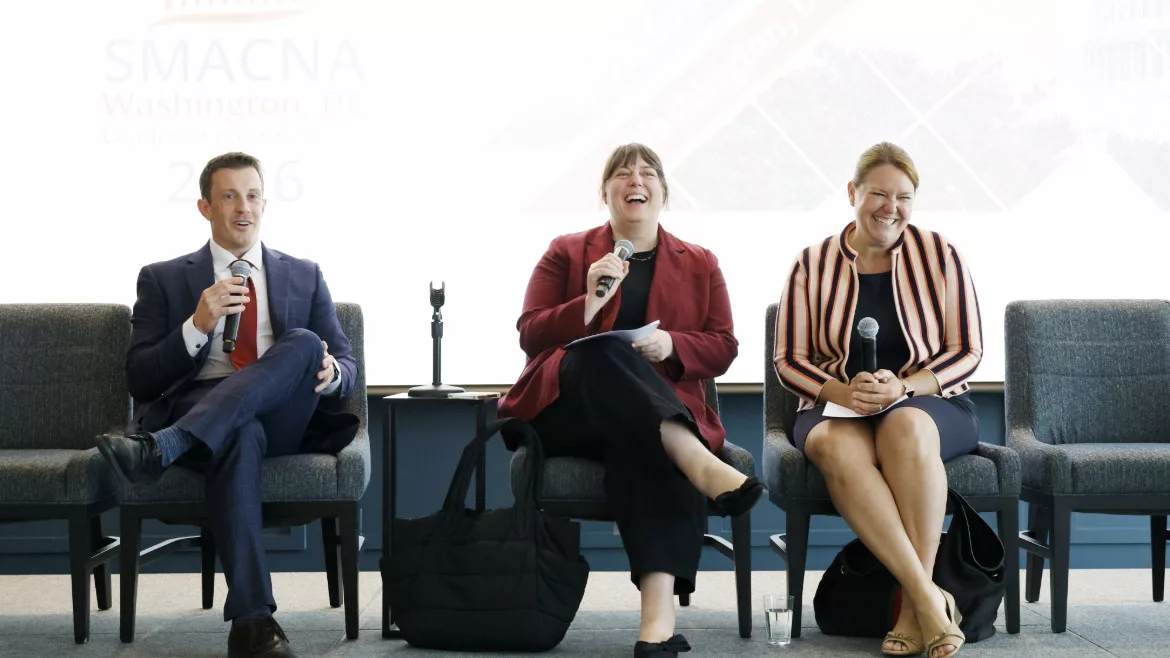
FROM THE BRINK: Panelists Mariah Becker and Kendra Kosko Isaacson recount the tense negotiations and last-minute pivots that brought America’s union pension system back from the brink with Jared Karbowsky of the Sheet Metal and Air Conditioning Contractors’ National Association.
When the pension system for America’s union workers was teetering on the edge of collapse, it took a global pandemic – and years of behind-the-scenes wrangling – for Congress to act. That was the message from a panel of pension policy insiders who spoke this week at a session moderated by Jared Karbowsky of the Sheet Metal and Air Conditioning Contractors’ National Association (SMACNA).
Karbowsky was joined by Mariah Becker, director of research and education at the National Coordinating Committee for Multiemployer Plans (NCCMP), and Kendra Kosko Isaacson, now a principal at Mindset and formerly the Senate’s top pension and tax policy expert for Senator Patty Murray and the Health, Education, Labor and Pensions Committee.
A System in Crisis
Becker and Isaacson detailed the turbulent years leading up to the passage of the American Rescue Plan Act’s pension rescue provisions, painting a picture of mounting failures in massive pension funds like Central States and the United Mine Workers’ plan.
“Congress really only works in a crisis,” Isaacson said, recalling how repeated warnings went unheeded until COVID-19 forced action. “Basically, it took COVID to get things done.”
The panelists described a “kitchen table economics” reality, where the threat of pension insolvency wasn’t just about numbers, but about retirees losing almost everything. “Some retirees would have seen annual benefits slashed from around $13,000 to as little as $1,200,” Becker explained. “People came to the Hill and made sure lawmakers understood these weren’t just statistics, these were real lives.”
Legislative Gridlock and the Last-Minute Pivot
For years, solutions stalled amid fierce partisan disagreement and complex proposals. At one point, the “Grassley-Alexander” plan would have hiked Pension Benefit Guaranty Corporation (PBGC) premiums to unsustainable levels. (The PBGC, or Pension Benefit Guaranty Corporation, is the federal agency that insures private-sector pension plans. Its multiemployer program acts as a financial backstop for union plans that run out of money, but before the American Rescue Plan Act, the PBGC itself was projected to become insolvent within a few years.) “They were quite literally talking $500 a person, both active and retired participants,” Becker recalled. The negotiations cycled endlessly: “We were talking loans, partitions, 12,000 different ways of trying to fix this problem, and none of it was coming together.”
The turning point only came after the 2020 election tipped Senate control, allowing Democrats to pivot to budget reconciliation that included pension rescue in the American Rescue Plan Act (ARPA). The process, panelists said, was “hammered out in like, six weeks. Two months, at most.” Isaacson confessed, “I spent my first seven years on the bill, and also the previous three at Department of Labor working on these issues. I was really depressed that we were never going to get to a solution. But then we had a surprise victories in Georgia, and were able to pivot very quickly.”
Did the Fix Address the Real Problems?
Some critics argue that simply injecting money into a broken system wouldn’t solve underlying challenges like declining union membership or flawed funding rules. “The best argument against just putting money in was that the conditions that caused these plans to go broke wouldn’t be addressed,” one audience member pressed.
Isaacson noted that Democrats have pushed for broader measures like the PRO Act, aiming to strengthen collective bargaining and bring more members into the system. Becker explained that, while major structural reforms didn’t make it into the final bill, the rescue funds came with “an enormous number of restrictions” – from how the money can be invested or used, to what kinds of benefit changes are allowed. “It doesn’t mean they are absolutely, 100% certain to be okay, but a lot of those plans have a good chance. They’re in much better shape than they were before.”
Panelists also pointed out that outside the legislative process, trustees have gradually become more conservative with investment assumptions – lowering discount rates and building more resilience into the system.
With pensions stabilized for now, the panelists stressed that policymakers still often lack a basic understanding of how multiemployer plans work. “Please don’t ever assume that they understand what a multiemployer plan is,” Becker warned, adding that ongoing education and vigilance are essential to prevent future crises or bad legislation.
Their takeaway: even after a crisis is averted, the work isn’t over. “The less Congress thinks about multiemployer pension plans … would be better,” Becker concluded. Staying organized, informed, and ready to educate lawmakers remains the best insurance for American retirement security.
Looking for a reprint of this article?
From high-res PDFs to custom plaques, order your copy today!