Understanding Superheat
Superheat is a measured value. It is the difference between two temperatures. Superheat is measured as the difference between the actual temperature of the refrigerant vapor and the saturation temperature of the refrigerant at that same point. Superheat on the system's low side can be divided into two types: evaporator superheat and total (or compressor) superheat.
Evaporator Superheat
Evaporator superheat starts at the 100-percent saturated vapor point in the evaporator and ends at the outlet of the evaporator. The 100-percent saturated vapor point is the point where all the liquid has just turned to vapor. The temperature at this point can be obtained from a pressure-temperature chart.
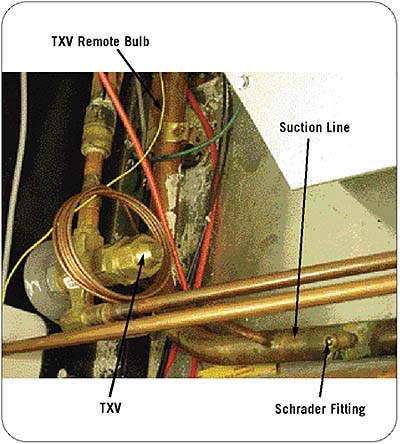
The evaporator outlet is where the remote bulb of the thermostatic expansion valve (TXV) is located. (See Figure 1.) Technicians usually put a thermistor or thermocouple at the evaporator outlet to get the evaporator outlet temperature. A pressure gauge at the same point as the temperature reading will give a technician the saturated vapor temperature. Most manufacturers of larger evaporators supply a Schrader fitting at the evaporator outlet pretty close to the remote bulb of the TXV for measuring pressure. (See Figure 2.)
Example No. 1
Let's look at an R-134a refrigeration system. The low-side gauge reading at the evaporator outlet equals 20 psig or 23 degrees F. (See Table 1.) The evaporator outlet temperature (thermistor reading) equals 30 degrees.The evaporator superheat calculation would be as follows: The evaporator outlet temperature (30 degrees) minus the saturation temperature at the evaporator (23 degrees) equals the evaporator superheat (7 degrees).
Errors To Avoid
If a technician were to measure the pressure at the compressor instead of the evaporator outlet, a higher and fictitious superheat value would be read. As the refrigerant travels the length of the suction line, there would be associated pressure drop from friction and/or restrictions. This would cause the pressure at the compressor to be lower than the pressure at the evaporator outlet.This higher, fictitious superheat reading may lead the technician to adjust the TXV stem clockwise (open) to compensate for the erroneously high superheat reading. This could cause compressor damage from liquid flooding or slugging from too low of a superheat setting.
Example No. 2
Assume a 5-psi pressure drop from the evaporator outlet to the compressor in an R-134a system. The low-side gauge reading at the compressor inlet equals 15 psig or 15 degrees. The evaporator outlet temperature (thermistor reading) equals 30 degrees.In this case, the evaporator superheat calculation would be: Evaporator outlet temperature (30 degrees) minus saturation temperature at compressor inlet (15 degrees) equals degrees superheat (15 degrees).
The superheat changed from 7 degrees to 15 degrees simply by reading the pressure at the compressor inlet instead of the evaporator outlet. This correct evaporator superheat would be 7 degrees. It is best to measure the pressure at the same location as you measured the temperature to exclude any system pressure drops.
Superheat Amounts
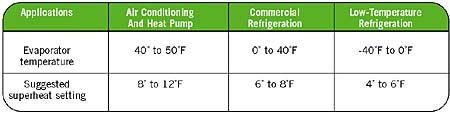
The amount of evaporator superheat that is required for a certain application will vary. Commercial icemakers call for 3 degrees to 5 degrees of evaporator superheat to fill out their ice sheets.However, suction line accumulators are often employed on these systems for added protection. This will help ensure the entire refrigerant entering the compressor is free of liquid. This will also help keep a fully active evaporator. Lower temperature applications generally utilize lower evaporator superheat. Please consult the case manufacturer if in doubt. In the absence of manufacturer's data, a chart such as the one shown in Table 2 shows guidelines for superheat settings.
There will always be a time when the evaporator sees a light load and the TXV may lose control of its evaporator superheat due to limitations of the valve and to system instability. This is where total superheat comes into play.
Looking for quick answers on air conditioning, heating and refrigeration topics? Try Ask ACHR NEWS, our new smart AI search tool. Ask ACHR NEWS
Total Superheat
Total superheat is all the superheat in the low side of the refrigeration system. It starts at the 100-percent saturated vapor point in the evaporator and ends at the compressor inlet. (See Figure 1.)Sometimes referred to as compressor superheat, total superheat consists of evaporator superheat plus suction line superheat. A technician can measure total superheat by placing a thermistor or thermocouple at the compressor's inlet and taking the temperature. A pressure reading will also be needed at this same location.

Example No. 3
Let's take another look at an R-134a system. Low-side pressure at the compressor is 20 psig or 23 degrees F. (See Table 1.) The compressor inlet temperature equals 50 degrees.The total superheat calculation is as follows: Degrees compressor in temperature (50 degrees) minus saturation temperature (23 degrees) equals total superheat (27 degrees).
In the above example, the total superheat was calculated to be 27 degrees. It is possible to have a TXV that is adjusted to control superheat at the coil (evaporator superheat) and still return liquid refrigerant to the compressor at certain low load conditions.
If so, the conditions causing the floodback should be found and corrected. It is recommended that all TXV-controlled refrigeration systems have at least 20 degrees of compressor superheat to ensure that the compressor will not see liquid refrigerant (flood or slug) at low evaporator loads. Total superheats from 20 degrees to 30 degrees are recommended to ensure adequate compressor cooling and preventive liquid control to the compressor. The TXV, however, should be set to maintain proper superheat for the evaporator.
Air-cooled compressors are more vulnerable to slugging and valve damage because the suction gases are not heated by the motor windings. The gases enter the sidewall of the compressor and go directly to the valves. The 20 degrees of compressor superheat will be a buffer in case the TXV loses control of superheat at these low loads.
However, the evaporator superheat must still be maintained by the guidelines in the chart shown. A buffer of 20 degrees to 30 degrees of compressor superheat will also make sure that the refrigerant vapor entering the compressor is not too dense. Vapors at too high of a density entering the compressor will cause the compressor to have a higher-than-normal amp draw.
This will overload the compressor in many instances and open thermal overloads.
On the other hand, excess suction gas superheat and/or long periods of low mass flow rate (e.g., an unloaded compressor), can result in insufficient cooling of the stator and open the internal protectors.
Increasing Total Superheat
Remember, the TXV controls evaporator superheat. To obtain more total superheat, one may add a liquid/suction heat exchanger, or even run a bit longer suction line to allow heat gains from the surrounding temperature to heat the suction line.It is not recommended to take the insulation off of the suction line to increase total superheat. This will cause the suction line to sweat from water vapor in the air reaching its dew point on the suction line. Freezing at this condensation may also occur if suction line temperatures are below 32 degrees. Water damage can occur.
If at all possible, do not sacrifice (raise) evaporator superheat to get the amount of total superheat needed. This will not maintain an active evaporator and system capacity will suffer.
TXVs often lose control of evaporator superheat at evaporator loads. Low evaporator loads can be caused by many different situations.
Causes for low load conditions on evaporator coils include:
TXV Hunting
Anytime the evaporator coil sees a reduced heat load than that it is designed to see, a TXV can lose control and hunt. Hunting is nothing but the valve overfeeding and then underfeeding, trying to find itself.Hunting occurs during periods of system unbalance (e.g., low loads), when temperatures and pressures become unstable. The TXV tends to overfeed and underfeed in response to these rapidly changing values until the system conditions settle out, and the TXV can stabilize.
It is this overfeeding condition that hurts compressors. Too low evaporator superheat setting also causes the TXV to hunt.
In conclusion, a total superheat of at least 20 degrees can prevent the compressor from seeing any liquid refrigerant.
Tomczyk is a professor of HVACR at Ferris State University, Big Rapids, Mich. He can be reached by e-mail at tomczykj@tucker-usa.com.
Publication date: 06/07/2004
Looking for a reprint of this article?
From high-res PDFs to custom plaques, order your copy today!