The Mystery Of The Beer Case Crisis

The problem with being a refrigeration service contractor, sometimes, is that even when you just stop in for a six-pack, you are dealing with a customer.
The problems described here could have started on a cool autumn day during an on-duty service call to a drive-through convenience store in a northern state, where the refrigeration service contractor finds that a 1-hp compressor failed on one of the store's walk-ins that incorporate a K-body compressor.
At first it looks like it failed due to liquid slugging. The store manager says it was "incredibly noisy" before it stopped working. The contractor looks for signs of floodback that could have led to slugging. The coils are clean and unobstructed. He does find that the head pressure is too low, possibly due to low ambient conditions. Our contractor first checks for other causes of low liquid line pressure (low charge, restrictions, etc.). He is able to rule them out.
"That low head pressure allows the liquid line pressure to fall," he reasons. "When the liquid line pressure dropped, maintaining adequate pressure drop across the expansion valve became a problem. Without good pressure drop across an expansion valve, floodback may occur."
To rectify this before he installs the new compressor, he installs a reverse-acting pressure control that senses the liquid line pressure. The condenser fan is wired through this control so that when the liquid line pressure drops below the setpoint, the control contacts open, disrupting power flowing to the condenser fan. When the condenser fan cycles off, the head pressure rises, which raises the liquid line pressure. So far, so good.
However, when the fan is cycled off during low ambient conditions, airflow is shut down too. Hey, the air blast is what cools air-cooled compressors. Over time, if the fan operation shuts down frequently and if there is no secondary cooling for the air-cooled compressor, this could lead to overheating and almost certain compressor death.

Several Months Later
Like many refrigeration service contractors, this one checks the conditions of "his" system when he comes in for beer or to grab a soda. One day during an unseasonably cold spring, he reaches into the beer case and notices that the air doesn't feel as cool as it should. He puts the back of his hand against a beer can, testing several this way on various shelves.He goes around to the back of the system. The condenser fan's low-ambient control is working, but he thinks he's losing liquid pressure to the expansion valve; he gets out his gauges to confirm it. Finding that it's so, he adjusts the pressure control, telling himself that this is a quick fix and that he will come back very soon to find a more permanent solution. Then all hell breaks loose on another job, and he forgets about the convenience store.
Looking for quick answers on air conditioning, heating and refrigeration topics? Try Ask ACHR NEWS, our new smart AI search tool. Ask ACHR NEWS
A few months later, his helper gets a call from the owner: The beer in his beer case seems kind of warm, could they check it out? The helper goes out to the store on a Sunday. He sees the recently installed low-ambient control, and sees that it's cycling the fan off and on; he knows it is working; he also sees that the line pressure to the expansion valve is low.
He adjusts the low-ambient control, telling the owner that the case should be good for now, and promising to check it out more thoroughly when he doesn't have to charge double time for the labor. However, the helper forgets to write down the problem.
After a few more seasons, the contractor gets a call from the infuriated owner. The beer cooler is completely warm and not running at all. The contractor goes out and discovers another dead compressor. "What kind of junky equipment is this, anyway?" he asks himself. Then he looks at the setting of the low ambient control. Uh oh ....

Whodunit?
The contractor sends the unit back to the factory and requests a teardown report. The factory teardown specialist finds general signs of lower end wear and burned oil on the discharge side of the valve plate. The culprit: overheating. Without proper airflow across the compressor, the oil inside the unit heated up until its lubricating properties broke down and it was unable to lubricate the surfaces as it should. This led to heat-related damage in the compressor, until eventually the unit died.Cycling the condenser fan led to the overheating. According to the manufacturer, it really turns into a lubrication problem. When they cycle the compressor fan off, they are losing the cooling to the compressor. Unfortunately, this is a very common practice.
Sometimes systems will benefit from the installation of a timer, temperature control, solenoid valve, and pumpdown control. "Mount everything in the cooler," commented another contractor. "Let the pumpdown be controlled by the low-pressure control." The solenoid closes, the system pumps down, and the compressor shuts off on low pressure.
The manufacturer agreed with the use of a pumpdown cycle, "but a pumpdown cycle or a crankcase heater will have no effect on the floodback situation. An accumulator could help, but the floodback just needs to be controlled if possible."
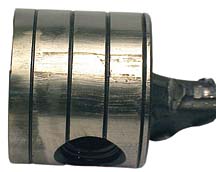
The Killer's Profile
"It is not only possible, but probable," stated the manufacturer, "that the great majority of compressor failures on low-temperature systems originate in compressor overheating, and field experience indicates the great majority of those failures can be eliminated if discharge gas temperatures are reduced to a reasonable level."Most refrigeration oils will start to break down or carbonize at temperatures of 350 degrees F. Tests in a contaminant-free atmosphere may indicate a reasonable tolerance for even higher temperatures, but the real world is inhabited by a multitude of systems that have varying degrees of contaminants such as air and moisture."
Ring and piston wear can occur at cylinder temperatures of 310 degrees to 330 degrees with little oil carbonization. "There is growing evidence that modern refrigeration oils have been so highly refined to obtain good solubility and high breakdown temperatures that the oil is unable to maintain a lubricating film at high temperatures. Field experience in general would indicate for good long-life characteristics, piston, ring, and valve port temperatures should be maintained below 300 degrees F. Normally, discharge line temperatures within 6 inches of the compressor outlet will be from 50 degrees to 75 degrees cooler than cylinder and piston temperatures, depending on the compressor design and the refrigerant mass flow. Therefore, as a general rule, 275 degree discharge line temperatures represent a certain failure temperature condition; 250 degrees is usually a danger level; and 225 degrees F and below are desirable for reasonable life expectancy."
In addition, "a critical temperature condition can occur on R-22 systems with evaporating temperatures below 10 degrees," stated the manufacturer. "Unfortunately, many medium-temperature R-22 systems designed for nominal evaporating temperatures of 5 degrees or 10 degrees wind up operating at suction pressures equivalent to evaporating temperatures of -10 degrees or lower, and such installations can develop severe problems. Note that it is the suction pressure at the compressor that is critical, not the case evaporating temperature, since in many cases the critical threat is caused by pressure drop between the case and the compressor.
"Compressor overheating has become and remains a major field problem primarily because few people recognize or understand the pattern of failure. In today's large, sophisticated systems, lower return gas temperatures are essential, and it appears the most direct way of accomplishing this is by insulating suction lines."
For more information on floodback, please visit www.emersonclimatecontractor.com.
Publication date: 11/17/2003
Looking for a reprint of this article?
From high-res PDFs to custom plaques, order your copy today!


