ACHR News
search
Ask ACHR NEWS AI
cart
facebook twitter instagram linkedin youtube
  • Sign In
  • Subscribe
  • Sign Out
  • My Account
ACHR News
  • NEWS
    • Breaking News
    • New HVAC Products
    • Featured Products
    • Manufacturer Reports
    • HVAC Data
    • Legislation
    • ACHR NEWS Centennial
  • RESIDENTIAL
    • Air Conditioners
    • Furnaces
    • Residential Heat Pumps
    • Ductless
    • Residential IAQ
    • Testing, Monitoring, Tools
    • Components & Accessories
  • COMMERCIAL
    • Air Handlers
    • Rooftop Units
    • Chillers and Cooling Towers
    • Commercial Heat Pumps
    • Boilers and Hydronics
    • VRF/Ductless
    • Commercial IAQ
  • REFRIGERATION
    • Refrigerants
    • Refrigerant Regulations
    • Leak Management
  • CONTRACTOR PRO
    • Geothermal
    • Homeowner Study
    • VRF and VRV Ductless
    • Unitary Trends
  • EDUCATION
    • Training and Education
    • Business Management
    • Service and Maintenance
    • Continuing Education
    • Market Research >
      • HVAC Brand Awareness Report
      • VRV, VRF, VRVZ Report
      • Unitary Trends Report
      • Water Heat Professionals Report
    • Webinars
    • Sponsor Insights
    • eProducts Info
    • White Papers
  • EVENTS
    • HVAC Contractor Forum
    • Industry Events and Webinars
  • MEDIA
    • Videos
    • AHR Expo 2025 Videos
    • Podcasts >
      • ACHR News Podcast
      • HARDI Podcasts
      • AHR Expo Podcasts
      • ACCA Podcasts
    • Interactive Spotlights
    • Quizzes
    • eBooks
    • HVAC Talkback
  • HVAC GROUP
    • ACHR NEWS >
      • Current Issue
      • Digital Edition
      • Subscribe
    • Distribution Trends
    • SNIPS NEWS >
      • Join SNIPS NEWS
    • Engineered Systems News >
      • Join ES News
    • HVACR Directory
    • Contests
    • Newsletters
    • Contact
    • Advertise
    • My Account
HVAC ContractingService and Maintenance

Twelve Solutions For Fixing Common TEV Problems

March 18, 2003
When responding to a refrigeration service call at a supermarket, the refrigeration technician immediately plays "problem percentages" upon entering the store. Most refrigeration equipment breakdowns are repeat problems to some degree. Playing the "percentages" when responding to a service call enables the technician to get to the root source of a problem as quickly as possible to prevent perishable product loss.

The purpose of this article is to cover the higher percentage problems and repair procedures of TEVs in supermarket applications.

A brief review of basic TEV operation is in order. The diaphragm is the actuating member of the TEV. There are three fundamental pressures acting on it: Sensing bulb pressure P1, equalizer pressure P2, and the equivalent spring pressure P3 (see illustration at right). The sensing bulb pressure is a function of temperature and acts on the top of the diaphragm causing the TEV to move in an opening direction. The equalizer and spring pressure act together underneath the diaphragm causing the valve to move in a closed position. Under normal operation (disregarding the pressure differential required across the diaphragm to move it), sensing bulb pressure equals equalizer pressure plus spring pressure, i.e.: P1 = P2 + P3. It is important to note that spring pressure is essentially constant once the valve is set. As a result, the TEV is actually controlling the difference between the bulb and the equalizer pressures, which is the amount of the spring pressure. The spring pressure represents the superheat the valve is controlling at the bulb location.

Now with TEV basics aside, lets review some of the higher percentage TEV problems when servicing a supermarket. The subject valves had previously been operating at the correct superheat setting.

The Valve Will Not Feed Enough Refrigerant

1 — Check the TEV adjustment: The factory setting of a Sporlan TEV is close to center stem. Count the total number of turns front seat to back seat, then front seat the adjustment stem to 50 percent of the total turns counted.

Turn the adjusting stem counterclockwise in increments of one-half to one full turn every 15 minutes until the correct superheat is reached.

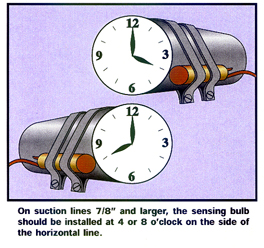
2 — Check the sensing bulb location: The sensing bulb should be securely fastened to a clean, straight section of the suction line. The bulb should not be influenced by ambient air temperature. The bulb should be attached to a horizontal suction line at the evaporator outlet. If the bulb cannot be located in this manner it may be located on a descending vertical line only. On suction lines 7/8 inch and larger, it should be installed at 4 or 8 o'clock on the side of the horizontal line. On smaller lines the bulb may be mounted at any point around the circumference except the bottom of the line where oil may influence the sensitivity. On multiple evaporators, the piping should be arranged so that the flow from any one valve cannot affect the sensing bulb of another. The equalizer connection should be made at a point several inches downstream of the bulb.

Verify the sensing bulb is correctly installed.

Note: This check is also valid when the TEV is flooding the evaporator.
3 — Check for moisture: Water or a mixture of water and oil frozen in the valve port (or working parts of the valve) prevent proper operation. Since the valve is the first cold spot in the system, moisture will freeze restricting flow. The fact that the system has not been opened for years does not eliminate the potential for this problem. Elevating the temperature of a liquid line drier (already at maximum water retention) beyond its normal operating temperature can cause it to release moisture into the system. Liquid lines increase in temperature during a slow refrigerant leak, dirty condenser coil, failed condenser fan motor, etc.

Pour a cup of hot water on the valve body to melt the suspected internal ice formation. A telltale audible surge in refrigerant flow will indicate system moisture. Install a new filter-drier.

Looking for quick answers on air conditioning, heating and refrigeration topics? Try Ask ACHR NEWS, our new smart AI search tool. Ask ACHR NEWS →

Note: This check is also valid when the TEV is flooding the evaporator; the valve may freeze in a "too open" position.

4 — Check for contaminants in the valve body: Look for restrictive dirt or foreign material such as copper oxide scale, metal chips, oil breakdown, sludge, etc. Conventional strainers allow some types of these materials through, ultimately obstructing the port of the TEV.

Pump the system down, disassemble, and clean the TEV. Install a filter-drier directly ahead of the TEV if additional contaminants are suspected between the main liquid line filter and the restricted TEV. If no contaminants are found, install a sight glass ahead of the TEV and go to step 5.

Note: This check is also valid when the TEV is flooding the evaporator; the foreign material may prevent the valve from closing.

5 — Check for a solid liquid column to the TEV: Install a liquid line sight glass directly ahead of the TEV during step 4 while the system is pumped down. If flash-gas is present, check for a liquid line restriction or pressure drop caused by incorrect pipe size or poor piping practices.

Correct the pressure drop as required. If the pressure drop is because of the length of the piping run or liquid lift, install a heat exchanger to subcool the refrigerant to the required temperature for elimination of the flash-gas.

6 — Check design pressure drop for required TEV capacity: The capacity of the TEV is a variable dependent on the pressure differential across the valve. Greater pressure drop across the TEV equals greater TEV capacity.

Remove the source of the pressure loss on the inlet, or pressure increase at the outlet. If the inlet pressure to the valve is due to low condensing pressure, install the appropriate head pressure controls. Installing a larger TEV is the last resort.

7 — Check for element charge migration: Pressure limiting type elements P, VGA, and G charges have a limited volume of constituents. The bulb temperature must be lower than the element or the bulb constituents will migrate into the element causing the valve to throttle and/or close.

Warm the element with a heat gun (not a rosebud torch), returning the superheat to normal. Relocate the valve body to a location with a higher temperature than the sensing bulb.

TEV Continuously Or Cyclically Floods The Evaporator

A TEV is a modulating type valve with the ability to modulate the refrigerant flow rate much lower than its full load design rating. The more oversized the TEV, the larger the valve superheat swings. The "superheat swing" references the number of degrees change from high to low at the evaporator outlet as the TEV modulates. The superheat swings are also referred to as "hunting".

A conventional non-balanced port TEV can modulate down to about 30 percent of its maximum loading. The TEV hunting (or swings) at this minimal percent are large enough that liquid refrigerant can spill past the sensing bulb before the valve throttles. A balanced port TEV can modulate down to approximately 25 percent of its maximum load rating before spillover occurs (the loading is lower with the balanced port valve because it is not influenced by inlet pressure).

Note: Increased pressure drop or decreased entering liquid temperature beyond design conditions increases the TEV's capacity.

8 — Check the TEV adjustment: The factory setting of a Sporlan TEV is close to center stem. Count the total number of turns from front seat to back seat, then front seat the adjustment stem 50 percent of the total turns counted.

Turn the adjusting stem clockwise in increments of one-half to one full turn every 15 minutes until the correct superheat is reached.

9 — Check for a solid liquid column to the TEV: The TEV adjustment stem may be opened far enough to offset less than a solid column of liquid in some applications. Should the condensing temperature drop, resulting in subcooled refrigerant (a solid head of refrigerant), the TEV may flood. A lighter evaporator load may also result in a solid head of refrigerant to the TEV, leading to a flooded evaporator condition that did not formerly exist.

Install a liquid line sight glass directly ahead of the TEV and verify a solid head of refrigerant during the adjustment procedure.

10 — Time study the flooding cycles: A TEV with a severe "hunt" will go to zero degrees of superheat before the valve throttles closed. It may take up to several minutes for the liquid refrigerant in the flooded evaporator to boil off (exhibiting zero degrees superheat). The evaporator superheat may then conversely rise 10 or more degrees for an additional minute or two before starting the cycle over.

A TEV that is exhibiting this type of cyclical flooding condition should slowly be adjusted OPEN. Not only will the higher superheat value get lower, the zero degrees at the bottom of the TEV swing will increase to a superheated value. Reducing the adjustment spring pressure results in a higher volume, less erratic evaporator feed, in most applications.

11 — Check the evaporator for air side heat loading: The number of air turns in a walk-in cooler or feet per minute airflow in a refrigerated fixture should not be reduced. A loss of air movement because of dirt, ice, missing sheet metal panels, or incorrect product load levels results in a loss of heat transfer. The TEV may hunt and flood if loaded too lightly.

Verify air movement is at design conditions.

12 — Check the evaporator for unequal circuit loading: Multi-circuit evaporators and parallel evaporators connected to a single refrigerant distributor must receive an equal percentage of the total load. When each circuit is not subjected to the same heat load, the lightly loaded circuits will allow liquid refrigerant or low temperature vapor to enter the suction line and throttle the TEV. This will cause normally loaded circuits to be deprived of their share of the refrigerant. The net result is a loss of refrigerated evaporator surface and a potentially oversized TEV. Check the temperature of the suction outlets of each distributor circuit before the suction header. Unequal temperatures at these locations are the result of unequal loading.

Check with the equipment manufacturer for the correct distributor and nozzle assembly if poor distribution is diagnosed.

Esslinger is senior application engineer of supermarket refrigeration, Sporlan Valve Company. Reprinted with permission from Sporlan Valve Company, Form 10-143. For more information, contact Sporlan at 206 Lange Drive, Washington, MO 63090; 636-239-1111; 636-239-9130 (fax); www.sporlan.com.

Publication date: 03/24/2003

Share This Story

Looking for a reprint of this article?
From high-res PDFs to custom plaques, order your copy today!


Recommended Content

JOIN TODAY
To unlock your recommendations.

Already have an account? Sign In

  • HVAC-enrollment

    The Trades Are Back: HVACR Programs See Nearly 30% Enrollment Spike

    A new wave of future technicians is entering the pipeline.  
    News
    By: Matt Jachman
  • 2025 Top 40 Under 40

    2025 Top 40 Under 40 HVACR Professionals List

    The 11th annual Top 40 Under 40 list highlights those...
    HVAC Light Commercial Market
    By: Hannah Belloli-Oster
  • LG Ductless Mini-Split Systems

    The 9 Types of Heat Pumps

    As the U.S. moves toward electrification, heat pumps are...
    HVAC Residential Market
    By: Joanna R. Turpin
Subscription Center
  • Create an Account
  • Start a Subscription
  • Manage My Account
  • Sign Up for Newsletters
  • Visit Customer Service
  • Update Preferences

More Videos

Sponsored Content

Sponsored Content is a special paid section where industry companies provide high quality, objective, non-commercial content around topics of interest to The News audience. All Sponsored Content is supplied by the advertising company and any opinions expressed in this article are those of the author and not necessarily reflect the views of The News or its parent company, BNP Media. Interested in participating in our Sponsored Content section? Contact your local rep!

close
  • Piggy Bank
    Sponsored byWatercress Financial

    Energy Prices, Inflation, and HVAC: What Today’s Homeowners Care About

  • Refrigerated Food
    Sponsored bySolstice Advanced Materials

    R-455A Refrigeration: A Cold Storage Solution for the Future

  • Airex Rooftop Units
    Sponsored byAirex Manufacturing Inc

    Consolidating Roof Penetrations: A Growing Trend in Multifamily HVAC Design

Popular Stories

Outdoor-condensing-units.jpg

EPA Removes R-410A Installation Deadline

Trump-Section-232.jpg

Trump Reduces Section 232 Tariffs on HVAC Equipment to 15%

cooling-habits.jpg

50 Percent of Americans Have Skipped HVAC Maintenance

ACHR NEWS Editor Chris Gray Presenting HVAC Minute 5-18-2026

HVAC Manufacturers Fight Pricing Lawsuits

tim-brooks.jpeg

2026’s Best Distributor Partners With Customers

View The ACHR NEWS
Centennial Anniversary Timeline

The ACHR News Timeline Chart
Submit a Letter
Submit a letter to our editors.

Events

November 6, 2025

Next-Gen Data Center Cooling: HVAC Innovation and Real-World Solutions

On Demand As AI workloads and high-density computing push traditional cooling methods to their limits, the data center industry is accelerating the adoption of next-generation HVAC technologies.

June 9, 2026

Before You Go All In on AI: Set Up Your Business to Actually Win

In this webinar, we'll walk you through exactly what to get in place before you add AI to your business. You'll leave with a clear picture of where you stand today and a practical action plan to set yourself up for real results.

View All Submit An Event

Poll

EPA Decision

Are you happy the EPA decided contractors can continue to install R-410A equipment?
View Results Poll Archive

Products

BNI Mechanical/Electrical Square Foot Costbook, 2026 Edition

BNI Mechanical/Electrical Square Foot Costbook, 2026 Edition

See More Products
A2L Refrigerants - Free Webinar - May 21, 2026

Related Articles

  • Solutions For Common TEV Problems

    See More
  • Wildfires

    HVAC Solutions for Wildfire IAQ Problems

    See More
  • Ventilation Solutions For School Problems

    See More

Related Products

See More Products
  • Lessons Learned in a Boiler Room: A common sense approach to servicing and installing commercial boilers

  • Evaluating-and-Troubleshooting-Refrigeration-Systems-Video-Cover-210x300.jpg

    Evaluating Refrigeration Systems Troubleshooting & Identifying Problems CONTINUED

  • Manual_SPS_new.jpg

    Manual SPS HVAC Design for Swimming Pools and Spas [ANSI/ACCA 10 Manual SPS - 2010 (RA 2017)]

See More Products

Related Directories

  • CELO Fixings USA Inc.

    Manufacturers of the Smart Clamps fastening systems. Nylon clamps especially designed for electric pipe and conduit installation to save the American installer time and money.
×

Sign Up. Stay Informed.

The #1 trusted source for the HVACR industry since 1926

SUBSCRIBE
  • RESOURCES
    • Advertise
    • Contact Us
    • Advisory Board
    • Classifieds
    • Submit a Letter
    • Directories
    • Store
  • ACCOUNT CENTER
    • Create an Account
    • Start a Subscription
    • Manage My Account
    • Sign Up for Newsletters
    • Visit Customer Service
    • Update Preferences
  • SERVICES
    • Marketing Services
    • Reprints
    • Market Research
    • List Rental
    • Survey/Respondent Access
  • STAY CONNECTED
    • LinkedIn
    • Facebook
    • Instagram
    • YouTube
    • X (Twitter)
  • PRIVACY
    • PRIVACY POLICY
    • TERMS & CONDITIONS
    • DO NOT SELL MY PERSONAL INFORMATION
    • PRIVACY REQUEST
    • ACCESSIBILITY

Copyright ©2026. All Rights Reserved BNP Media, Inc. and BNP Media II, LLC.

Design, CMS, Hosting & Web Development :: ePublishing