ACHR News
search
Ask ACHR NEWS AI
cart
facebook twitter instagram linkedin youtube
  • Sign In
  • Subscribe
  • Sign Out
  • My Account
ACHR News
  • NEWS
    • Breaking News
    • New HVAC Products
    • Featured Products
    • Manufacturer Reports
    • HVAC Data
    • Legislation
    • ACHR NEWS Centennial
  • RESIDENTIAL
    • Air Conditioners
    • Furnaces
    • Residential Heat Pumps
    • Ductless
    • Residential IAQ
    • Testing, Monitoring, Tools
    • Components & Accessories
  • COMMERCIAL
    • Air Handlers
    • Rooftop Units
    • Chillers and Cooling Towers
    • Commercial Heat Pumps
    • Boilers and Hydronics
    • VRF/Ductless
    • Commercial IAQ
  • REFRIGERATION
    • Refrigerants
    • Refrigerant Regulations
    • Leak Management
  • CONTRACTOR PRO
    • Geothermal
    • Homeowner Study
    • VRF and VRV Ductless
    • Unitary Trends
  • EDUCATION
    • Training and Education
    • Business Management
    • Service and Maintenance
    • Continuing Education
    • Market Research >
      • HVAC Brand Awareness Report
      • VRV, VRF, VRVZ Report
      • Unitary Trends Report
      • Water Heat Professionals Report
    • Webinars
    • Sponsor Insights
    • eProducts Info
    • White Papers
  • EVENTS
    • HVAC Contractor Forum
    • Industry Events and Webinars
  • MEDIA
    • Videos
    • AHR Expo 2025 Videos
    • Podcasts >
      • ACHR News Podcast
      • HARDI Podcasts
      • AHR Expo Podcasts
      • ACCA Podcasts
    • Interactive Spotlights
    • Quizzes
    • eBooks
    • HVAC Talkback
  • HVAC GROUP
    • ACHR NEWS >
      • Current Issue
      • Digital Edition
      • Subscribe
    • Distribution Trends
    • SNIPS NEWS >
      • Join SNIPS NEWS
    • Engineered Systems News >
      • Join ES News
    • HVACR Directory
    • Contests
    • Newsletters
    • Contact
    • Advertise
    • My Account

CO2 In Industrial Refrigeration

October 28, 2003
[Editor's note: This second installment of a two-part series looks at system compatibility.]

Last month's article described the history and fundamental physical characteristics of CO2 as a refrigerant, and presented some typical systems used in industrial applications. (See "CO2 in Refrigeration Applications," Oct. 6.)

It is now appropriate to discuss system compatibility considerations: oils, the effects of water, leak potential, and safety.

Oil In CO2 Systems

Either miscible or immiscible oils may be used in CO2 systems with traditional refrigeration compressors. In CO2 systems with immiscible oil such as PAO (polyalphaolefin), the oil management system is rather complicated. Oil filtration requirements are high, and the separation of oil from CO2 is complicated by the fact that the oil is less dense than CO2.

In CO2 systems with miscible POE oil (polyolester), oil management system requirements are simple in comparison. The challenge in POE systems is the stability of the POE oil. A comparison for PAOs and POEs may be found in Table 1.

In CO2 "brine" systems, and in pump circulating systems with oil-free compressors, there is no oil present in the circulated CO2. From an efficiency point of view, this is an optimum solution because of good heat transfer coefficients in the evaporators. However, it requires that all valves, controls, and other components be able to operate "dry."

Table 1. Oil properties and requirements compared for PAO and POE oils in CO2 systems.


Component Size, Refrigerant Charge

Due to the thermodynamic properties of CO2, in particular the relatively high pressure level, compressor capacity is significantly higher for CO2 than it is for NH3. The pipe dimensions for the vapor lines are smaller, but are larger for the liquid lines.

European standard EN 378 classifies CO2 as an L1 nontoxic, nonflammable refrigerant, while ammonia is classified as an L2 toxic refrigerant. Even though NH3 has been used for many years, requirements have become more restrictive in recent years, particularly in some European countries. There is, therefore, a great interest in minimizing the NH3 charge.

A CO2-NH3 cascade system is considered a perfect solution, with the NH3 used being limited to a small charge that can be contained in a special machinery room that meets the necessary safety requirements. The CO2 is then distributed to all coolers.

Materials Compatibility

Unlike NH3, CO2 is compatible with almost all common metallic materials. When using copper or brass, there are no restrictions from a compatibility point of view. The compatibility of CO2 with polymers is much more complex.

Because CO2 is an inert and stable substance, chemical reactions with polymers are not a concern. Rather, physiochemical effects such as permeation, swelling, and the generation of cavities and internal fractures are the main issues. These effects are related to the solubility and diffusivity of CO2 in the actual material.

Looking for quick answers on air conditioning, heating and refrigeration topics? Try Ask ACHR NEWS, our new smart AI search tool. Ask ACHR NEWS →

Danfoss laboratories have carried out a number of tests to ensure that components released for use with CO2 can withstand the effects of CO2 under all conditions. The tests have shown that for use with CO2, modifications have to be made on some products. The solubility of CO2 in some polymers must be taken into consideration. Some commonly used polymers are not compatible with CO2; others (such as sealing materials) re-quire different fixing methods.

When pressure is close to the critical pressure and the temperature is high, the impact of CO2 on polymers is much more pronounced. Those conditions, however, are not important in industrial refrigeration, where pressures and temperatures are lower.

Water

In NH3 systems, it is well known that there are reaction problems with oil, oxygen, water, and solid contaminants. These problems are all handled by frequent oil changes and air purges. Compared to NH3, CO2 is less sensitive, but problems may occur if water is present.

CO2 system pressure is always greater than atmospheric pressure; therefore there are not the same risks of water and air penetration at a leak as there are, for example, in NH3 systems. However, permeation of water into the system is still possible.

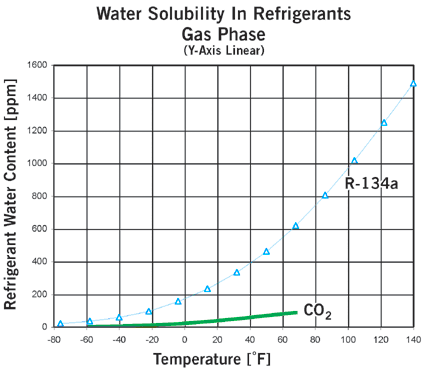
Figures 1 and 2 compare water solubility for CO2 and R-134a.
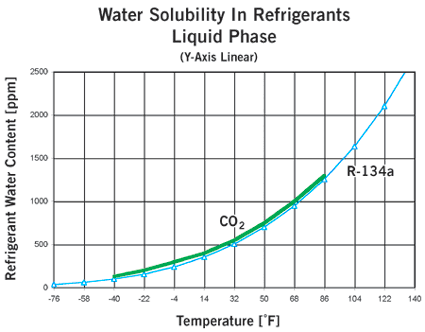
Figure 1. Water solubility in refrigerants, liquid phase.


Figure 2. Water solubility in refrigerants, gas phase.


At the high pressures found in a CO2 system, how can water enter?

  • Water can enter during charging because there are different grades of CO2, some of which allows relatively high water content.

  • Because CO2 is treated as a very safe refrigerant, it is sometimes handled without following normal safety precautions. If a system is opened up, air can penetrate into it, and moisture can condense inside the tubes. Also, some water may be retained if the system is not evacuated properly.

  • Water can enter when charging lubricant (oil) to the compressor.

    The amount of water that can be tolerated is much lower for CO2 systems than for systems with more common refrigerants. The curves in Figure 3 plot dewpoint versus refrigerant water content. If the water content exceeds that at the dewpoint (above the curve for a given refrigerant), and the temperature is lower than 0ÞC, the water will freeze, creating a risk of blocking control valves and other problems. The water can be removed very easily by mounting a drier in the system.

    Driers are very efficient in CO2 systems, and are normally mounted in the liquid line to avoid creation of any unnecessary pressure drops.

    Figure 3. Dewpoint versus refrigerant water content.


    Leaks, Safety Valves

    The most critical leak location in a CO2-NH3 cascade system is in the heat exchangers between CO2 and NH3. The pressure of the CO2 will be higher than that of the NH3, so the leak will occur in the NH3 system, which will therefore become contaminated.

    Ammonium carbonate, a solid substance, forms immediately when CO2 is in contact with NH3. Ammonium carbonate is corrosive.

    Because the triple point of CO2 is at a much higher pressure than for any other common refrigerant, the formation of solid CO2 can occur. If a safety valve is mounted in a CO2 system at (for example) 50 bar, the pressure in the downstream (outlet) line from the safety valve will pass the triple point at 5.2 bar. Below the triple point, CO2 will change from a mixture of liquid and vapor into a mixture of solid and vapor.

    The formation of solid CO2 in the downstream line can, in the worst case, block the line. The most efficient solution to this problem is to mount the safety valve without an outlet line, thus blowing directly into the atmosphere. The phase change of the CO2 does not take place directly in the valve, but just after the valve, and in this case in the atmosphere.

    Safety Concerns

    As previously mentioned, CO2 is classified as a nontoxic refrigerant. Unlike NH3, CO2 has no distinctive odor.

    CO2 is denser than air (approximately twice as dense at atmospheric pressure). That means it will collect in low places, which can be dangerous, especially in pits or confined spaces. It displaces air, causing a lower concentration of oxygen.

    Due to the acidic characteristics of CO2, local irritation of the mucous membranes of the nose, throat, and eyes may occur; coughing may be induced.

    Symptoms associated with the inhalation of air containing carbon dioxide are listed below, with increasing carbon dioxide concentrations:

  • 0.04 percent - Normal concentration in the atmospheric air.

  • 2 percent - 50 percent increase in breathing rate.

  • 3 percent - 10 minutes' short-term exposure limit; 100 percent increase in breathing rate.

  • 5 percent - 300 percent increase in breathing rate; headache and sweating may begin after about an hour. (Most persons in good health tolerate this, but it is physically burdening.)

  • 8 percent - Short-term exposure limit.

  • 8 percent to 10 percent - Headache after 10 to 15 minutes; dizziness, buzzing in the ears, blood pressure increase, high pulse rate, excitation, and nausea.

  • 10 percent to 18 percent - After a few minutes, cramps similar to epileptic fits, loss of consciousness, and shock (i.e., a sharp drop in blood pressure). Victims may recover quickly in fresh air.

  • 18 percent to 20 percent - Symptoms similar to those of a stroke.

    (Note: The data values are for adults in good health.)

    The OSHA safety requirements specify a Threshold Limit Value (TLV) of 5,000 ppm for CO2 and a TLV of 25 ppm for NH3.

    Conclusion

    Availability is good for components of industrial CO2 refrigeration systems with pressures up to approximately 30 bar.

    Several equipment manufacturers of traditional refrigeration systems can also supply some components for CO2 systems.

    Availability is limited for components for higher-pressure industrial CO2 refrigeration systems, and the availability of critical components is an important factor in the growth rate of CO2 applications.

    In industrial refrigeration, CO2 will not replace ammonia. Industrial CO2 systems are all hybrid systems that require ammonia on the high-temperature side of the system, but with a smaller ammonia charge.

    Vestergaard is R&D manager for Danfoss Industrial Refrigeration; Robinson is in technical communications in the Air-Conditioning & Refrigeration Division, Danfoss Inc.

    Publication date: 11/03/2003

  • Share This Story

    Looking for a reprint of this article?
    From high-res PDFs to custom plaques, order your copy today!


    Recommended Content

    JOIN TODAY
    To unlock your recommendations.

    Already have an account? Sign In

    • HVAC-enrollment

      The Trades Are Back: HVACR Programs See Nearly 30% Enrollment Spike

      A new wave of future technicians is entering the pipeline.  
      Training and Education
      By: Matt Jachman
    • 2025 Top 40 Under 40

      2025 Top 40 Under 40 HVACR Professionals List

      The 11th annual Top 40 Under 40 list highlights those...
      News
      By: Hannah Belloli-Oster
    • LG Ductless Mini-Split Systems

      The 9 Types of Heat Pumps

      As the U.S. moves toward electrification, heat pumps are...
      Heat Pumps
      By: Joanna R. Turpin
    Subscription Center
    • Create an Account
    • Start a Subscription
    • Manage My Account
    • Sign Up for Newsletters
    • Visit Customer Service
    • Update Preferences

    More Videos

    Sponsored Content

    Sponsored Content is a special paid section where industry companies provide high quality, objective, non-commercial content around topics of interest to The News audience. All Sponsored Content is supplied by the advertising company and any opinions expressed in this article are those of the author and not necessarily reflect the views of The News or its parent company, BNP Media. Interested in participating in our Sponsored Content section? Contact your local rep!

    close
    • Piggy Bank
      Sponsored byWatercress Financial

      Energy Prices, Inflation, and HVAC: What Today’s Homeowners Care About

    • Refrigerated Food
      Sponsored bySolstice Advanced Materials

      R-455A Refrigeration: A Cold Storage Solution for the Future

    • Airex Rooftop Units
      Sponsored byAirex Manufacturing Inc

      Consolidating Roof Penetrations: A Growing Trend in Multifamily HVAC Design

    Popular Stories

    HVAC-Price-Increase-graphic

    HVAC Price Increase List: June 2026

    Trump-Section-232.jpg

    Trump Reduces Section 232 Tariffs on HVAC Equipment to 15%

    ACHR NEWS Editor Chris Gray Presenting HVAC Minute 5-18-2026

    HVAC Manufacturers Fight Pricing Lawsuits

    R410A-Refrigerant-Cylinder.jpg

    Refrigerant Recovery is a Revenue Opportunity

    Heat-pump-cutaway.jpg

    PFAS Rules and A2L Building Codes Continue to Evolve

    View The ACHR NEWS
    Centennial Anniversary Timeline

    The ACHR News Timeline Chart
    Submit a Letter
    Submit a letter to our editors.

    Events

    November 6, 2025

    Next-Gen Data Center Cooling: HVAC Innovation and Real-World Solutions

    On Demand As AI workloads and high-density computing push traditional cooling methods to their limits, the data center industry is accelerating the adoption of next-generation HVAC technologies.

    June 9, 2026

    Before You Go All In on AI: Set Up Your Business to Actually Win

    In this webinar, we'll walk you through exactly what to get in place before you add AI to your business. You'll leave with a clear picture of where you stand today and a practical action plan to set yourself up for real results.

    View All Submit An Event

    Poll

    Summer Staff

    Are you fully staffed for the summer season?
    View Results Poll Archive

    Products

    BNI Mechanical/Electrical Square Foot Costbook, 2026 Edition

    BNI Mechanical/Electrical Square Foot Costbook, 2026 Edition

    See More Products
    A2L Refrigerants - Free Webinar - May 21, 2026

    Related Articles

    • IIAR Leads Out in Industrial Refrigeration

      See More
    • Trends in Industrial Refrigeration Discussed

      See More
    • Common Links in Industrial Refrigeration

      See More

    Related Products

    See More Products
    • The ACHR News - January 19, 2026

      ACHR NEWS January 19, 2026, Issue

    • The ACHR News - May 18, 2026

      ACHR NEWS May 18, 2026, Issue

    • Tech_CommRef_Guide_Small.jpg

      Technician’s Guide & Workbook for Quality Maintenance on Commercial Refrigeration Equipment

    See More Products
    ×

    Sign Up. Stay Informed.

    The #1 trusted source for the HVACR industry since 1926

    SUBSCRIBE
    • RESOURCES
      • Advertise
      • Contact Us
      • Advisory Board
      • Classifieds
      • Submit a Letter
      • Directories
      • Store
    • ACCOUNT CENTER
      • Create an Account
      • Start a Subscription
      • Manage My Account
      • Sign Up for Newsletters
      • Visit Customer Service
      • Update Preferences
    • SERVICES
      • Marketing Services
      • Reprints
      • Market Research
      • List Rental
      • Survey/Respondent Access
    • STAY CONNECTED
      • LinkedIn
      • Facebook
      • Instagram
      • YouTube
      • X (Twitter)
    • PRIVACY
      • PRIVACY POLICY
      • TERMS & CONDITIONS
      • DO NOT SELL MY PERSONAL INFORMATION
      • PRIVACY REQUEST
      • ACCESSIBILITY

    Copyright ©2026. All Rights Reserved BNP Media, Inc. and BNP Media II, LLC.

    Design, CMS, Hosting & Web Development :: ePublishing