ACHR News
search
Ask ACHR NEWS AI
cart
facebook twitter instagram linkedin youtube
  • Sign In
  • Subscribe
  • Sign Out
  • My Account
ACHR News
  • NEWS
    • Breaking News
    • New HVAC Products
    • Featured Products
    • Manufacturer Reports
    • HVAC Data
    • Legislation
    • ACHR NEWS Centennial
  • RESIDENTIAL
    • Air Conditioners
    • Furnaces
    • Residential Heat Pumps
    • Ductless
    • Residential IAQ
    • Testing, Monitoring, Tools
    • Components & Accessories
  • COMMERCIAL
    • Air Handlers
    • Rooftop Units
    • Chillers and Cooling Towers
    • Commercial Heat Pumps
    • Boilers and Hydronics
    • VRF/Ductless
    • Commercial IAQ
  • REFRIGERATION
    • Refrigerants
    • Refrigerant Regulations
    • Leak Management
  • CONTRACTOR PRO
    • Geothermal
    • Homeowner Study
    • VRF and VRV Ductless
    • Unitary Trends
  • EDUCATION
    • Training and Education
    • Business Management
    • Service and Maintenance
    • Continuing Education
    • Market Research >
      • HVAC Brand Awareness Report
      • VRV, VRF, VRVZ Report
      • Unitary Trends Report
      • Water Heat Professionals Report
    • Webinars
    • Sponsor Insights
    • eProducts Info
    • White Papers
  • EVENTS
    • HVAC Contractor Forum
    • Industry Events and Webinars
  • MEDIA
    • Videos
    • AHR Expo 2025 Videos
    • Podcasts >
      • ACHR News Podcast
      • HARDI Podcasts
      • AHR Expo Podcasts
      • ACCA Podcasts
    • Interactive Spotlights
    • Quizzes
    • eBooks
    • HVAC Talkback
  • HVAC GROUP
    • ACHR NEWS >
      • Current Issue
      • Digital Edition
      • Subscribe
    • Distribution Trends
    • SNIPS NEWS >
      • Join SNIPS NEWS
    • Engineered Systems News >
      • Join ES News
    • HVACR Directory
    • Contests
    • Newsletters
    • Contact
    • Advertise
    • My Account
HVAC ContractingTechnical

Preventing Leaks In A Copper Cooling Circuit
September 19, 2003
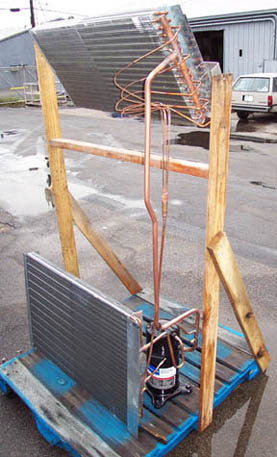
Figure 1. Prior to coating, the entire cooling circuit is removed and mounted on a wooden frame for cleaning and preparation. (Photos courtesy of Tim Rodwell of Blygold Houston.)
A couple weeks ago, we received a call from a frustrated HVACR consulting engineer in South Carolina. His tale of woe was one that we have heard time and time again. One of his clients, a municipal wastewater treatment facility, had purchased a package unit from one of the major HVACR manufacturers. The unit was ordered to be supplied complete with the optional factory anti-corrosion coating system applied by one of the prominent HVAC coating companies.

Typically, with this type of service, the coils are totally immersed in a dip coating process prior to the assembly of the unit. This particular coating system has a good reputation and is well known throughout the industry. However, after one year, the cooling circuit on this unit failed and is in need of replacement due to numerous leaks in the copper tubing.

The problem is, even though the entire condenser and evaporator may be covered with an effective coating system, the coils must ultimately be soldered into the copper cooling circuit. This results in sections of the tubing being exposed to the atmosphere.

In a marine or coastal environment, this may be an acceptable condition. Bare copper is fairly resistant to the corrosive effects of salty air. This is why, for many years, copper fin/copper tube (Cu/Cu) coils have been a popular (albeit expensive) solution for corrosion in marine applications. The all-copper coil will hold up reasonably well against salt air exposure, without the galvanic corrosion inherent with the dissimilar metals of uncoated aluminum fin/copper tube (Al/Cu) coils.

The catch is, what works well in one environment does not necessarily work well in another. Ask anyone who has ever installed a Cu/Cu coil in a sulfur or methane environment. Big mistake.

Cu/Cu coils are not a good solution for locations where the unit may be exposed to various aggressive acids and other chemicals. Several specific applications that come to mind are: waste water treatment, pulp and paper mills, refineries, chemical plants, meat and dairy processing, hog and mushroom farms, and others.

Figure 2. The end plates of the coils and all exposed copper are primed.
These environments contain varying parts per million (ppm) concentrations of chemicals, such as methane, ammonia, and sulfur compounds, that will immediately begin to cause exposed copper to deteriorate. Coating only the u-bends and headers of Al/Cu coils will not prevent chemicals from eating away at the remaining copper tubing left uncoated inside the unit. Pitting on the tubing walls will cause pinholes to develop, which will cause the coil to leak. Exposed solder joints are particularly vulnerable to attack and are usually the first places to leak.

The solution for these types of environments is to provide an effective protective coating for all the exposed copper in the circuit as well as the copper on the condenser and evaporator coils.

Typically, an aftermarket modification/coating service provider can perform these services for new equipment. This is best done before the equipment goes into the field. Once corrosion starts, it is very difficult, and usually not cost effective, to contain. A small investment made wisely at the beginning of a project can bring big savings in terms of downtime costs, leak repairs, coil replacements, and unit efficiency losses (increased energy consumption).

Looking for quick answers on air conditioning, heating and refrigeration topics? Try Ask ACHR NEWS, our new smart AI search tool. Ask ACHR NEWS →

Generally, this is how the exposed copper on a unit can be protected. On smaller units, the entire cooling circuit can be removed for coating. In addition to making the job easier, the circuit is not cut and the refrigerant does not have to be recovered. Larger units may require some disassembly for accessibility. The coils may need to be removed for coating depending on the extent of access and the coating system used. Either way, the galvanized end plates of the coils should be prepped in accordance with the coating system.

Both coils and all exposed tubing should be washed thoroughly with an effective detergent, rinsed, and allowed to dry. It is important to use a detergent that is effective, but not harsh, and one that does not leave a residue. A primer formulated for use on copper should be applied to all exposed tubing to provide an enhanced adhering surface for the topcoat. Once the primer is dry, the topcoat can be applied to both the tubing and coils. If the circuit has been cut when the coils are removed for coating, it must be re-soldered, tested, and the refrigerant re-installed. In this instance, the areas left uncoated for soldering will need to be washed, dried, and touched up with the primer and topcoat.

Figure 3. The topcoat is applied to the coils and over all primed surfaces.
In the accompanying photos, this process is illustrated. In Figure 1, the entire circuit of a popular brand of wall-mount unit has been removed and mounted on a wooden frame for cleaning and preparation.

In Figure 2, the end plates of both the condenser and evaporator and all exposed copper (including the compressor) have been primed with a fast-drying, moisture-curing polyurethane penetrating primer developed specifically for HVACR equipment.

In Figure 3, an aluminum-impregnated polyurethane topcoat has been applied to the coils and over all the primed surfaces. This particular system utilizes a conversion agent on the aluminum coil surface, prior to the application of the topcoat, which enhances adhesion to the aluminum without adding layer thickness.

This particular 3-ton wall-mount unit is installed in a chemical plant in Texas.

Richard C. Griffin is with Blygold America Inc., whose products have been protecting HVACR coils and equipment installed in corrosive coastal, marine, and industrial environments for over 30 years. Blygold products are applied through a network of licensed applicators. For more information, contact 410-643-6080; info@blygoldamerica.com; or visit www.blygoldamerica.com.

Publication date: 09/22/2003

Share This Story

Looking for a reprint of this article?
From high-res PDFs to custom plaques, order your copy today!


Recommended Content

JOIN TODAY
To unlock your recommendations.

Already have an account? Sign In

  • HVAC-enrollment

    The Trades Are Back: HVACR Programs See Nearly 30% Enrollment Spike

    A new wave of future technicians is entering the pipeline.  
    News
    By: Matt Jachman
  • 2025 Top 40 Under 40

    2025 Top 40 Under 40 HVACR Professionals List

    The 11th annual Top 40 Under 40 list highlights those...
    News
    By: Hannah Belloli-Oster
  • LG Ductless Mini-Split Systems

    The 9 Types of Heat Pumps

    As the U.S. moves toward electrification, heat pumps are...
    Heat Pumps
    By: Joanna R. Turpin
Subscription Center
  • Create an Account
  • Start a Subscription
  • Manage My Account
  • Sign Up for Newsletters
  • Visit Customer Service
  • Update Preferences

More Videos

Sponsored Content

Sponsored Content is a special paid section where industry companies provide high quality, objective, non-commercial content around topics of interest to The News audience. All Sponsored Content is supplied by the advertising company and any opinions expressed in this article are those of the author and not necessarily reflect the views of The News or its parent company, BNP Media. Interested in participating in our Sponsored Content section? Contact your local rep!

close
  • Piggy Bank
    Sponsored byWatercress Financial

    Energy Prices, Inflation, and HVAC: What Today’s Homeowners Care About

  • Refrigerated Food
    Sponsored bySolstice Advanced Materials

    R-455A Refrigeration: A Cold Storage Solution for the Future

  • Airex Rooftop Units
    Sponsored byAirex Manufacturing Inc

    Consolidating Roof Penetrations: A Growing Trend in Multifamily HVAC Design

Popular Stories

HVAC-Price-Increase-graphic

HVAC Price Increase List: June 2026

Trump-Section-232.jpg

Trump Reduces Section 232 Tariffs on HVAC Equipment to 15%

R410A-Refrigerant-Cylinder.jpg

Refrigerant Recovery is a Revenue Opportunity

Heat-pump-cutaway.jpg

PFAS Rules and A2L Building Codes Continue to Evolve

Kroger.jpg

Kroger to Spend $100 Million to Reduce Refrigerant Leaks

View The ACHR NEWS
Centennial Anniversary Timeline

The ACHR News Timeline Chart
Submit a Letter
Submit a letter to our editors.

Events

November 6, 2025

Next-Gen Data Center Cooling: HVAC Innovation and Real-World Solutions

On Demand As AI workloads and high-density computing push traditional cooling methods to their limits, the data center industry is accelerating the adoption of next-generation HVAC technologies.

June 9, 2026

Before You Go All In on AI: Set Up Your Business to Actually Win

In this webinar, we'll walk you through exactly what to get in place before you add AI to your business. You'll leave with a clear picture of where you stand today and a practical action plan to set yourself up for real results.

View All Submit An Event

Poll

Summer Staff

Are you fully staffed for the summer season?
View Results Poll Archive

Products

BNI Mechanical/Electrical Square Foot Costbook, 2026 Edition

BNI Mechanical/Electrical Square Foot Costbook, 2026 Edition

See More Products
A2L Refrigerants - Free Webinar - May 21, 2026

Related Articles

  • Refrigerant Leak

    Preventing Leaks In Refrigeration Systems

    See More
  • Preventing-Refrigerant-Leaks-in-Supermarket-Systems-1.jpg

    Ten Tips for Preventing Refrigerant Leaks in Supermarket Systems

    See More
  • What's New

    Marley, a brand of SPX Cooling Technologies Inc.: Closed-circuit Cooling Tower

    See More

Related Products

See More Products
  • Lessons Learned in a Boiler Room: A common sense approach to servicing and installing commercial boilers

  • bsctppm.png

    Brazing & Soldering: Copper Tubing and Processes

  • comfortcoolingdvd.jpg

    COMFORT COOLING REFRIGERATION SYSTEM TROUBLESHOOTING

See More Products

Related Directories

  • Spectronics Corp./Spectroline Leak Detection

    Established in 1955, Spectronics Corporation is the inventor of UV fluorescent leak detection technology and manufacturer of leak detection tools for AC&R systems. Our fluorescent dyes and system additives are OEM-grade, universal (POE), co-solvent free, and NSF-certified.
  • Copper Development Assn.-CDA

    Copper Development Association Inc. (CDA) is a U.S.-based, not-for-profit association of the global copper industry, committed to promoting the proper use of copper materials in sustainable, efficient applications.
×

Sign Up. Stay Informed.

The #1 trusted source for the HVACR industry since 1926

SUBSCRIBE
  • RESOURCES
    • Advertise
    • Contact Us
    • Advisory Board
    • Classifieds
    • Submit a Letter
    • Directories
    • Store
  • ACCOUNT CENTER
    • Create an Account
    • Start a Subscription
    • Manage My Account
    • Sign Up for Newsletters
    • Visit Customer Service
    • Update Preferences
  • SERVICES
    • Marketing Services
    • Reprints
    • Market Research
    • List Rental
    • Survey/Respondent Access
  • STAY CONNECTED
    • LinkedIn
    • Facebook
    • Instagram
    • YouTube
    • X (Twitter)
  • PRIVACY
    • PRIVACY POLICY
    • TERMS & CONDITIONS
    • DO NOT SELL MY PERSONAL INFORMATION
    • PRIVACY REQUEST
    • ACCESSIBILITY

Copyright ©2026. All Rights Reserved BNP Media, Inc. and BNP Media II, LLC.

Design, CMS, Hosting & Web Development :: ePublishing