ACHR News
search
Ask ACHR NEWS AI
cart
facebook twitter instagram linkedin youtube
  • Sign In
  • Subscribe
  • Sign Out
  • My Account
ACHR News
  • NEWS
    • Breaking News
    • New HVAC Products
    • Featured Products
    • Manufacturer Reports
    • HVAC Data
    • Legislation
    • ACHR NEWS Centennial
  • RESIDENTIAL
    • Air Conditioners
    • Furnaces
    • Residential Heat Pumps
    • Ductless
    • Residential IAQ
    • Testing, Monitoring, Tools
    • Components & Accessories
  • COMMERCIAL
    • Air Handlers
    • Rooftop Units
    • Chillers and Cooling Towers
    • Commercial Heat Pumps
    • Boilers and Hydronics
    • VRF/Ductless
    • Commercial IAQ
  • REFRIGERATION
    • Refrigerants
    • Refrigerant Regulations
    • Leak Management
  • CONTRACTOR PRO
    • Geothermal
    • Homeowner Study
    • VRF and VRV Ductless
    • Unitary Trends
  • EDUCATION
    • Training and Education
    • Business Management
    • Service and Maintenance
    • Continuing Education
    • Market Research >
      • HVAC Brand Awareness Report
      • VRV, VRF, VRVZ Report
      • Unitary Trends Report
      • Water Heat Professionals Report
    • Webinars
    • Sponsor Insights
    • eProducts Info
    • White Papers
  • EVENTS
    • HVAC Contractor Forum
    • Industry Events and Webinars
  • MEDIA
    • Videos
    • AHR Expo 2025 Videos
    • Podcasts >
      • ACHR News Podcast
      • HARDI Podcasts
      • AHR Expo Podcasts
      • ACCA Podcasts
    • Interactive Spotlights
    • Quizzes
    • eBooks
    • HVAC Talkback
  • HVAC GROUP
    • ACHR NEWS >
      • Current Issue
      • Digital Edition
      • Subscribe
    • Distribution Trends
    • SNIPS NEWS >
      • Join SNIPS NEWS
    • Engineered Systems News >
      • Join ES News
    • HVACR Directory
    • Contests
    • Newsletters
    • Contact
    • Advertise
    • My Account

Understanding Pressure Control Technology

June 26, 2001
Figure 1. Conventional combination low- and high-pressure control.


Figure 2. Combination low- and high-pressure control on a forced air condensing unit.
Pressure controls have been workhorses in the hvacr industry for decades. Figure 1 shows a conventional combination low- and high-pressure control. Such controls have been used in many applications, including:

  • Box temperature controllers;
  • Compressor cycling devices; and
  • Compressor and component high- and low-pressure protection.


  • Figure 3. Schematic wiring diagram of an automatic pumpdown system. (Courtesy ESCO Press)

    BOX TEMPERATURE CONTROLLERS

    Low-pressure controls have been controlling box temperatures in freezers and refrigerators for many years. Figure 2 shows a combination low- and high-pressure control on a forced-air condensing unit.

    The low-pressure control is set to maintain box temperatures in the refrigerated case by setting the cut-out/cut-in and differential setpoints on the pressure control. The difference between the cut-in and the cut-out of the control is called the differential, as illustrated by the following equation:

    (Cut-in) – (Cut-out) = Differential

    For example, if the low-pressure control is set to cut the compressor out at 20 psi and back in at 35 psi, the differential would be 15 psi (35 psi - 20 psi). Table 1 is a chart to help the service technician set low-pressure controls for different fixtures and applications.
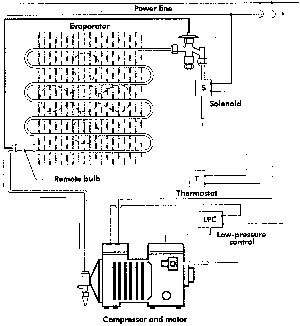


    Figure 4. Point-to-point diagram of an automatic pump-down system. (Courtesy ESCO Press.)

    COMPRESSOR CYCLING DEVICES

    Low-pressure controls can cycle the compressor on and off in response to a liquid line solenoid opening and closing in the liquid line of the refrigeration system. This type of control scheme is called an automatic pumpdown system.

    The thermostat in the refrigerated case controls the box temperature of the case. When the box temperature is satisfied, the box thermostat opens and de-energizes the liquid line solenoid. With the liquid line blocked, the compressor pumps the refrigerant to the high side of the system.

    The low side of the system falls in pressure and the low-pressure control opens at a predetermined pressure, shutting the compressor off. The predetermined pressure is system dependent but is usually about 5 to 8 psi on refrigerated cases. (Cutting the compressor off at 0 psi is too hard on compressors because of the higher compression ratio at 0 psi.)

    The pumpdown system uses the low-pressure control simply to cycle the compressor and not to control box temperature. The thermostat controls the box temperature. Figure 3 shows a schematic wiring diagram of an automatic pumpdown system. Figure 4 shows a point-to-point diagram of an automatic pumpdown system.


    Figure 5. Electronic pressure control with a digital display. (Courtesy Johnson Controls.)

    PRESSURE PROTECTION

    Pressure controls can also be used as protective devices.

    Low-pressure controls can protect compressors from too low of a pressure situation in case of a coil freeze-up or lost refrigerant charge. Low-pressure controls can also protect some water chillers from freeze-ups.

    Looking for quick answers on air conditioning, heating and refrigeration topics? Try Ask ACHR NEWS, our new smart AI search tool. Ask ACHR NEWS →

    High-pressure controls can protect compressors and system components from dangerously high-pressure situations by shutting the compressor off at certain elevated pressures.

    Some high- and low-pressure controls have to be manually reset and some reset automatically.


    NEW TECHNOLOGY

    Figure 5 shows an electronic pressure control with a digital display. This electronic pressure control is a single-stage, on-off, single-pole, double-throw (spdt) output relay.

    Notice that the control has no capillary tubes to vibrate and cause wear and eventually refrigerant leaks. In many applications, manufacturers would have to put a silicone type of sealant between the coils of the capillary tubes to lessen vibration and try to prevent leaks.

    Electronic pressure controls are designed for on/off control of direct- or pilot-duty hvacr loads based on system operating pressures. These controls are replacing a variety of electromechanical pressure controls.

    The electronic pressure control features a large liquid crystal display (LCD) that show the magnitude of the pressure it senses along with other system status functions. During normal operation, the sensed pressure and other control status information is refreshed every 2 sec for the LCD. It also has a lockable, three-button touch pad that the technician can use to adjust setpoints in the programming mode. This lockout feature prevents building owners and/or the general public from tampering with the controller’s setpoints.

    The same pressure control can be programmed to operate in one of three pressure ranges: 0 to 100 psi, 0 to 500 psi, and 50 to 750 psi. However, each of these operating ranges requires different transducers for proper operation.

    Small jumpers also have to be repositioned when selecting different pressure ranges and unlocking the touch pad. The pressure control can also operate to open on either low or high pressure.

    A flexible wiring harness connects the pressure transducer to the control. The wiring harness eliminates leak problems and is much more versatile with fewer constraints than capillary tubes. The transducer may be wired up to 100 ft away from the controller using three-wire shielded cable.


    ANTI-SHORT CYCLE DELAY

    The controller also has an anti-short cycle feature.

    There is a programmable minimum time that the equipment remains off before starting again. It may be programmed for 0 to 9 min in 1-min increments.

    When the delay is activated, the LCD flashes the sensed pressure and gives the time remaining on the time delay. This added time-delay feature can prevent compressor overheating problems and also prevent starting relay and capacitor damage.


    SECONDARY POINTS

    The pressure control can establish a secondary set of cut-in and cut-out values. They are enabled when a circuit is closed between the binary input terminals.

    The LCD shows the primary (S1) or secondary (S2) setpoints, the sensed pressure in psi, and whether the control is set for opening on high or low pressure.


    PRESSURE TRANSDUCER

    The electronic pressure control uses a pressure transducer to sense pressure (Figure 5). The pressure transducer is mounted directly on the system and is designed for use in commercial refrigeration and air conditioning applications.

    The transducer is supplied with a constant 5-vdc supply voltage. The pressure transducer’s output voltage is an analog signal that varies 10% to 90% of the supply voltage. In other words, the output voltage varies from 0.5 to 4.5 vdc, depending on the magnitude of the pressure signal that it senses.

    The output signal varies in direct linear proportion to the sensed pressure. The pressure transducer is available in several pressure ranges up to 750 psi and can handle all noncorrosive refrigerants, as well as ammonia.

    One pressure transducer can be wired to up to four controls on applications where pressure can control different functions. Examples of these applications are a high-pressure control controlling condenser fan cycling and compressor protection.

    Also, four low-pressure controls may be connected to a single pressure transducer on the common suction header of a parallel compressor rack to stage the compressors.

    Tomczyk is a professor of hvacr at Ferris State University, Big Rapids, MI, and author of the book Troubleshooting and Servicing Modern Air Conditioning and Refrigeration Systems, published by ESCO Press. To order, call 800-726-9696.

    Publication date: 07/02/2001

    Share This Story

    Looking for a reprint of this article?
    From high-res PDFs to custom plaques, order your copy today!


    Recommended Content

    JOIN TODAY
    To unlock your recommendations.

    Already have an account? Sign In

    • HVAC-enrollment

      The Trades Are Back: HVACR Programs See Nearly 30% Enrollment Spike

      A new wave of future technicians is entering the pipeline.  
      Training and Education
      By: Matt Jachman
    • 2025 Top 40 Under 40

      2025 Top 40 Under 40 HVACR Professionals List

      The 11th annual Top 40 Under 40 list highlights those...
      HVAC Light Commercial Market
      By: Hannah Belloli-Oster
    • LG Ductless Mini-Split Systems

      The 9 Types of Heat Pumps

      As the U.S. moves toward electrification, heat pumps are...
      HVAC Commercial Market
      By: Joanna R. Turpin
    Subscription Center
    • Create an Account
    • Start a Subscription
    • Manage My Account
    • Sign Up for Newsletters
    • Visit Customer Service
    • Update Preferences

    More Videos

    Sponsored Content

    Sponsored Content is a special paid section where industry companies provide high quality, objective, non-commercial content around topics of interest to The News audience. All Sponsored Content is supplied by the advertising company and any opinions expressed in this article are those of the author and not necessarily reflect the views of The News or its parent company, BNP Media. Interested in participating in our Sponsored Content section? Contact your local rep!

    close
    • Piggy Bank
      Sponsored byWatercress Financial

      Energy Prices, Inflation, and HVAC: What Today’s Homeowners Care About

    • Refrigerated Food
      Sponsored bySolstice Advanced Materials

      R-455A Refrigeration: A Cold Storage Solution for the Future

    • Airex Rooftop Units
      Sponsored byAirex Manufacturing Inc

      Consolidating Roof Penetrations: A Growing Trend in Multifamily HVAC Design

    Popular Stories

    HVAC-Price-Increase-graphic

    HVAC Price Increase List: June 2026

    Trump-Section-232.jpg

    Trump Reduces Section 232 Tariffs on HVAC Equipment to 15%

    Refrigerants-and-gauge.jpg

    HVAC Industry Warns of Counterfeit Refrigerants Entering U.S. Supply Chain

    U.S. Supreme Court building

    95% Furnace Efficiency Rule to Get New Hearing

    Midea-training.jpg

    HVAC Workforce Crisis Expands Beyond Technicians to Instructor Shortages

    View The ACHR NEWS
    Centennial Anniversary Timeline

    The ACHR News Timeline Chart
    Submit a Letter
    Submit a letter to our editors.

    Events

    November 6, 2025

    Next-Gen Data Center Cooling: HVAC Innovation and Real-World Solutions

    On Demand As AI workloads and high-density computing push traditional cooling methods to their limits, the data center industry is accelerating the adoption of next-generation HVAC technologies.

    June 17, 2026

    Decarbonization Without Disruption

    This webinar will explore practical HVAC decarbonization strategies that minimize disruption while maximizing long-term performance and ROI.

    View All Submit An Event

    Poll

    Summer Staff

    Are you fully staffed for the summer season?
    View Results Poll Archive

    Products

    BNI Mechanical/Electrical Square Foot Costbook, 2026 Edition

    BNI Mechanical/Electrical Square Foot Costbook, 2026 Edition

    See More Products
    Decarbonization Without Disruption - Free Webinar - 6/17/2026

    Related Articles

    • Trane to employ Belimo technology in air control technology

      See More
    • 4-Pipe Climate Control Technology Launched for 2-Pipe Installations

      See More
    • Jan. 12, 2015: Smart Fog Offers Condensation Control Technology for Commercial Humidifiers

      See More

    Related Products

    See More Products
    • controltransformersdvd.jpg

      UNDERSTANDING CONTROL TRANSFORMERS

    • Understanding TXV Refrigeration Systems: Superheat and Subcooling DVD

    • fanfelaysdvd.jpg

      Understanding Fan Relays and Multiple Speed Motors

    See More Products
    ×

    Sign Up. Stay Informed.

    The #1 trusted source for the HVACR industry since 1926

    SUBSCRIBE
    • RESOURCES
      • Advertise
      • Contact Us
      • Advisory Board
      • Classifieds
      • Submit a Letter
      • Directories
      • Store
    • ACCOUNT CENTER
      • Create an Account
      • Start a Subscription
      • Manage My Account
      • Sign Up for Newsletters
      • Visit Customer Service
      • Update Preferences
    • SERVICES
      • Marketing Services
      • Reprints
      • Market Research
      • List Rental
      • Survey/Respondent Access
    • STAY CONNECTED
      • LinkedIn
      • Facebook
      • Instagram
      • YouTube
      • X (Twitter)
    • PRIVACY
      • PRIVACY POLICY
      • TERMS & CONDITIONS
      • DO NOT SELL MY PERSONAL INFORMATION
      • PRIVACY REQUEST
      • ACCESSIBILITY

    Copyright ©2026. All Rights Reserved BNP Media, Inc. and BNP Media II, LLC.

    Design, CMS, Hosting & Web Development :: ePublishing