'One-of-a-Kind' Chiller-Heater Design Unveiled
“It’s kind of unique, a one-of-a-kind,” said Turquist of the product. “It’s a gas-fired chiller, and the heater is presently adaptable to radiant-type heating.”
Turnquist said the product has been around for a long time, but it wasn’t widely accepted for use because of the water circulation system, which was an “open” system. As he explained, the units couldn’t be manifolded together.
“The open system was quite involved,” he said. “With Robur’s new design, it has a closed-loop system, which matches industry standards, and a positive-pressure circulation system. In short, this particular product is more highly adaptable.
“The Robur Corporation wanted to work with the top utility companies around the country and with the Department of Energy for input on designing a different type of cooling system. Electricity is always going to be there, but not in the great supply people think. We needed a quality product that is efficient and has adaptability. This product is as flexible as can possibly be.”
Radiant Applications
Because his crowd consisted of RPA members, Turnquist focused on the heating side of the chiller-heater.“The combined unit provides chilled water for the air conditioning, and warm water for the heat. You can have this unit adapted for in-floor use. The radiant panel, for example, can be located inside the base foundation, or under the wood floor, and incorporate sub-flooring. The tubing can be installed in the cement.”
In addition, it can be put under carpeting or underneath tile, he said. Some houses have grooves put into the subfloor for this type of heating.
“You don’t even know that it’s there,” said Turnquist. “For example, in the bathroom, the installer can pour a thin layer concrete base and glue the ceramic tiles onto them. This is better than installing the heavy concrete. The tubing is put in it, and there needs to be a base below so that it doesn’t flex a lot.
Looking for quick answers on air conditioning, heating and refrigeration topics? Try Ask ACHR NEWS, our new smart AI search tool. Ask ACHR NEWS
“There are all kinds of variations to install the tubing. Instead of having baseboards around the floors, you can have heat coming up directly from the floor. Once a unit is installed, both the radiant and forced air come up from the floor. If the owner comes home and finds the house chilly, turn on the forced air for a quick warm-up and then turn it back off.”
According to Turnquist, the units are designed for commercial use. However, he mentioned that the units have applications in homes where there may be multiple heating and cooling zones.
“It makes sense to have one unit that provides both heating and air conditioning needs,” he said. “Today, many more homes that are built with 3,000 to 5,000 sq ft usually require two air conditioning units and two furnaces. It’s hard to have a home where every room has the same heat loss. With the Servel unit, the system provides different temperatures for the different load zones. You set the temperature for each load zones.”
Next year the company is looking to manufacture a four-pipe unit than can be used during the summer to heat a spa, pool, or domestic hot water.
Turnquist said the chiller-heater may be more costly upfront. However, that should not be the deciding factor, in his estimation. “It’s twice as much to install, but it lasts twice as long and operates better with gas,” he said. “After 25 years, it doesn’t lose its ability to cool.”
Sidebar: How it Works
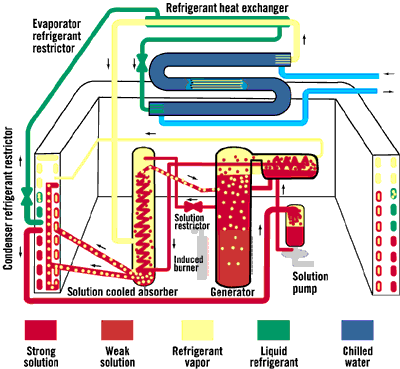
Here is how Robur Corp. explains how its Servel high-efficiency chiller-heater operates:The cycle begins in the generator, where the burner’s heat is introduced to the strong solution (high ammonia content). The burner’s heat separates the ammonia out of the water and produces weak solution (low ammonia content). The ammonia vapor, rising to the top, creates high-side pressure and forces weak solution out a tube in the bottom of the generator.
The ammonia vapor moves into the leveling chamber, where it passes over a rectifier coil. The rectifier coil removes water and allows only pure, high-pressure, high-temperature ammonia vapor to travel to the condenser coil. In the condenser coil, ambient air being drawn across the coil cools and condenses the ammonia vapor into a liquid refrigerant.
The liquid refrigerant now flows through the first of two restrictors, which regulate the refrigerant’s flow. The liquid refrigerant then flows into a refrigerant heat exchanger, where it is further cooled by counter-flowing cool refrigerant vapor. The liquid refrigerant proceeds to flow into the second restrictor, which meters the flow of refrigerant into the closed-loop shell-and-tube evaporator.
Circulating water, which has picked up heat in the load zone, enters the evaporator to be cooled by the liquid refrigerant. The water gives up its heat to the refrigerant, causing the refrigerant to boil and change back to vapor. The vapor refrigerant now flows through the refrigerant heat exchanger and enters the solution-cooled absorber (SCA).
Weak solution, leaving the generator, flows through a solution restrictor, which meters the solution’s flow into the SCA. A coil in the SCA, containing cooler strong solution, cools the weak solution and aids in the absorption process. Weak solution and entrained ammonia vapor then leave the SCA and enter the air-cooled absorber coil.
Ambient air drawn across this coil finalizes the absorption process and produces strong solution. The strong solution now enters the solution pump, which houses the only three moving parts of the sealed system. The solution pump, in conjunction with a hydraulic pump’s operation, moves the solution through the rectifier coil, then through the SCA’s coil, where it picks up heat and then is moved back into the generator, where the cycle repeats itself.
Publication date: 10/23/2000
Sidebar: How it Works
Here is how Robur Corp. explains how its Servel high-efficiency chiller-heater operates:The cycle begins in the generator, where the burner’s heat is introduced to the strong solution (high ammonia content). The burner’s heat separates the ammonia out of the water and produces weak solution (low ammonia content). The ammonia vapor, rising to the top, creates high-side pressure and forces weak solution out a tube in the bottom of the generator.
The ammonia vapor moves into the leveling chamber, where it passes over a rectifier coil. The rectifier coil removes water and allows only pure, high-pressure, high-temperature ammonia vapor to travel to the condenser coil. In the condenser coil, ambient air being drawn across the coil cools and condenses the ammonia vapor into a liquid refrigerant.
The liquid refrigerant now flows through the first of two restrictors, which regulate the refrigerant’s flow. The liquid refrigerant then flows into a refrigerant heat exchanger, where it is further cooled by counter-flowing cool refrigerant vapor. The liquid refrigerant proceeds to flow into the second restrictor, which meters the flow of refrigerant into the closed-loop shell-and-tube evaporator.
Circulating water, which has picked up heat in the load zone, enters the evaporator to be cooled by the liquid refrigerant. The water gives up its heat to the refrigerant, causing the refrigerant to boil and change back to vapor. The vapor refrigerant now flows through the refrigerant heat exchanger and enters the solution-cooled absorber (SCA).
Weak solution, leaving the generator, flows through a solution restrictor, which meters the solution’s flow into the SCA. A coil in the SCA, containing cooler strong solution, cools the weak solution and aids in the absorption process. Weak solution and entrained ammonia vapor then leave the SCA and enter the air-cooled absorber coil.
Ambient air drawn across this coil finalizes the absorption process and produces strong solution. The strong solution now enters the solution pump, which houses the only three moving parts of the sealed system. The solution pump, in conjunction with a hydraulic pump’s operation, moves the solution through the rectifier coil, then through the SCA’s coil, where it picks up heat and then is moved back into the generator, where the cycle repeats itself.
Looking for a reprint of this article?
From high-res PDFs to custom plaques, order your copy today!