ACHR News
search
Ask ACHR NEWS AI
cart
facebook twitter instagram linkedin youtube
  • Sign In
  • Subscribe
  • Sign Out
  • My Account
ACHR News
  • NEWS
    • Breaking News
    • New HVAC Products
    • Featured Products
    • Manufacturer Reports
    • HVAC Data
    • Legislation
    • ACHR NEWS Centennial
  • RESIDENTIAL
    • Air Conditioners
    • Furnaces
    • Residential Heat Pumps
    • Ductless
    • Residential IAQ
    • Testing, Monitoring, Tools
    • Components & Accessories
  • COMMERCIAL
    • Air Handlers
    • Rooftop Units
    • Chillers and Cooling Towers
    • Commercial Heat Pumps
    • Boilers and Hydronics
    • VRF/Ductless
    • Commercial IAQ
  • REFRIGERATION
    • Refrigerants
    • Refrigerant Regulations
    • Leak Management
  • CONTRACTOR PRO
    • Geothermal
    • Homeowner Study
    • VRF and VRV Ductless
    • Unitary Trends
  • EDUCATION
    • Training and Education
    • Business Management
    • Service and Maintenance
    • Continuing Education
    • Market Research >
      • HVAC Brand Awareness Report
      • VRV, VRF, VRVZ Report
      • Unitary Trends Report
      • Water Heat Professionals Report
    • Webinars
    • Sponsor Insights
    • eProducts Info
    • White Papers
  • EVENTS
    • HVAC Contractor Forum
    • Industry Events and Webinars
  • MEDIA
    • Videos
    • AHR Expo 2025 Videos
    • Podcasts >
      • ACHR News Podcast
      • HARDI Podcasts
      • AHR Expo Podcasts
      • ACCA Podcasts
    • Interactive Spotlights
    • Quizzes
    • eBooks
    • HVAC Talkback
  • HVAC GROUP
    • ACHR NEWS >
      • Current Issue
      • Digital Edition
      • Subscribe
    • Distribution Trends
    • SNIPS NEWS >
      • Join SNIPS NEWS
    • Engineered Systems News >
      • Join ES News
    • HVACR Directory
    • Contests
    • Newsletters
    • Contact
    • Advertise
    • My Account
Regional ReportsWest

Innovative Solution to California’s High Energy Prices

June 28, 2001
Long shot of central plant building and cooling tower. (All photos provided by Frank Vitone.)


Variable-frequency drives for chill water pumps.
Over 110? F and no a/c. That’s what Pierce College students and faculty endured for more than five decades. Critical areas, such as computer rooms and the library, out of necessity, were fitted with air-conditioning, and some administration offices were also kept cool, but budget constraints left classroom windows and doors wide open when temperatures soared.

Now, thanks to a new hybrid chiller system, this community college in the San Fernando Valley, northwest of Los Angeles, is on its way to campus-wide comfort year-round.


Back view of centrifugal chiller.

EXTREME TEMPS INTERFERED WITH LEARNING

In years past, summer classes were often moved to air-conditioned areas, held outdoors or cancelled due to the heat.

“On hot days, I’d get so many calls to see if space was available for classes in air-conditioned environments,” says Frank Vitone, Pierce College hvac supervisor for the past 10 years. “The students were all fanning themselves. It was a real uncomfortable way to learn.”

In the late 1990s, president Darroch Young headed a task force that assessed the campus’s future needs. Among the recommendations was the installation of energy-efficient lighting and air-conditioned classrooms.

Consulting mechanical engineering firm, Kevin A. Smola and Associates of Pasadena, helped develop a comprehensive cooling plan. Only scattered buildings had a/c, which were generally old, inefficient room units and small package units. Where there were duct systems, they were typically dual-duct and constant-volume.

The absorption chiller in place at Pierce College.

ONE-OF-A-KIND HYBRID CHILLER SYSTEM

“Most hybrids are half-gas, half-electricity all the time,” says Smola. “Which one the system uses is determined by time of day. During the peak period for electricity, gas is used, and vice versa. But for the Pierce College system, I developed an equation to determine which chiller to use, based on energy prices from the utilities. There are only about 20 hybrid systems in the country, but this is the only one I know of that determines which chiller to use.”

Jim Lowe, systems manager with RSD/Total Control of Lake Forest, CA, which furnished the controls and inputted the program according to Smola’s specifications, says, “I hadn’t written this type of program before — one that involves time-of-day usage rates and cost of utilities.”

Though the system is capable of switching between gas and electric on “an hour-by-hour or minute-by-minute basis,” Smola says, “we’re a long way from having instantaneous response to changing prices because the utilities only provide rates on a daily basis. If the utilities provided that information, we’d act on it. It’s fairly simple to make the conversion, but not if we can’t anticipate price fluctuations. Right now, all we have to work with is the current rate for the day.”

But that’s plenty enough for Vitone, who is not phased by California’s energy crisis. “The higher the prices go,” he says, “the more money we save.”

Looking for quick answers on air conditioning, heating and refrigeration topics? Try Ask ACHR NEWS, our new smart AI search tool. Ask ACHR NEWS →
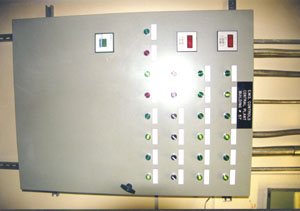
EMS panel located in central plant.

PIPED IN SERIES, NOT IN PARALLEL

“It’s piped in series, not in parallel,” says Smola. “By doing that, it’s much easier to know which chiller picks up the majority of the load, and we can put a minimum load on the absorption machine when both have to run simultaneously.”

Project manager Mike Hart of All Temperatures Controlled, which served as the general, as well as the electrical/mechanical, contractor, says, “Originally, all the piping was to be on the tops of canopies, but we decided to put it underground — almost a mile of pipe. What’s amazing is that we completed the entire project without disrupting classes by working a lot of nights and weekends.”

Eight thousand lights — 24,000 light bulbs — were swapped out. The new low-wattage, high-efficiency lighting resulted in “tremendous savings,” says Smola.

Vitone concurs: “Last summer our electricity costs went up only $100 a month, but we added 900 tons of a/c!”

“The electrical retrofit helped pay for the a/c,” says Smola, and a $57,000 gas company rebate further sweetened the deal.

All lights and a/c are set to occupancy levels. If the campus is closed, they’re off, regardless of what happens. If the campus is open, but no one is in the room, they’re on standby. And if class is in session, they’re on.

“Typically, it’s set at 74 degrees, plus or minus a degree or two,” says Smola. “When the classroom isn’t occupied, it’s given a wider tolerance — five or six extra degrees in both directions. At first, Frank worked with a tolerance of plus or minus 10 degrees, but he felt that it took too long to get the room back in control. I suggested he keep moving that number until no one complains.

“When we converted from double-duct to vav, we used the existing equipment. Typically, you take out the old and put in the new, but using what was there saved a couple million dollars.

“My firm has been doing this type of conversion since 1994. I know of only one other company in the greater Los Angeles area that does this, and they only started three years ago.”

In regard to the new carbon dioxide sensors, Smola said if the air quality is good inside the building, “we can reduce the amount of outside air brought inside, thereby saving energy and money.

“When we designed the system, we used temperatures from the on-campus weather station rather than temperatures from nearby LA. The weather at Pierce College can get to 110, while the surrounding areas are 102. Typically, Pierce is seven to 10 degrees higher than the rest of the Valley.”

But no longer does that make students and faculty hot and bothered because now when temperatures soar, they’re sitting cool.

Sidebar: College’s Plans to Generate its Own Power

“We’re planning an on-site generator of our own power,” says hvac supervisor for Pierce College, Frank Vitone. “Then we’ll be able to cut loose from the DWP (Department of Water and Power).”

Vitone envisions fuel cells and micro-turbines allowing the “use of waste heat to heat buildings in the winter, and eventually to air-condition them in the summer. As such, we’ll become one of the leaders in the community as far as energy savings are concerned.”

To date, the college has hired an engineering consulting firm to “do the value engineering and lay out the cost savings in a report.”

Pierce College currently spends approximately $750,000 on electricity each year. “If we generate our own power, we anticipate a net savings of $30,000 a month — from day one!”

The estimated cost of the equipment and installation to pull this off is $4 million. The money the college is now paying to the electric company would instead be paid to the equipment manufacturer to pay off the loan. In about seven years, Vitone says, the cost of the system would be completely paid off.

“It’s really a no-brainer,” he says. “There’s so much instability with the utility companies that we don’t know where prices are going. This way, we lock in our costs, and we can sell our excess power to our sister colleges — Valley College in Van Nuys and Mission College in Sylmar.”

The means to self-sufficiency are “already in place,” Vitone says. “We have a 30,000-gallon propane tank that’s a back-up at present. In case our gas supply is cut off during an earthquake, we can keep the campus open, converting the propane to natural gas, electricity and hot water. As technology evolves, we’ll be able to convert that to a/c too. A micro-turbine will run the excess heat through the absorption chiller to generate chilled water to air-condition buildings in the summer, just as that excess heat can be used to heat buildings in the winter.”

Vitone is just as excited about the academic aspects of such a system as he is about its energy efficiency and profit potential.

“The interesting part,” he says, “ is that we can incorporate this into the academics here. Students could take a look at fuel cells and the micro-turbine. It could become a course of its own. There aren’t many places you can study energy devices that are online. When this project finally comes through, it’s going to be a good one!”

Facts, Figures, and Specs for Pierce College Project

Campus specs: 25 buildings (approx. 200,000 sq ft) on almost 500 acres Hvac design: Kevin Smola, Kevin A. Smola and Associates, Pasadena, CA Hvac installation/general contractor: All Temperatures Controlled, Inc., Chatsworth, CA Controls supplier and software program designer: RSD/Total Control, Lake Forest, CA Overall cost: $6 million for the initial phase; additional $3 million for Phase 2 Mechanical equipment involved:
  • one 312-ton Trane centrifugal chiller
  • one 440-ton Trane absorption chiller
  • Seven boilers totaling more than 10,350,000 BTU, all low NOx types
  • two condenser water pumps totaling 75 hp
  • two primary chilled water pumps totaling 60 hp
  • two secondary chilled water pumps totaling 250 hp
  • 21 air-handling units (three new and 18 existing) totaling 204,500 cfm
  • Air handlers were converted from constant volume systems (double duct and multi-zone) to variable air volume, double duct systems.
  • Return air quality is monitored and used to control the volume of outside air, allowing, at times, to reduce the required volume of outside air and thereby save energy.
  • The classrooms are monitored for occupancy: when not in use, the temperature tolerance is enlarged to save energy.
  • A fume hood makeup air system was installed to provide tempered makeup air for the fume hoods.
  • Construction notes:
  • Charlie Imboden, general superintendent
  • 10 field sheet metal technicians during peak installation
  • 10 field piping technicians during peak installation (Richard Hayden, piping detailer)
  • Publication date: 07/02/2001

    Share This Story

    Looking for a reprint of this article?
    From high-res PDFs to custom plaques, order your copy today!


    Recommended Content

    JOIN TODAY
    To unlock your recommendations.

    Already have an account? Sign In

    • HVAC-enrollment

      The Trades Are Back: HVACR Programs See Nearly 30% Enrollment Spike

      A new wave of future technicians is entering the pipeline.  
      Training and Education
      By: Matt Jachman
    • 2025 Top 40 Under 40

      2025 Top 40 Under 40 HVACR Professionals List

      The 11th annual Top 40 Under 40 list highlights those...
      HVAC Light Commercial Market
      By: Hannah Belloli-Oster
    • LG Ductless Mini-Split Systems

      The 9 Types of Heat Pumps

      As the U.S. moves toward electrification, heat pumps are...
      News
      By: Joanna R. Turpin
    Subscription Center
    • Create an Account
    • Start a Subscription
    • Manage My Account
    • Sign Up for Newsletters
    • Visit Customer Service
    • Update Preferences

    More Videos

    Sponsored Content

    Sponsored Content is a special paid section where industry companies provide high quality, objective, non-commercial content around topics of interest to The News audience. All Sponsored Content is supplied by the advertising company and any opinions expressed in this article are those of the author and not necessarily reflect the views of The News or its parent company, BNP Media. Interested in participating in our Sponsored Content section? Contact your local rep!

    close
    • Piggy Bank
      Sponsored byWatercress Financial

      Energy Prices, Inflation, and HVAC: What Today’s Homeowners Care About

    • Refrigerated Food
      Sponsored bySolstice Advanced Materials

      R-455A Refrigeration: A Cold Storage Solution for the Future

    • Airex Rooftop Units
      Sponsored byAirex Manufacturing Inc

      Consolidating Roof Penetrations: A Growing Trend in Multifamily HVAC Design

    Popular Stories

    HVAC-Price-Increase-graphic

    HVAC Price Increase List: June 2026

    Trump-Section-232.jpg

    Trump Reduces Section 232 Tariffs on HVAC Equipment to 15%

    R410A-Refrigerant-Cylinder.jpg

    Refrigerant Recovery is a Revenue Opportunity

    Heat-pump-cutaway.jpg

    PFAS Rules and A2L Building Codes Continue to Evolve

    Kroger.jpg

    Kroger to Spend $100 Million to Reduce Refrigerant Leaks

    View The ACHR NEWS
    Centennial Anniversary Timeline

    The ACHR News Timeline Chart
    Submit a Letter
    Submit a letter to our editors.

    Events

    November 6, 2025

    Next-Gen Data Center Cooling: HVAC Innovation and Real-World Solutions

    On Demand As AI workloads and high-density computing push traditional cooling methods to their limits, the data center industry is accelerating the adoption of next-generation HVAC technologies.

    June 9, 2026

    Before You Go All In on AI: Set Up Your Business to Actually Win

    In this webinar, we'll walk you through exactly what to get in place before you add AI to your business. You'll leave with a clear picture of where you stand today and a practical action plan to set yourself up for real results.

    View All Submit An Event

    Poll

    Summer Staff

    Are you fully staffed for the summer season?
    View Results Poll Archive

    Products

    BNI Mechanical/Electrical Square Foot Costbook, 2026 Edition

    BNI Mechanical/Electrical Square Foot Costbook, 2026 Edition

    See More Products
    A2L Refrigerants - Free Webinar - May 21, 2026

    Related Articles

    • Innovative Solution To California’s Energy Prices

      See More
    • Dec. 12, 2005: EIA Expects High Energy Prices Through 2006

      See More
    • Newsline

      Innovative Solution to Extend Filter Life

      See More

    Related Products

    See More Products
    • The ACHR News - May 4, 2026

      ACHR NEWS May 4, 2026, Issue

    • The ACHR News - June 30, 2025

      ACHR NEWS June 30, 2025, Issue

    • Using Schematic Diagrams to Troubleshoot HVAC/R Electrical Circuits

    See More Products

    Related Directories

    • Alliance to Save Energy

      Coalition of business, government, environmental, consumer leaders promoting the efficient and clean use of energy worldwide to benefit consumers, the environment, the economy, national security.
    ×

    Sign Up. Stay Informed.

    The #1 trusted source for the HVACR industry since 1926

    SUBSCRIBE
    • RESOURCES
      • Advertise
      • Contact Us
      • Advisory Board
      • Classifieds
      • Submit a Letter
      • Directories
      • Store
    • ACCOUNT CENTER
      • Create an Account
      • Start a Subscription
      • Manage My Account
      • Sign Up for Newsletters
      • Visit Customer Service
      • Update Preferences
    • SERVICES
      • Marketing Services
      • Reprints
      • Market Research
      • List Rental
      • Survey/Respondent Access
    • STAY CONNECTED
      • LinkedIn
      • Facebook
      • Instagram
      • YouTube
      • X (Twitter)
    • PRIVACY
      • PRIVACY POLICY
      • TERMS & CONDITIONS
      • DO NOT SELL MY PERSONAL INFORMATION
      • PRIVACY REQUEST
      • ACCESSIBILITY

    Copyright ©2026. All Rights Reserved BNP Media, Inc. and BNP Media II, LLC.

    Design, CMS, Hosting & Web Development :: ePublishing